A Clue to October 7
Through a series of geopolitical maneuvers and financial channels, a discernible pattern emerges of Iran systematically backing Palestinian “resistance” groups, such as Hamas and Palestinian Islamic Jihad, by providing substantial military aid, training, and funding—estimated at $70-100 million annually to Hamas alone—while leveraging Qatar as a key facilitator and intermediary to amplify this support without direct exposure. Qatar, with its “symbiosis” with Iran, has channeled over $2 billion to Hamas since 2012, often under the guise of humanitarian aid but knowingly bolstering terror infrastructure, while hosting Hamas leaders in Doha and mediating hostage negotiations and ceasefires that indirectly advance Iran’s proxy agenda. This intermediary role is evident in Qatar’s facilitation of Iranian-sanction evasion through its financial institutions, allowing money laundering for terror groups, and providing alternative funding during periods when Iran temporarily withheld support to pressure Palestinian factions into alignment. In the cyber domain, this pattern extends to Iran’s sponsorship of hacktivist groups like Handala, which in 2025 claimed high-profile breaches including doxxing Israeli nuclear scientists at Sorek, infiltrating former PM Naftali Bennett’s phone, and targeting Netanyahu’s chief of staff Tzachi Braverman—operations that echo Iran’s asymmetric warfare strategy in support of Palestinian causes, potentially coordinated through regional allies like Qatar to maintain plausible deniability.
Brand Analysis
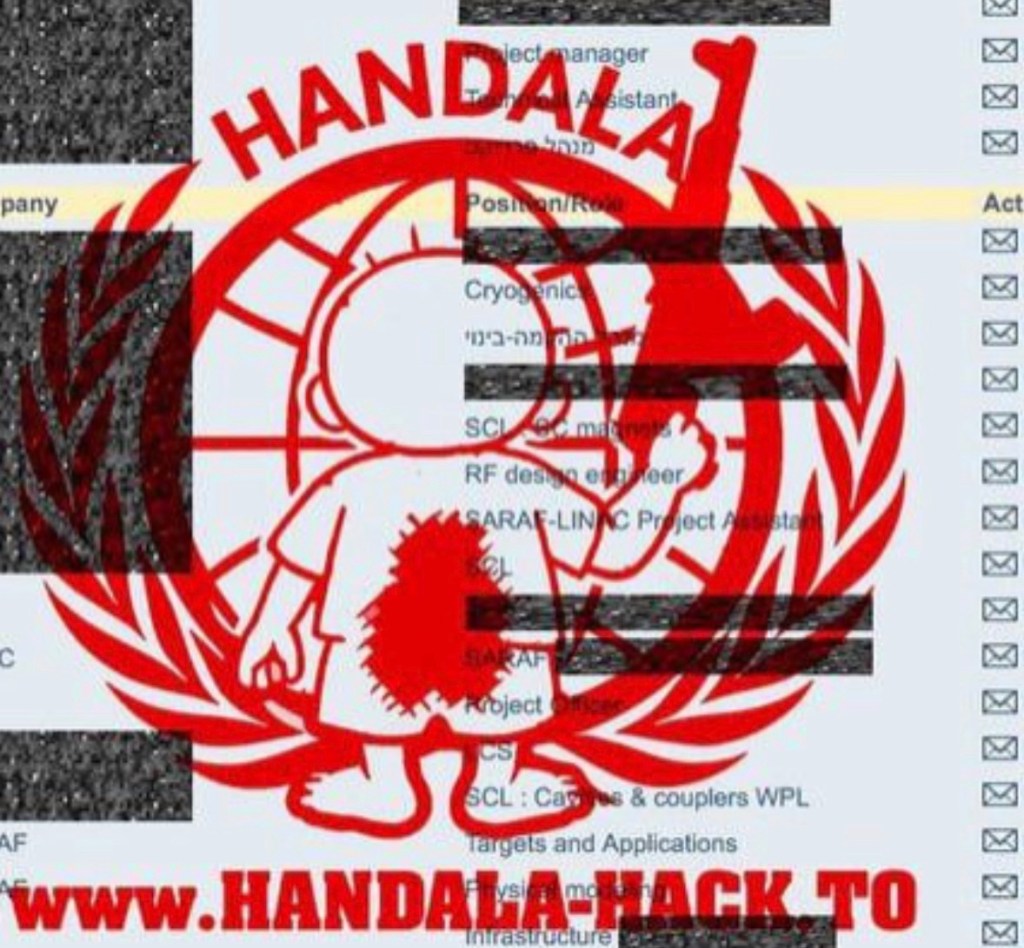
The logo of the Handala Hack group is a bold, red-emblazoned adaptation of one of the most enduring symbols in Palestinian culture: the cartoon character Handala (also spelled Hanzala or Handhala). Created in 1969 by the renowned Palestinian political cartoonist Naji al-Ali, Handala depicts a barefoot, ragged-clothed 10-year-old boy with spiky hair, viewed from behind, hands clasped behind his back. This simple yet powerful image has become an iconic representation of Palestinian identity, resilience, defiance, and the refugee experience.
Naji al-Ali, born around 1938 in the village of al-Shajara in Galilee (now northern Israel), was himself displaced during the 1948 Nakba, when hundreds of thousands of Palestinians fled or were expelled. At age 10—the same age Handala is frozen in—al-Ali became a refugee in Lebanon’s Ain al-Hilweh camp. He explained that Handala would remain 10 years old until Palestinians could return to their homeland: “When Handala returns, he will still be 10 years old, and then he will start growing up.” The boy’s turned back symbolizes rejection of compromised “solutions” imposed from outside (often critiqued as “the American way”), while his clasped hands signify steadfast refusal to surrender or normalize injustice. The name “Handala” derives from a bitter desert plant (Citrullus colocynthis), deep-rooted and resilient despite harsh conditions, mirroring Palestinian endurance.
Handala appeared in over 40,000 of al-Ali’s cartoons, which sharply criticized not only Israeli policies but also Arab regimes, corruption, and inaction on Palestine. Al-Ali’s work earned him enemies; he was assassinated in London in 1987, a crime still unsolved but widely suspected to involve state actors. Today, Handala adorns murals in Gaza and the West Bank, refugee camps, protest banners, tattoos, and merchandise worldwide—a universal emblem of Palestinian nationalism and resistance against occupation.
The Handala Hack group’s logo adapts this figure dramatically: placed centrally within a wreath resembling the United Nations emblem (olive branches encircling a world map, here replaced by Handala), rendered in striking red. This design twists international symbolism, perhaps satirizing the UN’s perceived failures on Palestine while asserting global relevance. The group pairs it with aggressive rhetoric on leak sites and Telegram, framing operations as solidarity with Gaza. 0 “LARGE” 1 “LARGE” 2 “LARGE”
Iranian State Sponsorship Behind the Palestinian Facade
Despite its pro-Palestinian branding, extensive cybersecurity research attributes the Handala Hacking Team (active since late 2023) to Iranian state actors, specifically a unit within the Ministry of Intelligence (MOIS). Firms like Microsoft, ClearSky, Trustwave, Splunk, Intezer, and Recorded Future link it to known Iranian clusters such as Storm-0842 (aliases: Banished Kitten, Void Manticore, Red Sandstorm, Dune). These overlap with previous MOIS personas like DarkBit and Homeland Justice, used for influence operations, wipers, and leaks.
Iran’s strategy involves proxy hacktivism: adopting ideological covers (here, Palestinian symbolism) for plausible deniability while advancing Tehran’s goals—retaliating against Israel, sowing chaos, and amplifying anti-Israel narratives. Iran’s long-standing political and financial support for Palestinian causes makes this branding effective. Operations often escalate after Iranian setbacks (e.g., assassinations of IRGC figures) or align with broader campaigns against critics of the regime.
Attribution evidence includes:
- Shared infrastructure, TTPs (tactics, techniques, procedures), and malware with confirmed Iranian groups.
- Timing and targets aligning with Iranian interests, not purely Palestinian ones (e.g., doxxing Iran International journalists critical of Tehran).
- Exaggerated claims and psychological warfare mirroring Iranian asymmetric doctrine.
Western governments (Canada, US) and Israeli sources consistently describe Handala as Iran-linked, viewing it as part of Iran’s surged cyber efforts post-October 2023 Gaza war.
Recent Claimed Hacks: Escalation in 2025
Handala’s operations blend data theft, doxxing, wipers, phishing, DDoS, and psychological ops, primarily targeting Israeli military, tech, nuclear, and government entities. Claims are often amplified via Telegram, leak sites, and pro-Iran media like PressTV. While some are verified or partially confirmed, others involve exaggeration or recycled data for impact.
Key recent activities in 2025 (as of December 28, 2025):
- January 2025: Breached emergency PA systems in ~20 Israeli kindergartens, triggering sirens and terrorizing children—pure psychological warfare.
- February 2025: Claimed theft of 2.1 TB from Israeli police, including 350,000 documents (personnel files, psychological profiles, crime data). Police denied full breach, suggesting third-party compromise.
- June 2025: Post-Israel strikes on Iranian facilities, claimed intrusions into multiple organizations, including energy giant Delek Group (2+ TB exfiltrated, partial leaks).
- July 2025: Hack-and-leak on Iran International journalists (including a Canadian), releasing IDs and private data, amplified via AI chatbots.
- November 2025: Infiltrated Sorek Nuclear Research Center; doxxed scientist Dr. Isaac Gertz (personal details, addresses), symbolically leaving flowers in his car trunk—timed to anniversary of Iranian scientist Mohsen Fakhrizadeh’s assassination.
- December 2025:
- Doxxed high-tech/aerospace professionals (mostly scraped from LinkedIn), labeling them “criminals,” offering bounties.
- $30,000 reward for info on missile defense designers (Arrow, David’s Sling).
- “Operation Octopus”: Claimed hack of former PM Naftali Bennett’s iPhone 13, leaking documents, memos, political comms (Bennett denied).
- December 28 claim: Breached phone of Netanyahu’s chief of staff Tzachi Braverman, teasing release of sensitive material (possibly Qatar ties).
These ops highlight a shift: from infrastructure disruption to individual intimidation, risking real-world harm via doxxing. Handala’s use of a sacred Palestinian symbol for state-sponsored attacks raises questions about authenticity in hacktivism.
In the Iran-Israel shadow war, Handala exemplifies how cultural icons are weaponized in cyberspace—blurring activism, propaganda, and aggression. As conflicts evolve, distinguishing genuine grassroots efforts from state proxies grows ever harder.
The Link to “Qatargate”
Connecting the Dots: Netanyahu’s Alleged “Betrayal” on October 7, Shin Bet Warnings, and the Israeli “Qatargate” Scandal
The query appears to seek connections between three elements: claims of a “betrayal” surrounding Israeli Prime Minister Benjamin Netanyahu in the context of the October 7, 2023, Hamas attack; reports that Israel’s Shin Bet security agency had advance warnings but failed to adequately inform him; and “Qatargate,” which in this context refers not primarily to the 2022 EU corruption scandal but to a recent Israeli political affair involving Netanyahu’s aides and alleged illicit ties to Qatar. While these topics stem from distinct events, they intersect through Netanyahu’s long-standing policy of permitting Qatari funding to Hamas—ostensibly for stability in Gaza—which critics argue emboldened the group responsible for October 7, amid intelligence lapses and accusations of treasonous dealings exposed in the scandal. Drawing from verified reports, the narrative reveals a web of geopolitical maneuvering, blame-shifting, and accountability failures, with Qatar as a central facilitator of Iranian-backed Palestinian “resistance” (as discussed in prior analyses), potentially linking financial flows to the attack’s preconditions. Starting with the October 7 attack—Hamas’s surprise assault that killed about 1,200 Israelis and took over 250 hostages—Netanyahu has faced intense scrutiny for what many describe as a monumental intelligence and leadership failure. Critics, including opposition leaders and protesters, have labeled it a “betrayal” of the Israeli people, pointing to Netanyahu’s pre-attack policies that allegedly weakened defenses while prioritizing political survival, such as judicial reforms that divided the military and society. Some conspiracy-tinged narratives even suggest a “deep state” sabotage by security elites to undermine Netanyahu, withholding critical intelligence flows. As of December 2025, ongoing inquiries, including a potential Netanyahu-led probe into October 7, continue to fuel debates over personal responsibility, with the prime minister refusing to acknowledge fault and instead blaming subordinates.
Central to the “betrayal” claims are reports of ignored warnings from Shin Bet (Israel’s internal security service). In March 2025, Shin Bet publicly admitted it “failed in its mission” by dismissing repeated indicators of Hamas’s preparations, including unusual border activities and internal communications, which could have averted the attack if acted upon differently. 8 10 14 Netanyahu has specifically accused former Shin Bet chief Ronen Bar of knowing by 4:30 a.m. on October 7 that an onslaught was imminent but not alerting him, framing this as a deliberate omission rather than mere oversight—a claim Bar and others dispute as blame-shifting. Earlier warnings date back further: Bar reportedly cautioned Netanyahu in July 2023 about an “imminent war” involving Hamas and other fronts, but Gaza specifics were allegedly downplayed or ignored amid Netanyahu’s focus on other priorities, like West Bank tensions. IDF spotters and other intelligence also flagged Hamas drills, but these were dismissed by leadership, contributing to the surprise. Skeptics argue this wasn’t active betrayal but systemic hubris, with Netanyahu’s government underestimating Hamas due to overreliance on technological barriers like the Gaza fence. Enter “Qatargate,” the thread tying these to broader geopolitical intrigue. While the term originated from a 2022 EU scandal involving Qatari bribery of European officials, in Israel, it has evolved into a 2025 domestic bombshell accusing Netanyahu’s inner circle of unlawful Qatari connections—dubbed the “Qatari connection affair” or “Israeli Qatargate.” Key aides like Jonatan Urich (Netanyahu’s spokesman) and Eli Feldstein (chief of staff) were arrested for allegedly accepting funds from Qatar via a U.S. lobbyist to plant pro-Qatari stories in Israeli media, aiming to rehabilitate Qatar’s image post-October This included leaking sensitive documents to outlets like Germany’s Bild to criticize Egypt’s mediation role, favoring Qatar instead. Critics call it “the most serious act of treason in Israeli history,” as Qatar hosts Hamas leaders and has funneled billions to the group, enabling its military buildup for October 7. Netanyahu denies direct involvement, claiming Qatari money didn’t fund the attack (which used low-cost tactics) and labeling the affair a “libel,” but his ex-aide Feldstein revealed post-October 7 efforts to evade accountability, including media manipulation.
The connections crystallize around Qatar’s role as an intermediary for Iranian support to Hamas, aligning with patterns of Tehran backing Palestinian groups via Doha to evade sanctions and maintain deniability. Netanyahu’s decade-long “buying quiet” strategy allowed Qatar to inject $1.8-2 billion into Gaza since 2012—framed as humanitarian aid for salaries and fuel but effectively propping up Hamas’s regime and terror infrastructure, with Israeli approval to divide Palestinians and avert broader conflict. This policy, critics argue, blinded leadership to escalating threats, ignoring Shin Bet warnings about Hamas’s growing capabilities funded by Qatari (and Iranian) cash. Post-attack, Qatargate revelations—sparked by leaks and arrests—exposed how Netanyahu’s office allegedly continued favoring Qatar as a mediator, despite its Hamas ties, possibly to control narratives and negotiations. This has ignited protests accusing Netanyahu of betrayal, linking his Qatar dependencies to the intelligence oversights that enabled October In essence, the “betrayal” narrative posits that Netanyahu’s Qatar-centric approach, now mired in scandal, contributed to downplaying warnings and empowering Hamas, with Shin Bet’s failures as a symptom of broader policy miscalculations—though no direct evidence ties Shin Bet withholding to Qatari influence. This remains a highly politicized issue, with ongoing investigations likely to reveal more.
Sources
Al-Ali, Naji. “Handala.” Cleopatra Restaurant. Accessed December 28, 2025. https://www.cleocuisine.com/pal-art/handala.
“Bennett Revives Qatargate Scandal in Attack on Netanyahu Leadership.” Middle East Online, December 23, 2025. https://www.middle-east-online.com/en/bennett-revives-qatargate-scandal-attack-netanyahu-leadership.
“A Deep Dive into Recent Israeli Breaches.” Constella Intelligence, October 16, 2024. https://constella.ai/israeli-breaches/.
“Flash Report: Israel-Iran Cyber Threat Landscape.” ZeroFox, June 26, 2025. https://www.zerofox.com/intelligence/flash-report-israel-iran-cyber-threat-landscape/.
“Following Terrorist Attack on Israel, Treasury Sanctions Hamas….” US Department of the Treasury, October 18, 2023. https://home.treasury.gov/news/press-releases/jy1816.
“Former Israeli PM Accuses Netanyahu’s Office of Treason over Alleged Qatar Funding.” Le Monde, December 22, 2025. https://www.lemonde.fr/en/international/article/2025/12/22/former-israeli-pm-accuses-netanyahu-s-office-of-treason-over-alleged-qatar-funding_6748766_4.html.
“From Target to Key Player: Qatar’s Resilience as a Regional Mediator.” Oasis Center, December 4, 2025. https://www.oasiscenter.eu/en/from-target-to-key-player-qatar-s-resilience-as-a-regional-mediator.
“Full Article: Israel and the Politics of Intelligence Failure on 7 October.” Taylor & Francis Online. Accessed December 28, 2025. https://www.tandfonline.com/doi/full/10.1080/03071847.2025.2487510.
“General Question, Did the Israeli Government Knew That a Attack from….” Reddit, June 11, 2025. https://www.reddit.com/r/Israel/comments/1l8ou5y/general_question_did_the_israeli_government_knew/.
“Hacktivism in the Israel-Iran Conflict.” Silobreaker, July 9, 2025. https://www.silobreaker.com/blog/geopolitical/hacktivism-in-the-israel-iran-conflict/.
“Hamas: Background, Current Status, and US Policy.” Congressional Research Service, June 14, 2024. https://www.congress.gov/crs_external_products/IF/PDF/IF12549/IF12549.3.pdf.
“Handala.” Librarians and Archivists with Palestine, April 2019. https://librarianswithpalestine.org/wp-content/uploads/2019/04/HandalaZine.pdf.
“Handala as a Symbol of Sexual Assault.” We Are Not Numbers. Accessed December 28, 2025. https://wearenotnumbers.org/handala-as-a-symbol-of-sexual-assault/.
“Handala Hack: What We Know About the Rising Threat Actor.” Cyberint, July 16, 2024. https://cyberint.com/blog/threat-intelligence/handala-hack-what-we-know-about-the-rising-threat-actor/.
“Handala’s Latest Publication Targets Israeli High-Tech Specialists.” LevelBlue, November 26, 2025. https://levelblue.com/blogs/spiderlabs-blog/handalas-latest-publication-targets-israeli-high-tech-specialists/.
“Handala Symbol: Artists Call for Gaza Ceasefire – Naji al-Ali.” Facebook, January 17, 2024. https://www.facebook.com/ajplusenglish/posts/palestinian-cartoonist-naji-al-ali-created-his-iconic-character-handala-to-symbo/767564825404497/.
“Handling Israel-Hamas War Mediation: The Role of Qatar.” University of Navarra. Accessed December 28, 2025. https://www.unav.edu/web/global-affairs/handling-israel-hamas-war-mediation-the-role-of-qatar.
“How a String of Hacks Embarrassed Cyber Powerhouse Israel.” Wall Street Journal, December 23, 2025. https://www.wsj.com/world/middle-east/israel-iran-cyberattacks-hacks-ddcd10d0.
“How America and Its Allies Can Stop Hamas, Hezbollah, and Iran….” US House of Representatives, October 25, 2023. https://docs.house.gov/meetings/BA/BA10/20231025/116509/HHRG-118-BA10-Wstate-LevittM-20231025.pdf.
“How Hacktivist Cyber Operations Surged Amid Israeli-Iranian Conflict.” Outpost24, November 27, 2025. https://outpost24.com/blog/hacktivist-cyber-operations-iran-israel/.
“How the US Can Balance Qatar’s Mediation Role with the Fight Against Terrorist Financing.” Atlantic Council, November 13, 2025. https://www.atlanticcouncil.org/blogs/econographics/how-the-us-can-balance-qatars-mediation-role-with-the-fight-against-terrorist-financing/.
“Iran and the Palestinians in Gaza.” United States Institute of Peace, November 2, 2023. https://iranprimer.usip.org/blog/2023/nov/02/iran-and-palestinians-gaza.
“Iran Conducts Cyberattacks to Terrorize Israelis.” Foundation for Defense of Democracies, February 3, 2025. https://www.fdd.org/analysis/policy_briefs/2025/02/03/iran-conducts-cyberattacks-to-terrorize-israelis/.
“Iran, Hamas & Palestinian Islamic Jihad.” Wilson Center, July 9, 2018. https://www.wilsoncenter.org/article/iran-hamas-and-palestinian-islamic-jihad.
“Iran, Hamas, and Islamic Jihad: A Marriage of Convenience.” European Council on Foreign Relations, December 18, 2023. https://ecfr.eu/article/iran-hamas-and-islamic-jihad-a-marriage-of-convenience/.
“Iran-Linked Hackers Offer Cash Bounties on Israeli Air Defense….” Combat Antisemitism Movement, December 15, 2025. https://combatantisemitism.org/cam-news/iran-linked-hackers-offer-cash-bounties-on-israeli-air-defense-engineers/.
“Iran-Linked Hacker Group Doxes Journalists and Amplifies Leaked….” Government of Canada, September 12, 2025. https://www.international.gc.ca/transparency-transparence/rapid-response-mechanism-mecanisme-reponse-rapide/iran-hack-piratage-iranien.aspx?lang=eng.
“Iran-Linked Hacking Group Claims Access to Phone of Netanyahu Aide.” Iran International, December 28, 2025. https://www.iranintl.com/en/202512284069.
“Iranian Hacker Group Handala Claims Breach of Ex-PM Naftali….” Our Lady of the Lake University Athletics, December 17, 2025. https://www.ollusaintsathletics.com/sports/mbkb/2018-19/bios/Brandon_Joseph?s-news-22802132-2025-12-17-iranian-hacker-group-handala-claims-breach-of-ex-pm-naftali-bennett-phone.
“Iranian Hackers Claim to Break into Former PM Naftali Bennett’s Phone.” Times of Israel, December 17, 2025. https://www.timesofisrael.com/liveblog_entry/iranian-hackers-reportedly-claim-to-break-into-former-pm-naftali-bennetts-phone/.
“Iran’s Hackers Keep a Low Profile After Israeli and US Strikes.” Reuters, June 27, 2025. https://www.reuters.com/world/middle-east/irans-hackers-keep-low-profile-after-israeli-us-strikes-2025-06-27/.
“Israel Knew Hamas’s Attack Plan Over a Year Ago.” New York Times, December 2, 2023. https://www.nytimes.com/2023/11/30/world/middleeast/israel-hamas-attack-intelligence.html.
“Israel PM Attacks Qatar Probe as ‘Witch Hunt’ After Aides Arrested.” BBC, April 1, 2025. https://www.bbc.com/news/articles/c3ev9xq0408o.
“Israel Spy Agency Lists Failures in Preventing Oct. 7 Attack.” NPR, March 5, 2025. https://www.npr.org/2025/03/05/nx-s1-5318591/israel-shin-bet-security-failure-october-7-attack.
“Israel Unveils New Proof of Qatar and Hamas’s Close Collaboration.” Foundation for Defense of Democracies, June 11, 2025. https://www.fdd.org/analysis/policy_briefs/2025/06/11/israel-unveils-new-proof-of-qatar-and-hamass-close-collaboration/.
“Israel’s Oct. 7 Early Warning Failure: Who Is to Blame?” War on the Rocks, October 4, 2024. https://warontherocks.com/2024/10/israels-oct-7-early-warning-failure-who-is-to-blame/.
“Israel’s Shin Bet Says October 7 Attack Could Have Been Prevented….” CNN, March 5, 2025. https://www.cnn.com/2025/03/04/middleeast/israel-shin-bet-october-7-fault-intl-latam.
“Israelis Protest Nationwide Amid Qatargate Revelations Tied….” Haaretz, December 27, 2025. https://www.haaretz.com/israel-news/2025-12-27/ty-article/.premium/israelis-protest-nationwide-amid-qatargate-revelations-tied-to-pms-office/0000019b-60bd-d2b2-affb-76ff449b0000.
“Naftali Bennett Calls on Benjamin Netanyahu to Resign over Qatargate.” Jerusalem Post, December 22, 2025. https://www.jpost.com/israel-news/politics-and-diplomacy/article-881043.
“Naji al-Ali’s Handala: Palestinian Resistance and British Collusion.” Revolutionary Communist Group, September 16, 2024. https://revolutionarycommunist.org/middle-east/palestine/naji-al-alis-handala-palestinian-resistance-and-british-collusion/.
“Netanyahu Claims Shin Bet Head Failed to Warn Him of October 7….” Jerusalem Post, April 27, 2025. https://www.jpost.com/breaking-news/article-851693.
“New Iran-Linked Cyberattack Targets Former Israeli Prime Minister.” Wall Street Journal, December 18, 2025. https://www.wsj.com/world/middle-east/iran-hacks-former-israeli-prime-minister-in-new-tehran-linked-cyberattack-f1a959ca.
“Officials Say Netanyahu Ignored Warnings on False Claims Targeting….” Israel Hayom, December 27, 2025. https://www.israelhayom.com/2025/12/27/officials-say-netanyahu-ignored-warnings-on-false-claims-targeting-egypt/.
“Palestinian Refugee Handala: Artists Use Symbol for Gaza Ceasefire.” Instagram, January 17, 2024. https://www.instagram.com/p/C2Na24fR5cK/?hl=en.
“PM: ‘Fact, Not Conspiracy’ Shin Bet Chief Knew Oct. 7 Attack Likely….” Times of Israel, March 28, 2025. https://www.timesofisrael.com/pm-fact-not-conspiracy-shin-bet-chief-knew-oct-7-attack-likely-didnt-wake-me/.
“PMO States Braverman’s Phone Remains Uncompromised Following….” Yahoo News, December 28, 2025. https://www.yahoo.com/news/articles/pmo-states-bravermans-phone-remains-102829592.html.
“Qatar Becomes a Key Intermediary in Israel-Hamas War Amid Tense….” PBS NewsHour, October 24, 2023. https://www.pbs.org/newshour/world/qatar-becomes-a-key-intermediary-in-israel-hamas-war-amid-tense-hostage-negotiations.
“Qatar Open to Reconsidering Hamas Presence, US Official Says.” Iran International, October 27, 2023. https://www.iranintl.com/en/202310271570.
“Qatar Positions Itself as Intermediary in Gaza War, Even as Leader….” Times of Israel, October 24, 2023. https://www.timesofisrael.com/qatar-positions-itself-as-intermediary-in-gaza-war-even-as-leader-blasts-israel/.
“Qatar Sent Millions to Gaza for Years – with Israel’s Backing….” CNN, December 12, 2023. https://www.cnn.com/2023/12/11/middleeast/qatar-hamas-funds-israel-backing-intl.
“Qatar, Iran, Turkey and Beyond: Hamas’s Network of Allies.” France 24, October 14, 2023. https://www.france24.com/en/middle-east/20231014-qatar-iran-turkey-and-beyond-the-galaxy-of-hamas-supporters.
“Scrutiny Around Qatargate and Bild Leak May Put PM One Step Closer….” Times of Israel, December 25, 2025. https://www.timesofisrael.com/scrutiny-around-qatargate-and-bild-leak-may-put-pm-one-step-closer-to-hot-seat/.
“The Path to October 7: How Iran Built Up and Managed a Palestinian Axis of Resistance.” Combating Terrorism Center at West Point, December 4, 2023. https://ctc.westpoint.edu/the-path-to-october-7-how-iran-built-up-and-managed-a-palestinian-axis-of-resistance/.
“Two Scandals, One Office: Qatar Messages, Germany Leak and….” Ynet News, December 26, 2025. https://www.ynetnews.com/article/rk11thdiqbl.
“Unraveling a Complex Web: A Primer on Hamas Funding Sources….” Association of Certified Financial Crime Specialists, November 1, 2023. https://www.acfcs.org/unraveling-a-complex-web-a-primer-on-hamas-funding-sources-iranian-support-global-connections-and-compliance-concerns-considerations.
“‘War Warning’ Dismissed: Netanyahu’s Ignored Alerts and His Push to….” Ynet News, October 22, 2025. https://www.ynetnews.com/article/sjlujo80gx.
“What Is Hamas?” Council on Foreign Relations. Accessed December 28, 2025. https://www.cfr.org/backgrounder/what-hamas.
“What Is the ‘Qatargate’ Scandal Roiling Israel?” CTV News, April 2, 2025. https://www.ctvnews.ca/world/article/what-is-the-qatargate-scandal-roiling-israel/.
“What We Know About Qatargate Scandal Surrounding Netanyahu….” ABC News, April 3, 2025. https://www.abc.net.au/news/2025-04-03/what-is-the-qatargate-scandal-gripping-israel/105131640.
“Who Is Handala?” Council on Arab-British Understanding. Accessed December 28, 2025. https://www.caabu.org/sites/default/files/resources/Handala%2520Handout.pdf.
“Who Is Handala?” YouTube, February 6, 2024. https://www.youtube.com/shorts/5BTAnlUvOSM.
“Who Is Handala, the Boy Who Symbolizes Palestinian Resistance?” NPR, February 6, 2024. https://www.npr.org/2024/02/06/1228097975/handala-naji-al-ali-cartoon-palestinian-symbol.
(Written with the help of Grok AI.)
 Writing by Dr. Dannielle Blumenthal
You must be logged in to post a comment.