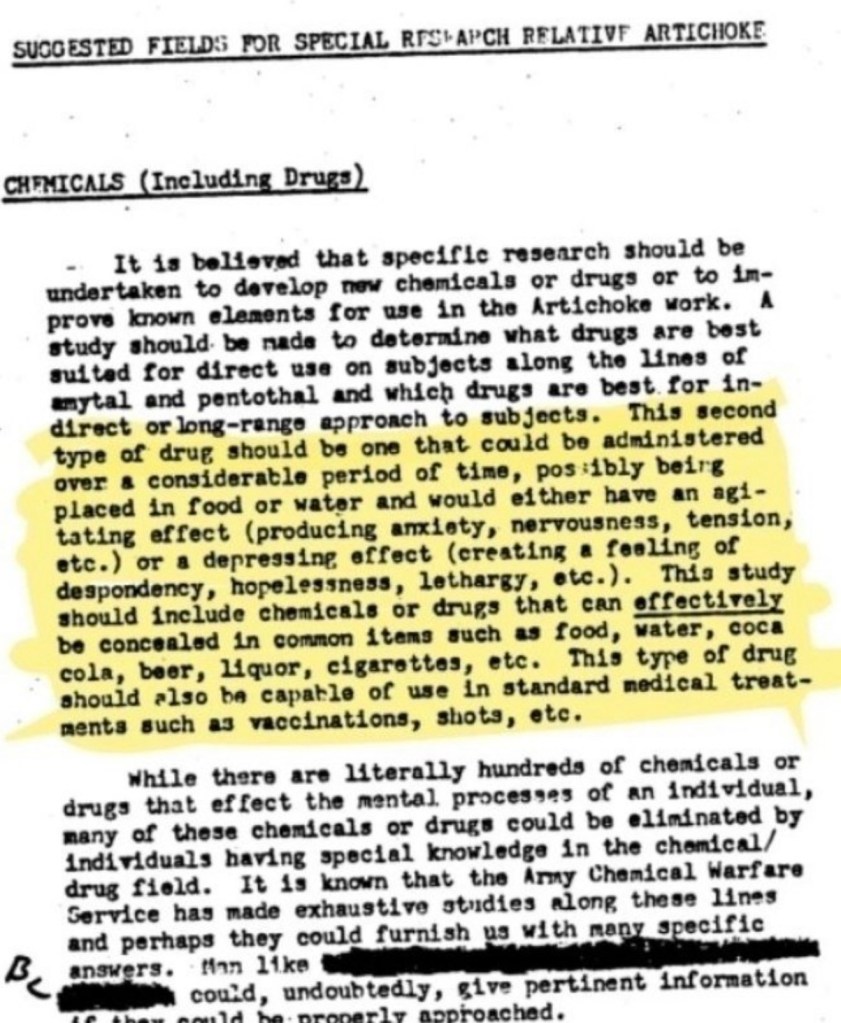
The Central Intelligence Agency once formally discussed the possibility of mass drugging civilians—through food, water, and consumer products.
This comes directly from a declassified CIA memorandum from the early 1950s, produced under Project ARTICHOKE, a covert behavioral research program and direct precursor to MKULTRA.
In a document titled “Suggested Fields for Special Research Relative to ARTICHOKE,” CIA officials outlined research priorities related to psychological and behavioral control. One passage states that research should include substances:
“which can be administered through food, water, or cigarettes, so as to be practically undetectable, and which will produce temporary or permanent effects on the human organism.”
The memo goes on to discuss drugs that could be administered over long periods of time, potentially disguised as routine medical treatments, and capable of inducing anxiety, nervous tension, lethargy, hopelessness, or emotional instability.
Context matters. This document was written during the early Cold War, when U.S. intelligence agencies feared communist “brainwashing” and were racing to understand — and replicate — methods of psychological coercion. Ethical standards for human experimentation were weak, oversight was minimal, and secrecy dominated decision-making.
If you’re watching the show “Stranger Things,” which is a top-10 Netflix program right now, you can see that “fear of the Russians” was not a made-up phenomenon. But the extent to which the CIA went to secure superior capabilities crossed all moral boundaries.
It should also be noted that the existence of this document does not prove that such methods were ever successfully deployed at scale. However, it does show how far dysfunctional institutional thinking can go when fear, secrecy, and national security pressures eclipse ethical restraint.
Why does this matter today? Because transparency, informed consent, and oversight are not abstract ideals — they are safeguards learned through historical failure. Declassified records like this remind us why skepticism toward unchecked power is not paranoia, but civic responsibility.
Primary Source (Declassified CIA Document):
Central Intelligence Agency. Special Research for ARTICHOKE with Attachment Titled “Suggested Fields for Special Research Relative ARTICHOKE.” April 24, 1952. CIA FOIA Electronic Reading Room, Document No. 00184365.
https://www.cia.gov/readingroom/document/00184365
Written with the help of AI.
 Writing by Dr. Dannielle Blumenthal
You must be logged in to post a comment.