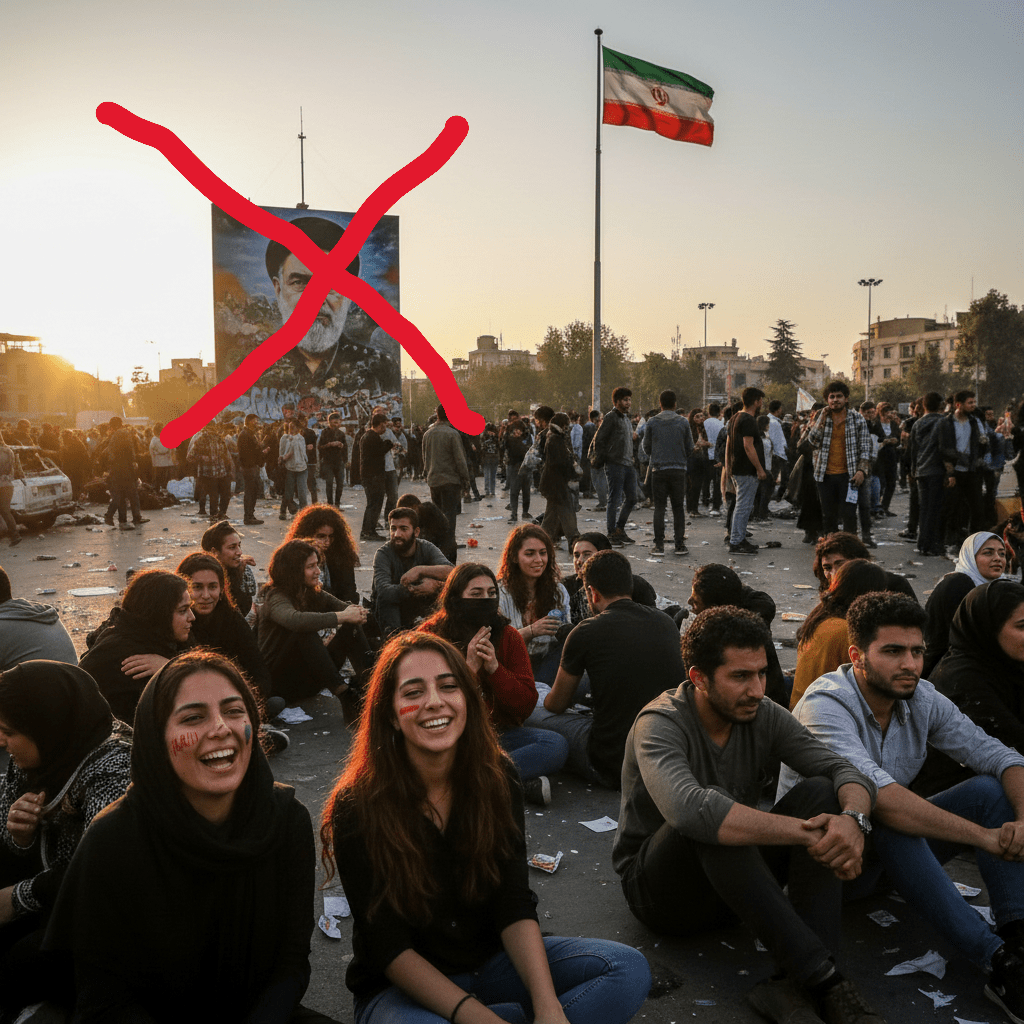
The Q posts clearly identified Iran as a focal point for the Trump administration: We want these people to be free and happy.
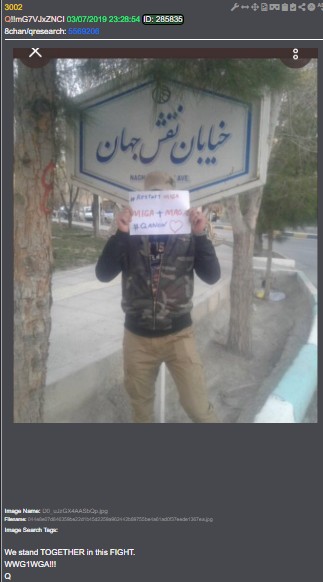
Without focusing on those messages, this post synthesizes the current Iran crisis into a single analytical narrative. The aim is to weave together history, culture, economic and military analysis to understand the likely trajectory of Iran’s future and what the United States will likely support in that regard.
I. Historical Context: Why Iran Unravels the Way It Does
Iran’s modern political instability is rooted in two defining ruptures.
- The 1953 overthrow of Prime Minister Mohammad Mossadegh and the consolidation of power under Shah Mohammad Reza Pahlavi: This created a state that modernized rapidly under Western “guidance” but relied on religious repression.
- The 1979 Islamic Revolution: This replaced monarchy with a theocratic system built on revolutionary legitimacy, ideological enforcement, and security dominance. Since 1979, dissent has routinely been framed as foreign subversion.
Notice the two extremes at play: Either Iran is owned by the West or it’s owned by the Islamists, but at no time is it owned by the people themselves.
The Pattern: Managed Exhaustion
Iranian systems do not typically collapse in one cinematic moment. They erode through attrition, elite fracture, narrative exhaustion, and negotiated power shifts.
1. Attrition: The Erosion of Material Resilience
In Iran, attrition isn’t just about money; it’s about the hollowing out of state capacity.
- The “Survival Economy”: Decades of “Maximum Pressure” and the 2025 reimposition of UN “snapback” sanctions have moved Iran from a developing economy to a subsistence one. The state can no longer provide basic services—water, electricity, and a stable currency ($1$ Rial has hit historic lows).
- Security Exhaustion: While the IRGC remains powerful, the Basij (paramilitary) and local police face “suppression fatigue.” Frequent nationwide protests (2019, 2022, and the current 2025–26 wave) force the state to constantly mobilize, which is expensive and emotionally draining for the rank-and-file who live in the same struggling neighborhoods they are ordered to police.
2. Elite Fracture: The “War Cabinet” vs. The Ultra-Hardliners
The Iranian elite are no longer a monolith; they are split on how to survive the post-Khamenei era.
- Institutionalization of Power: Recent moves, such as the creation of a Defense Council in 2025, suggest the elite are trying to “Khamenei-proof” the system. This body concentrates power in a small “war cabinet,” notably excluding the most radical “ultra-hardliners” (like the Stability Front) to allow for more pragmatic survival decisions.
- Succession Anxiety: With Supreme Leader Ali Khamenei at age 86, the “inner circle” is fracturing into factions: those who want a military-led state (IRGC-heavy) and those who want a “North Korea” style absolute isolation. This creates “silent defections” where certain officials stop implementing central orders to protect their own future.
3. Narrative Exhaustion: The Psychological Divide Between The People And The State
The state’s “Why” has largely evaporated for the majority of the population.
- The Generational Divorce: Nearly half of Iranians are under 30. For them, the 1979 Revolution is ancient history. The narrative of “Resistance against the Great Satan” (the U.S.) feels irrelevant compared to the reality of 60% inflation.
- Ideological Bankruptcy: The “Woman, Life, Freedom” movement and the current 2026 strikes in the Grand Bazaar show that the state has lost its moral authority. When people move from “asking for reform” to “challenging the moral right of the clergy to rule,” the narrative is exhausted. The state is left with only one tool: coercion.
- The Precipitous Decline of Islam: The Islamic Republic’s founding claim—that it is a government of the “pious” for a “pious” nation—has collided with a reality where Iran is now one of the most rapidly secularizing societies in the world. Despite this, The state continues to govern as if it were 1979, using a religious vocabulary that no longer has an audience.
- While official state census data often claims that over 99% of Iranians are Muslim, independent and anonymous surveys (such as those by GAMAAN in 2024–2025) reveal a starkly different landscape. In these studies, only about 40% of Iranians explicitly identify as Muslim.
- The rest of the population has fragmented into a “post-Islamic” spiritual spectrum. A large plurality believes in “God” or a “Higher Power” but rejects all organized religion. Roughly 9% to 15% identify as atheists or agnostics, a rate significantly higher than in many neighboring countries. Small but growing numbers are turning toward Zoroastrianism (as a way to reclaim “Persian” identity over “Arabized” Islam) or even Christianity and New Age spiritualities.
- A Grassroots Ideological Uprising: Unlike Western secularism, which was often led by intellectuals, Iran’s secularism is a visceral reaction to theocracy. Because the state forced religion into every aspect of life—from the courtroom to the bedroom—people have come to associate “Islam” with “the government.” When the government fails (economically or socially), the religion is rejected along with it.
- Visual Reminders of the Symbolic Death of Regime Legitimacy: In 2026, with the majority of the population (especially Gen Z) no longer believing in the religious necessity of the Hijab or the “divine right” of the Supreme Leader, the state has lost its moral authority. Mosque attendance has plummeted. Many mosques in Tehran and other major cities are now used primarily as bureaucratic outposts or bases for the Basij militia rather than community centers for prayer. This visual of empty mosques creates a sense of “narrative death”—the state is preaching to an empty room.
The Result: A Hollowed-Out Identity
When the state’s narrative is exhausted, the citizenry stops being “angry” and starts being apathetic. They no longer try to “reform” the religious laws; they simply ignore them.
This is why you see women walking unveiled in Tehran despite the threat of the morality police—the state’s “sacred” rules have become, in the eyes of the public, merely annoying obstacles to be bypassed.
4. Negotiated Power Shifts: The “Green” to “Khaki” Transition
Rather than a collapse into democracy, Iran is experiencing a slow-motion military takeover from within.
- The Rise of the IRGC-State: Power is shifting from the “turbans” (clergy) to the “boots” (the IRGC). The IRGC now controls vast swaths of the economy (engineering, telecommunications, oil) and increasingly dictates foreign policy.
- Shadow Concessions: The state often “negotiates” by simply looking the other way. For example, while the Hijab law remains on the books, enforcement in major cities fluctuates based on how much “street heat” the regime can handle at that moment. This is a negotiated retreat from the state’s ideological territory to maintain its physical territory.
II. Domestic Unrest and Public Mobilization (Late December 2025–January 17, 2026)
Nationwide protests erupt in late December 2025 amid economic collapse, currency devaluation, and shortages. They rapidly transform from grievance-driven demonstrations into open challenges to regime legitimacy.
Security forces respond with lethal force, mass arrests, and intimidation. A near-total internet blackout is imposed to block coordination and documentation.
Despite this, a sustained social media outpouring continues via satellite links, VPNs, and diaspora amplification. Protest footage, strikes, and chants circulate widely. The tone shifts from protest to assertion: many Iranians behave as though the regime’s authority is already spent.
III. Information War and Narrative Control
The regime curates information aggressively.
State television selectively rebroadcasts Tucker Carlson segments, presenting them as evidence of Western division.
Al Jazeera (Qatar) is permitted to broadcast when most other international outlets are restricted, providing Tehran a narrow but useful external narrative channel.
On social platforms, pro-Palestinian and anti-Israel networks increasingly align rhetorically with Iranian state framing, portraying unrest as foreign-instigated.
On January 16, 2026, the Mossad Farsi-language account posts a message stating, in effect, “We are with you, the people of Iran.” The message spreads rapidly and is widely interpreted as a psychological signal rather than an operational one.
IV. Regime Anxiety: Assets, Gold, and Elite Behavior
Multiple signals suggest elite hedging rather than confidence.
- Reports describe Russian cargo planes landing repeatedly in Tehran, with claims that gold or strategic assets are being moved out.
- U.S. officials state publicly that senior regime figures are transferring large sums abroad, characterizing the behavior as “abandoning ship.”
- Media reporting alleges that Mojtaba Khamenei, son of Supreme Leader Ali Khamenei, transferred substantial funds out of Iran.
- Separate intelligence-linked reporting suggests contingency exit planning among senior leadership, potentially involving Russia.
V. External Power Positioning and Diplomacy
- The United States places military and intelligence assets in the region, signaling deterrence without immediate escalation.
- Israel coordinates closely with Washington, maintaining intelligence pressure while discouraging premature kinetic action.
- Israel’s secret services, the Mossad, tweets to the people that they are with them on the ground.
- Israeli Prime Minister Netanyahu asks President Trump to put a pause on military action.
- President Donald Trump states publicly that “there will be a big price to pay,” then states that executions have been halted, adopting an unusually conciliatory tone while maintaining sanctions and warning of consequences if killings resume.
- Vladimir Putin makes calls aimed at stabilizing the situation; reporting is unclear whether these were primarily to Iran, Israel, the U.S., or a combination.
VI. Opposition Figures and Alternative Legitimacy
- Reza Pahlavi issues public statements emphasizing unity, non-violence, and continuity of the Iranian state without clerical rule. He avoids calls for armed uprising, framing change as national restoration rather than revenge.
- Support for alternative political futures becomes increasingly visible online, especially among younger Iranians and the diaspora.
VII. The “Q” Lens and the 17th
- Within “Q”-aligned communities, January 17 is highlighted as symbolically significant. Observers point to the convergence of elite financial flight, foreign asset positioning, narrative shifts, and diplomatic signaling.
- They reference an earlier Q post from roughly six years ago referencing Iran and “MIGA,” interpreting current events as delayed exposure rather than a sudden rupture.
VIII. U.S. Policy Logic Under Trump: Not Regime Change—But Intervention When Lines Are Crossed
- Trump’s Iran policy rejects traditional regime change (no invasion, no occupation, no nation-building).
- Instead, it combines maximum pressure and deterrence: sanctions, intelligence pressure, rhetorical signaling, and readiness to act if red lines are crossed (nuclear escalation, mass executions, direct threats to U.S. forces or allies).
- The Administration prioritizes ending terrorism and promoting economic reconstruction for peace.
- This explains the present posture: assets in place, sanctions tightened, warnings issued—paired with public restraint and openness to internal Iranian outcomes rather than imposed ones.
IX. Where This Is Likely Going
- The accumulated signals suggest the Islamic Republic is unlikely to survive in its current form, potentially in the short term.
- However, change is unlikely to be linear or dramatic. Expect fragmentation, elite withdrawal, negotiated exits, quiet defections, and a mainstream media/political shift toward endorsing the end of the regime.
- A transformation may appear “peaceful” on the surface—administrative or bureaucratic—even if preceded by intense repression. As in Iran’s past, the decisive moment may only be obvious in hindsight.
Sources and Further Reading
Reuters. 2026. Ongoing Middle East reporting on Iran protests, asset movements, U.S. and Israeli military positioning, and Russian diplomacy.
Associated Press. 2026. Coverage of Khamenei speeches, protest death tolls, Trump statements on executions, and regional reactions.
The Guardian. 2026. Reporting on Iran’s crackdown, clerical rhetoric, executions debate, and internet shutdowns.
Iran International. 2026. Investigative reporting on capital flight, Russian cargo flights, elite behavior, and regime anxiety.
NV.ua. 2026. Intelligence-linked reporting on Iranian leadership contingency planning and regional implications.
Al Jazeera. 2026. Coverage of Iran unrest, U.S. statements, and regional diplomatic positioning.
Britannica. “1953 Coup in Iran.” Historical overview of the Mossadegh overthrow and its legacy.
Britannica. “Iranian Revolution of 1978–1979.” Causes, course, and consequences of the Islamic Revolution.
Kinzer, Stephen. All the Shah’s Men: An American Coup and the Roots of Middle East Terror. Background on 1953 and its long shadow.
Milani, Abbas. The Persian Sphinx: Amir Abbas Hoveyda and the Riddle of the Iranian Revolution. Political biography and pre-1979 context.
Congressional Research Service. 2025–2026. Reports on Iran’s internal politics and U.S. policy options.
Human Rights Watch. 2026. Documentation of protest-related abuses and repression in Iran.
Amnesty International. 2026. Reporting on executions, detentions, and internet shutdowns.
HRANA (Human Rights Activists News Agency). 2026. Protest casualty and arrest tracking.
Written with the help of AI. “MIGA” image via Q posts. Stock image of of Iranian people generated by Gemini AI and edited.
 Writing by Dr. Dannielle Blumenthal
You must be logged in to post a comment.