Introduction
In the landscape of contemporary American activism, the “No Kings” protests stand as a prominent example of coordinated nationwide mobilization. Emerging in 2025 as a coalition opposing perceived authoritarian tendencies in the Trump administration, these events—such as the October 18 rallies and earlier Flag Day actions—drew thousands across all 50 states. Protesters framed themselves as grassroots uprisings against “kings and billionaires.” Yet beneath the surface lies a sophisticated funding apparatus that channels resources from elite philanthropists and foundations to national organizers and, indirectly, to local participants. This post explores the multi-layered structure of this support, revealing how vast sums enable large-scale movements without direct payments to protesters. It traces the origins and flows of these funds, highlighting the irony of anti-billionaire rhetoric backed by billionaire networks.
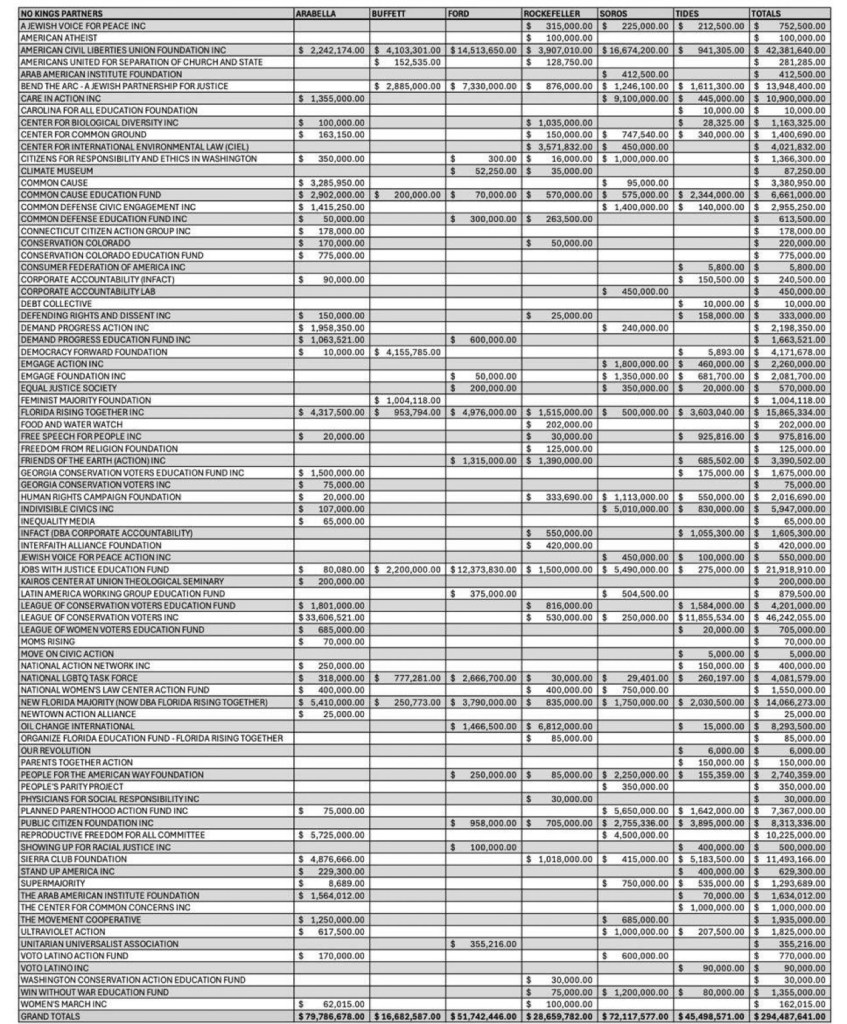
The “No Kings” Alliance comprises over 200 partner organizations, relying on a web of nonprofits, unions, and digital platforms to orchestrate events. While protesters often emphasize self-funded elements—like homemade signs—the backbone of these operations is sustained by institutional donors. Researcher Seamus Bruner traced $294,487,641 to the official No Kings 2.0 partners and organizers, all funneled through the same “Riot Inc.” dark-money networks: Arabella network $79.7 million-plus, Soros network $72.1 million-plus, Ford network $51.7 million-plus, Tides $45.5 million-plus, Rockefeller $28.6 million-plus, Buffett $16.6 million-plus. This breakdown underscores the scale of dark money involvement, where opaque channels obscure direct ties.
Bruner’s X post from October 16, 2025 (https://x.com/seamusbruner/status/1978943052065464630?s=46), made by the researcher and author affiliated with the Government Accountability Institute, shares a table titled “TOTAL FUNDS SENT TO NO KINGS 2 PARTNERS.” The table lists:
- Arabella Network: $79,786,678.00
- Buffett: $16,682,587.00
- Ford: $51,742,446.00
- Rockefeller: $28,659,782.00
- Soros: $72,117,577.00
- Tides: $45,498,571.00
- Grand Total: $294,487,641.00
Bruner describes this as funding funneled to official No Kings 2.0 partners and organizers, emphasizing the irony of anti-billionaire protests backed by billionaire-linked sources.
This table does not originate from a single publicly available source document, such as a specific IRS Form 990 or grant report. Instead, it is a compiled aggregation from multiple nonprofit financial data sources, a common practice in investigative journalism on philanthropy. Primary data comes from IRS Form 990 filings, accessible via ProPublica Nonprofit Explorer and Foundation Center (now Candid.org). The totals cover grants from approximately 2017–2025, focused on organizations involved in the No Kings protests, such as Indivisible’s 5,000-plus chapters and ACLU state affiliates.
Fiscal sponsorship and dark money networks include Arabella Advisors, managing funds like the New Venture Fund; and the Tides Foundation/Network, acting as donor-advised funds that redistribute anonymously. Bruner likely used tools like Excel to sum grants tied to No Kings 2.0 partners, including unions like SEIU and groups like Women’s March. Independent fact-checks confirm that these networks funded No Kings partners, but the total represents the broader ecosystem—digital tools, legal aid, mobilization—rather than direct event costs. No evidence exists of payments to protesters; funds went to infrastructure.
The Funding Ecosystem: Major Donors and Intermediaries
At the apex sit high-profile foundations and billionaire-backed networks. Funds originate from entities like the Open Society Foundations (OSF), associated with George Soros, which disbursed over $7.6 million to key organizers since 2017, including a $3 million grant in 2023 for “social welfare activities.” Other major contributors include the Tides Foundation ($45.5 million), Arabella Advisors-linked funds ($79.7 million), the Ford Foundation ($51.7 million), Rockefeller entities ($28.6 million), and Buffett-related grants ($16.6 million).
These resources flow through intermediaries such as the New Venture Fund and Tides, acting as fiscal sponsors to redistribute to national-level partners like Indivisible Project, ACLU, MoveOn, and Public Citizen. For instance, Tides channeled $955,000 to groups like 350.org, a “No Kings” partner, while Arabella-linked entities contributed $79 million overall. Labor unions, including SEIU and the American Federation of Teachers, add in-kind support, focusing on logistics rather than cash.
The total aggregate of $294 million represents not direct event costs but the broader ecosystem enabling virality. This includes national websites, legal teams, and coordination tools, allowing protests to scale without overt billionaire branding. Funding Network Sum of Amount ARABELLA $79,786,678.00 BUFFETT $16,682,587.00 FORD $51,742,446.00 ROCKEFELLER $28,659,782.00 SOROS $72,117,577.00 TIDES $45,498,571.00 Grand Total $294,487,641.00
Flow to the Local Level: Indirect Facilitation
Direct payments to individual protesters are absent, aligning with coalition statements debunking “paid protester” myths. Instead, funds support infrastructure that empowers locals. National organizations like Indivisible, with its 5,000-plus chapters, provide micro-grants (under $1,000) for permits or materials, but primarily offer free digital toolkits, training, and platforms like Mobilize for event registration.
ACLU national grants fund state affiliates—for example, ACLU of Texas received $2.27 million nationally plus $200,000 from Tides—for legal observers and resources. Unions allocate to locals for transportation and security, while federal grant overlaps support broader activities. This model ensures scalability: Over 2,700 rallies were coordinated through centrally funded tools, informing protesters “where and when to show up” without personal payouts.
George Soros: Destabilization as a Decades-Long Business Model
George Soros exemplifies the dual role of philanthropist and speculator, profiting from instability while funding movements that may exacerbate it. His approach, rooted in “reflexivity”—where market perceptions influence reality—has yielded billions from currency crises, often at nations’ expense.
Soros’s breakthrough came on “Black Wednesday” in 1992, when he shorted the British pound, betting against its ERM peg. His $10 billion position forced devaluation, netting $1-2 billion in profits while costing the UK £3.4 billion and ejecting it from the ERM. Critics label him “the man who broke the Bank of England,” accusing him of exploiting vulnerabilities for gain.
This model extended to the 1997 Asian financial crisis, where Soros shorted the Thai baht and Malaysian ringgit, accelerating collapses that plunged economies into depression. Malaysian Prime Minister Mahathir accused him of causation, though Soros claimed he bought post-decline to realize profits.
Soros profits on “both sides” by speculating on volatility his philanthropy may indirectly foster. Through OSF, established in 1979 and operating in 120-plus countries, he funds NGOs promoting “open societies,” often tied to regime change or unrest. In post-Soviet states, his “Soros Empire” shaped transitions but faced destabilization accusations. In India, the BJP alleges Soros funds opposition to destabilize Modi.
In a 1998 60 Minutes interview, Soros candidly addressed his amoral approach: “I am basically there to make money. I cannot and do not look at the social consequences of what I do.” He described moving markets or destabilizing governments via currency trades, expressing no guilt, even likening it to his Holocaust survival experiences. This detachment underscores his business model: Create or exploit instability for profit, then philanthropically address fallout, potentially perpetuating cycles.
Conclusion
The “No Kings” protests illustrate how elite funding sustains modern activism, transforming potential grassroots efforts into amplified movements. While the $294 million figure overstates single-event costs, it accurately captures the institutional scaffolding—from digital platforms to legal aid—that makes such scale possible. Soros’s role, blending speculation and philanthropy, highlights a broader pattern where billionaires shape dissent, often profiting from the volatility they help engender. As Bruner quips for those claiming “I brought my own sign,” the money buys the platform, not the markers.
For deeper dives, see Bruner’s X post (https://x.com/seamusbruner/status/1978943052065464630?s=46) and MJTruthUltra’s analysis (https://x.com/mjtruthultra/status/1980324293444817133?s=46).
References
Al Jazeera. 2024. “How George Soros Became ‘Enemy Number 1’ for India’s Modi.” December 26.
BBC. 2019. “Why Is Billionaire George Soros a Bogeyman for the Hard Right?” September 6.
Bruner, Seamus. 2025. X Post on No Kings Funding. October 16. https://x.com/seamusbruner/status/1978943052065464630.
Burja, Samo. 2022. “The Legacy of George Soros’ Open Society.” March 16.
CBS. 1998. “60 Minutes: George Soros.” Interview Transcript.
Congress.gov. 2006. “The Guilt-Free Record of George Soros.” September 29.
Economic Times. 2024. “Where Does Global Disruptor George Soros Get His Power From?” December 9.
Guardian. 2018. “The George Soros Philosophy – and Its Fatal Flaw.” July 6.
Hindu Dvesha. 2025. “George Soros and the Far-Left Rhetoric of Globalism.” November 10.
Indivisible. 2025. Organizational Reports.
Investopedia. 2024. “George Soros and Black Wednesday.”
Mesirow. 2024. “The New Currency Wars.”
MJTruthUltra. 2025. X Post on No Kings Financials. October 20. https://x.com/mjtruthultra/status/1980324293444817133.
Osnos, Peter. 2018. “George Soros, a Teenage Moment and 60 Minutes.” October 26.
Reddit. 2025. “Uncensored 1998 George Soros Interview with 60 Minutes.” January 15.
Roberts, Eric. 1999. “Case Study: George Soros.”
Schweizer, Peter. 2025. Investigative Reports on Riot Inc.
Soros, George. 1998. The Crisis of Global Capitalism.
Soros, George. 2008. Statement on Asian Crisis.
Wikipedia. 2024. “George Soros Conspiracy Theories.”
YouTube. 2022. “George Soros Interview 1998 On 60 Minutes.” February 16.
Written with the help of AI.
 Writing by Dr. Dannielle Blumenthal
You must be logged in to post a comment.