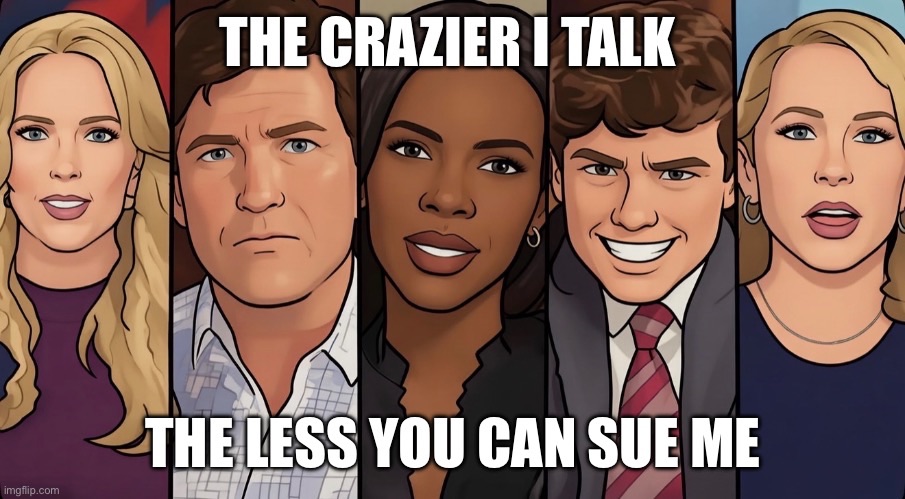
Have you ever watched a viral commentary video or a late-night cable news segment and wondered, “How are they allowed to say that without getting sued?”
The answer isn’t that they have better lawyers (though they do); it’s that they’ve mastered a specific, paradoxical legal strategy. In the eyes of the law, being too outrageous to be believed is actually a bulletproof defense.
Welcome to the world of “Rhetorical Hyperbole”—the legal loophole that turns misinformation into “entertainment.”
At the heart of this strategy is a concept called “breathing space.” Derived from the landmark case New York Times Co. v. Sullivan, the First Amendment provides a buffer for speakers. The idea is that if we punished every single factual error, public debate would dry up because everyone would be too terrified of a lawsuit to speak.
However, in the age of the “influencer,” this breathing space has expanded into a massive hangar.
In 2020, a court case involving Tucker Carlson set a fascinating precedent. The defense argued—and the judge agreed—that the “general tenor” of certain programs signals to the audience that they shouldn’t take the words literally.
Because the show was framed as “opinion” and “entertainment” rather than “hard news,” the court ruled that a reasonable viewer would realize the speaker is not “stating actual facts.”
This leads to a troubling legal reality: The more extreme a claim is, the safer the speaker is.
If an influencer makes a small, believable false claim about a person, they can be sued for defamation.
But if they make a claim so wild, inflammatory, and “out there” that it enters the realm of the absurd, they can argue that “no reasonable person” would have believed them.
This is legally similar to “puffery” in advertising. When Papa John’s says they have “Better Ingredients,” the law says you can’t sue them for lying because it’s a vague claim of superiority that no one should take as a scientific fact.
Influencers are now using this same logic.
The biggest issue with this legal strategy is the massive disconnect between the courtroom and the living room:
- The Legal Assumption: Judges assume the “reasonable viewer” approaches the content with skepticism, recognizing it as a performance.
- The Audience Reality: In many cases, the audience doesn’t see a performer; they see a “truth-telling patriot” or an outsider finally exposing the “real” story.
By the time a judge labels a statement “too outrageous to be true,” millions of followers already believe it.
Perhaps most surprisingly, this defense doesn’t require a “This is a joke” disclaimer on the screen. It relies entirely on the subjective interpretation of “style” and “tone.”
As long as the speaker stays loud, angry, and sufficiently “performative,” they can shield misinformation from the legal consequences that would sink a traditional journalist.
Written with the help of AI.
 Writing by Dr. Dannielle Blumenthal
You must be logged in to post a comment.