Written with the help of AI.
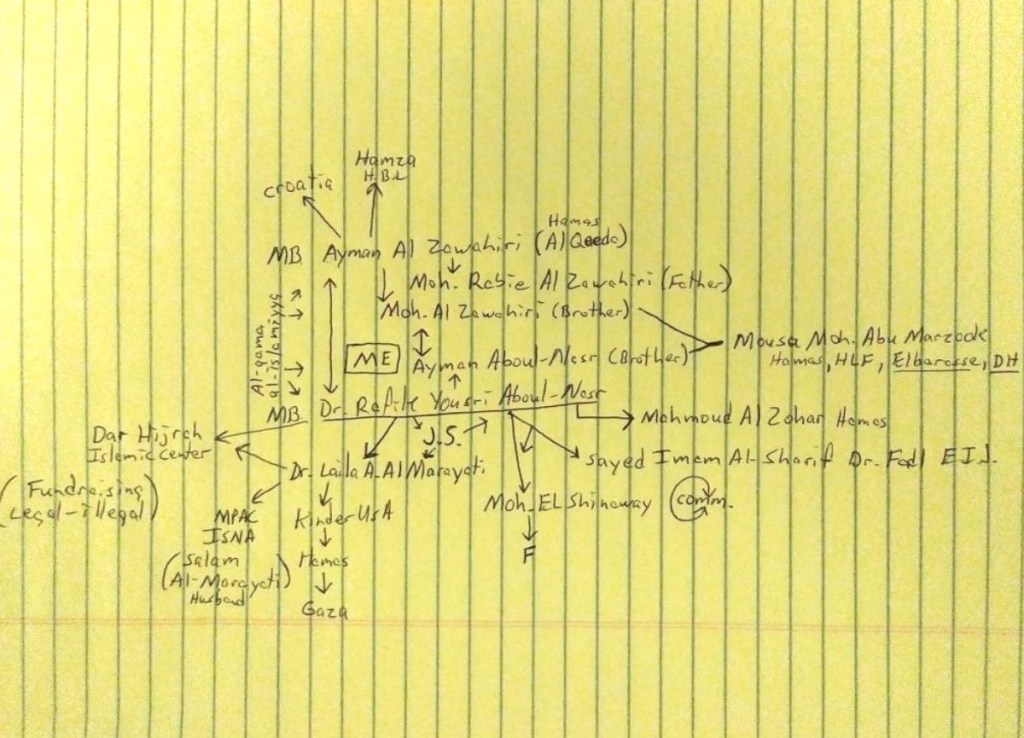
This summary covers the handwritten intelligence diagram found on a yellow notepad, authored by whistleblower Ryan White (Jon McGreevy), who was murdered (blunt force trauma) in 2023, although the case was never pursued as murder.
The diagram acts as a link analysis of a top-down network connecting global jihadist groups through family ties and financial flows. It was published posthumously to X by Sean Maguire, who was in receipt of at least some of White/McGreevy’s devices after his death and who actively investigated the whistleblower’s claims.
Visual Layout and the Central Witness
The diagram is sketched on yellow lined paper. In the dead center is a small rectangle containing the word “ME.” This represents White himself, “walled off” in a box to signify his role as an outside observer and witness who recorded the information provided by his physician.
Directly below “ME” is Dr. Rafik Yousri Aboul-Nasr, who serves as the foundational anchor for the bottom half of the chart.
White emphasizes that while Dr. Rafik is the primary informant and central source of this knowledge, he was a non-violent physician who rejected the Brotherhood’s ideology and provided this data to him, which assisted law enforcement. Dr. Al Nasr died suddenly of a massive heart attack in 2014 — after years of providing incriminating information about radical Islamic terror networks, after Barack Obama took office, a change which led to the alleged setup of the whistleblower by the very DOJ (Rod Rosenstein) he had served.
The Operational Zone (Top Half)
The upper section of the diagram maps the operational leadership and logistical pipelines of the network.
- Al-Qaeda Hierarchy: At the very top is Ayman Al Zawahiri, explicitly labeled “(A) Qaeda”. Vertical arrows point down to his father, Mohammed Rabie, and his brother, Mohammed Al Zawahiri, indicating hierarchical command and lineage.
- The Balkan Pipeline: To the left of the Zawahiri family, arrows point to “Croatia,” identified as a 1990s transit hub for foreign fighters.
- Operational Hubs: The node for “Hamza” (likely Abu Hamza al-Masri) is positioned near H.B.L. (Habib Bank Limited), identifying the specific financial conduit used to support operations in the Balkans.
- Family Operational Link: A double-headed arrow connects Mohammed Al Zawahiri to Ayman Aboul-Nasr (Brother), Dr. Rafik’s sibling. This signifies a peer-level working relationship between the brothers of the two families, representing the “violent side” of the network that Dr. Rafik kept at a distance.
The Funding Zone (Bottom Half)
The lower section of the diagram details how resources were moved through domestic and international entities.
- Charitable Conduits: A downward pipeline flows from Dr. Rafik to Dr. Laila A. Al-Marayati. From her, arrows lead to KinderUSA, which then flows to Hamas and Gaza, mapping how humanitarian aid was used to move resources to militant zones.
- Institutional Infiltration: Dr. Laila is linked to advocacy groups MPAC (Muslim Public Affairs Council) and ISNA (Islamic Society of North America), with her husband, Salam, listed as a leader within them.
- Hamas and Local Nodes: On the right, Mousa Moh. Abu Marzook (a senior Hamas leader) is linked to the Holy Land Foundation (HLF) and the Dar al-Hijrah (DH) mosque.
- Fundraising and Communications: At the very bottom, Moh. EL Shinaway is linked to a box marked “F” (Fundraising) and a circled node marked “comm.” representing a Communications Hub or dispatch point for transmitting orders.
- Marginal Shorthand: A large bracket on the far left contains the note “(Fundraising Legal-Illegal),” intended to categorize the movement of resources through both legitimate charities and clandestine operations.
Timeline and Context
The diagram was likely authored between 2005 and 2009. While it was drawn during White’s time as a patient of Dr. Rafik, it captures a retrospective map of the 1991–1995 era. This period coincides with the height of the Balkan transit pipeline and Dr. Rafik’s arrival in Maryland in 1991, establishing the timeframe when these networks first took root in the local U.S. community.
Fact Check
The diagram effectively maps out a complex web of historical and geopolitical connections that align with documented counter-terrorism investigations from the 1990s and early 2000s. In the “Operational Zone,” the links between Ayman al-Zawahiri, his brother Mohammed, and the Balkan pipeline are grounded in historical fact. Mohammed al-Zawahiri was a known leader in the Egyptian Islamic Jihad (EIJ) who operated in Croatia and Bosnia during the early 1990s, often using humanitarian cover to facilitate the movement of “Afghan Arab” fighters. The mention of Hamza (likely Abu Hamza al-Masri) and Habib Bank Limited (HBL) also mirrors real-world scrutiny; HBL’s U.S. operations were eventually shuttered following years of regulatory pressure regarding the bank’s failure to monitor transactions linked to extremist financing. While the diagram posits a direct peer-level operational link between the Zawahiri brothers and the Aboul-Nasr family, this remains a more speculative element of the author’s personal mapping, likely intended to bridge local Maryland figures with global high-value targets.
In the “Funding Zone,” the diagram transitions from international militancy to domestic U.S. organizations, utilizing a “guilt-by-association” framework common in post-9/11 intelligence analysis. The link between Mousa Abu Marzook (a senior Hamas leader) and the Holy Land Foundation (HLF) is a verified legal fact established during the landmark 2008 federal trial, which proved the charity funneled millions to Hamas-controlled committees. Similarly, the Dar al-Hijrah mosque and the organization KinderUSA were subjects of intense federal interest during this era due to their proximity to individuals and charities accused of militant ties. While figures like Dr. Laila Al-Marayati and organizations like MPAC and ISNA are mainstream entities that have consistently denied and defended themselves against allegations of clandestine activity, the diagram reflects a specific era of investigative theory that viewed legal charitable giving as a potential conduit for “illegal” resource movement.
Ultimately, the diagram serves as a retrospective snapshot of the “Global War on Terror” mindset between 2005 and 2009. It utilizes verified nodes of the Muslim Brotherhood and Hamas networks to create a flowchart that seeks to explain how international radicalism could theoretically take root in local American communities. The timeline matches the period when the U.S. government was aggressively mapping “dual-track” networks—where legitimate civic involvement and humanitarian aid were scrutinized for hidden operational overlaps. While many of the individual names and organizations in the diagram are real and historically significant, the lines connecting them represent the author’s specific hypothesis regarding a unified command structure between local professionals and Al-Qaeda’s inner circle.
 Writing by Dr. Dannielle Blumenthal
You must be logged in to post a comment.