Michael Flynn is not a fringe figure who drifted into controversy. He is a retired three-star general, former head of the Defense Intelligence Agency, and briefly served as National Security Advisor to the President of the United States. He has operated at the highest levels of military intelligence and national security decision-making. That matters, because the pattern his career reveals is not peripheral—it sits uncomfortably close to the core of American power.
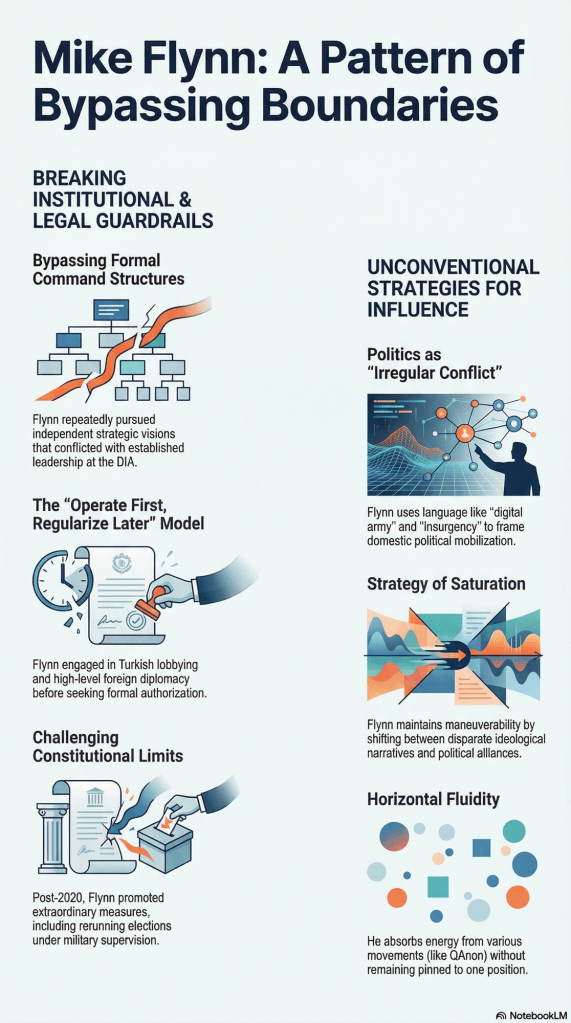
Across that career, Flynn exhibits a consistent throughline: a drive not just to influence decisions, but to expand his authority beyond the limits set by superiors, institutions, or formal roles. At the DIA, this tendency brought him into sustained conflict with leadership. His early removal in 2014 followed concerns that he was pursuing his own strategic vision rather than functioning within established command structures. This was not simply stylistic friction. It raised a deeper issue: whether Flynn saw institutional constraint as something to work within—or something to work around.
That question became more acute during the 2016 transition. Despite explicit warnings from President Obama, Flynn was elevated to National Security Advisor. Within weeks, he was forced out after it emerged that he had discussed U.S. sanctions with Russian Ambassador Sergey Kislyak before taking office, then misled officials about those conversations. The episode is often framed narrowly as a scandal of disclosure. But at its core, it reflects something more fundamental: an attempt to exercise foreign policy authority before it was formally his to wield, followed by efforts to manage the fallout.
The same pattern appears in his foreign lobbying work tied to Turkish interests. Flynn and his firm engaged in activities that were later retroactively registered under the Foreign Agents Registration Act. Again, the sequence is telling: operate in a gray zone first, regularize later under pressure. This is not accidental sloppiness—it is a recurring mode of action.
After leaving government, Flynn did not recede. Instead, he became increasingly central to political movements challenging institutional legitimacy itself. Following the 2020 election, he publicly entertained and promoted extraordinary measures, including the idea of rerunning elections under military supervision. Here, the trajectory is clear: from pushing bureaucratic limits, to blurring legal boundaries, to openly questioning constitutional ones.
He has also explicitly framed his political engagement in quasi-organizational and mobilizational terms. In public remarks, Flynn has referred to the existence of a “digital army,” language that evokes coordinated, networked influence rather than conventional political participation. In other instances, he has invoked the idea of an “insurgency” in a metaphorical or political sense, signaling a posture that treats domestic political struggle in terms more often associated with irregular conflict. Even when interpreted rhetorically, this language reinforces a broader pattern: politics not as deliberation within institutions, but as a domain to be contested, mobilized, and ultimately dominated.
At the same time, Flynn has signaled ambitions that extend beyond influence into formal power. Reports and public speculation about a potential presidential run—whether exploratory or aspirational—fit within the same trajectory. They suggest a figure not content to remain a behind-the-scenes actor or movement entrepreneur, but one oriented toward consolidating authority at the highest level. In that light, earlier patterns of boundary-testing and coalition-building take on added significance: they begin to look less like isolated behaviors and more like groundwork.
What makes Flynn distinct, however, is that this vertical push for authority is paired with horizontal fluidity. He does not remain within a fixed ideological lane. He engages broadly, often inconsistently, across movements and narratives. He has amplified themes associated with QAnon-aligned communities, then distanced himself from them. He has circulated geopolitical commentary—at times echoing narratives favorable to foreign powers such as China—only to reverse course and repudiate those positions. He brings in disparate actors, absorbs their energy, and moves on when advantageous.
This is not easily dismissed as simple inconsistency. It looks more like a deliberate strategy of saturation: occupy as many spaces as possible, build overlapping audiences, and avoid being pinned down to any single position that might limit maneuverability. In that sense, Flynn is not just testing institutional boundaries—he is attempting to operate above them, while simultaneously expanding his reach across fragmented political ecosystems.
That combination is what makes his trajectory significant. A figure with high-level intelligence experience, a demonstrated willingness to bypass formal constraints, and a pattern of rapidly shifting alliances and narratives is not merely controversial—it is structurally difficult to contain or predict. Traditional checks assume stable roles, clear lines of authority, and consistent ideological commitments. Flynn’s career cuts across all three.
And that raises the uncomfortable question that lingers behind the public record: if this much boundary-testing, repositioning, and informal maneuvering is visible, how much of it has occurred outside view? What networks, relationships, or lines of influence remain undisclosed—not because they are necessarily illicit, but because operating in the gray has been a consistent feature rather than an exception?
Written with the help of AI.
 Writing by Dr. Dannielle Blumenthal
You must be logged in to post a comment.