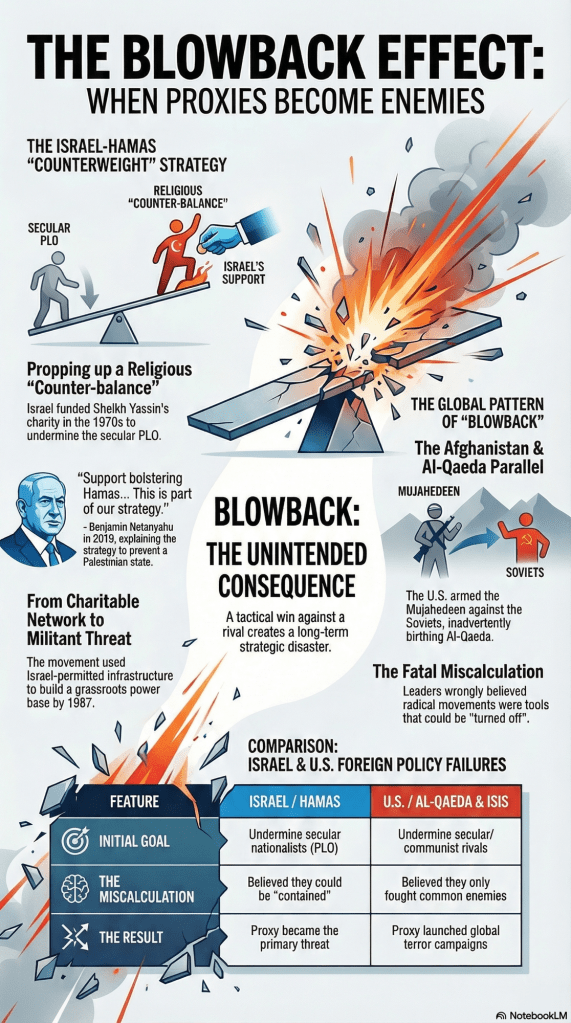
The idea often described as the “Frankenstein strategy” in geopolitics refers to a recurring and dangerous pattern: states attempt to use radical movements—whether religious or nationalist—as tools against their rivals, only to later face those same forces as serious threats.
This phenomenon, commonly known as “blowback,” reflects the unintended long-term consequences of short-term tactical decisions.
This dynamic began to take shape in the Israeli-Palestinian context during the Cold War as the Soviet Union supported the rise of the Palestine Liberation Organization (PLO) and elevated Yasser Arafat as a central figure, partly to challenge Western influence and destabilize Israel. The PLO was founded in 1964.
By the 1970s and 1980s, Israeli policymakers were searching for ways to weaken the PLO’s dominance. In Gaza, attention turned to a religious leader, Ahmed Yassin, who ran a social and religious network known as Mujama al-Islamiya. His organization focused on building mosques, schools, and clinics, presenting itself as a charitable alternative to the PLO’s militant secularism.
In 1984, Israeli authorities discovered weapons stored in one of Yassin’s mosques, revealing a militant dimension to the movement.
Yassin was arrested, then released in a prisoner exchange in 1985. In 1987, Yassin formally established Hamas during the First Intifada.
Unlike the PLO, Hamas fused religious ideology with armed resistance, and its 1988 charter explicitly called for the destruction of Israel. Yet even then, Israel’s immediate focus remained largely on suppressing the PLO.
Only in 1989, after Hamas carried out deadly attacks including the killing of Israeli soldiers, did Israel formally designate it as a terrorist organization and begin treating it as a primary threat.
Why did Israel allow funds to Hamas after 1989?
- Divide & Rule: Bolstered Hamas in Gaza to fracture Palestinian leadership, weakening the PA and blocking a two-state solution.
- “Domesticated” Enemy: Gambled that governing responsibilities and Qatari cash would trade “quiet for quiet.”
- Humanitarian Safety Valve: Used external funds to prevent a total Gazan collapse, shifting the financial burden and legal liability away from Israel.
The Hamas-led attacks on October 7, 2023 blew all these assumptions to pieces.
More broadly, the idea that people can be “directed” then “contained” by the state was the fatal flaw of arrogant superpower thinking post-WWII. The USA made this same mistake. Two examples:
- In Afghanistan during the 1980s, the USA supported Islamist fighters known as the Mujahideen to resist the Soviet occupation. Over time, elements of that network contributed to the formation of Al-Qaeda, which later turned against the United States.
- In Iraq, the 2003 U.S. invasion dismantled the existing state structure, creating conditions that allowed insurgent groups to evolve into ISIS.
- There’s also the 1953 Iran Coup: CIA/MI6 hired “spontaneous” mobs to trigger a collapse of the secular gov. Bribed clerics to brand the PM an atheist, using the mosque as a political weapon. Result: Crushing the secular center left a vacuum that Ayatollah Khomeini filled in 1979.
So Islamism is blowback, but the example holds with white nationalism too.
By empowering elite ultra-nationalist proxies in Ukraine like Azov, the USA risks openly empowering new Nazis who cannot be controlled.
Point is, we have a way of manufacturing our own problems. President Trump’s populist “peace through strength” approach is a far more durable and stable alternative.
Addendum: The Frankenstein strategy, part of “Cold War logic,” was and is common. Today, we see this risk with AI; it serves as a proxy for the urge to dominate. But once you release the genie from the bottle, you cannot very easily put it back. It might even come back to bite you, God forbid.
Written with the help of AI. AI-generated graphic.
 Writing by Dr. Dannielle Blumenthal
You must be logged in to post a comment.