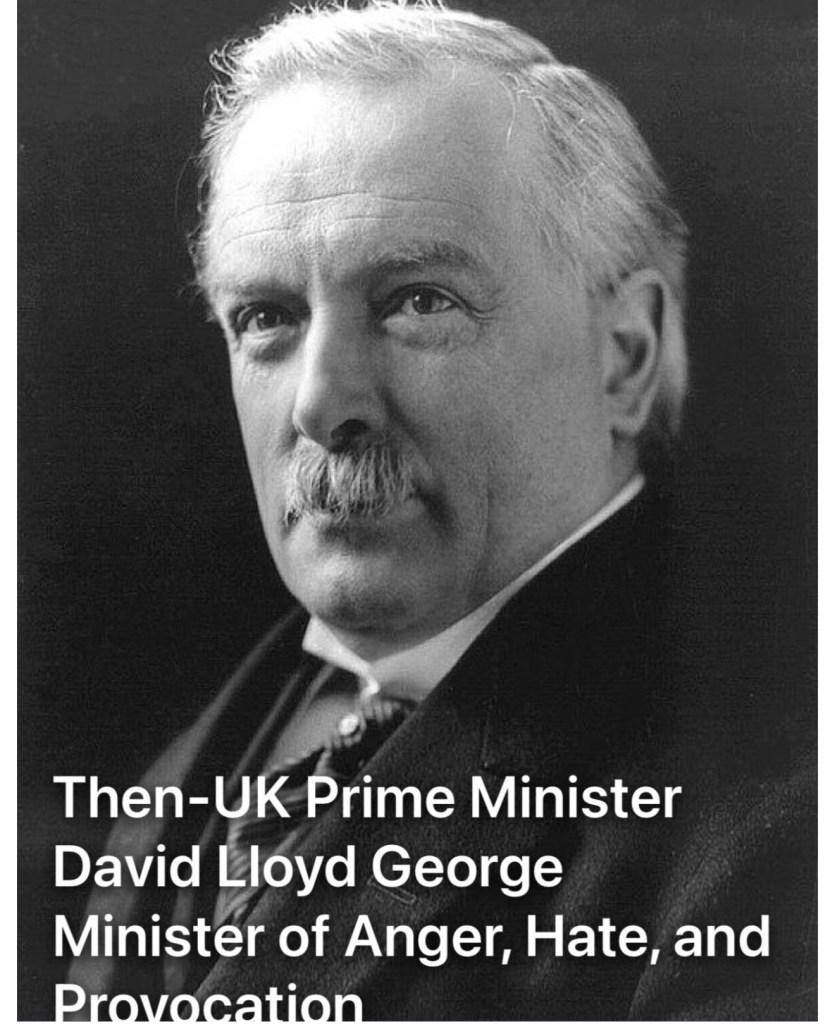
The roots of the modern animosity between Israel and the Arab world can be traced directly to the onset of Zionism and the contradictory policies of the British government, led at the top by Prime Minister David Lloyd George.
Under his leadership, the British Empire engaged in a strategy of political expediency that fundamentally destabilized the region.
By overseeing the issuance of the Balfour Declaration in 1917, Lloyd George’s government gave official imperial backing to the Zionist goal of establishing a Jewish national home in Palestine.
This was done with the strategic intent of securing a loyal presence near the Suez Canal, yet it directly collided with the McMahon-Hussein Correspondence, in which British officials had already promised the Arabs independence in that same territory in exchange for their revolt against the Ottoman Empire.
By the time the British Mandate was established, the stage for permanent conflict had been set.
Lloyd George’s administration transitioned from a wartime ally to a colonial occupier, presiding over a period where mass Jewish immigration—facilitated by British policy—clashed with the burgeoning national aspirations of the local Arab population.
This created a zero-sum environment where the fulfillment of one group’s national identity was perceived as the absolute destruction of the other’s.
The resulting friction was not a product of ancient hatreds, but a modern political consequence of the British decision to tell the Arabs one thing and the Jews another.
This legacy of broken promises and competing legal claims, fostered under Lloyd George’s watch, effectively converted a local territorial dispute into the deeply entrenched international struggle that persists today.
Written with the help of AI.
 Writing by Dr. Dannielle Blumenthal
You must be logged in to post a comment.