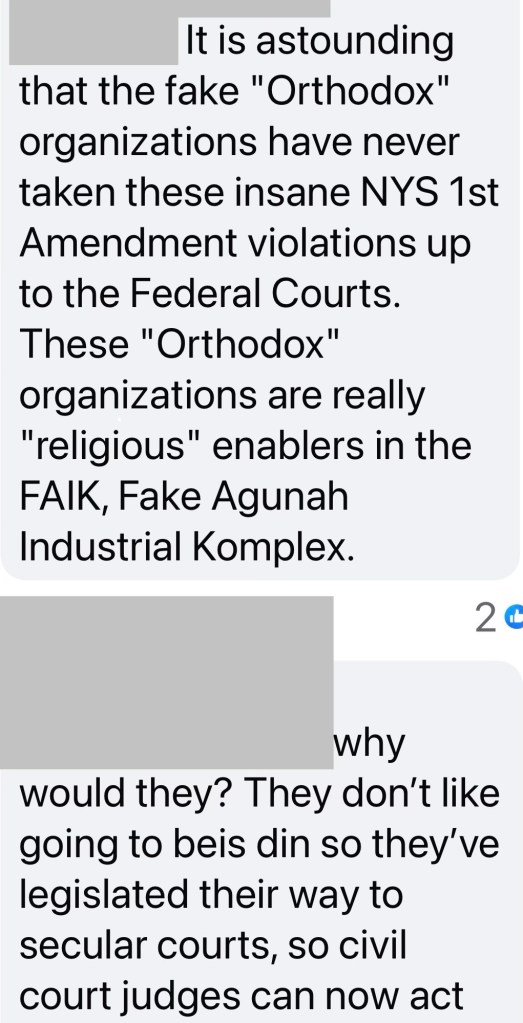
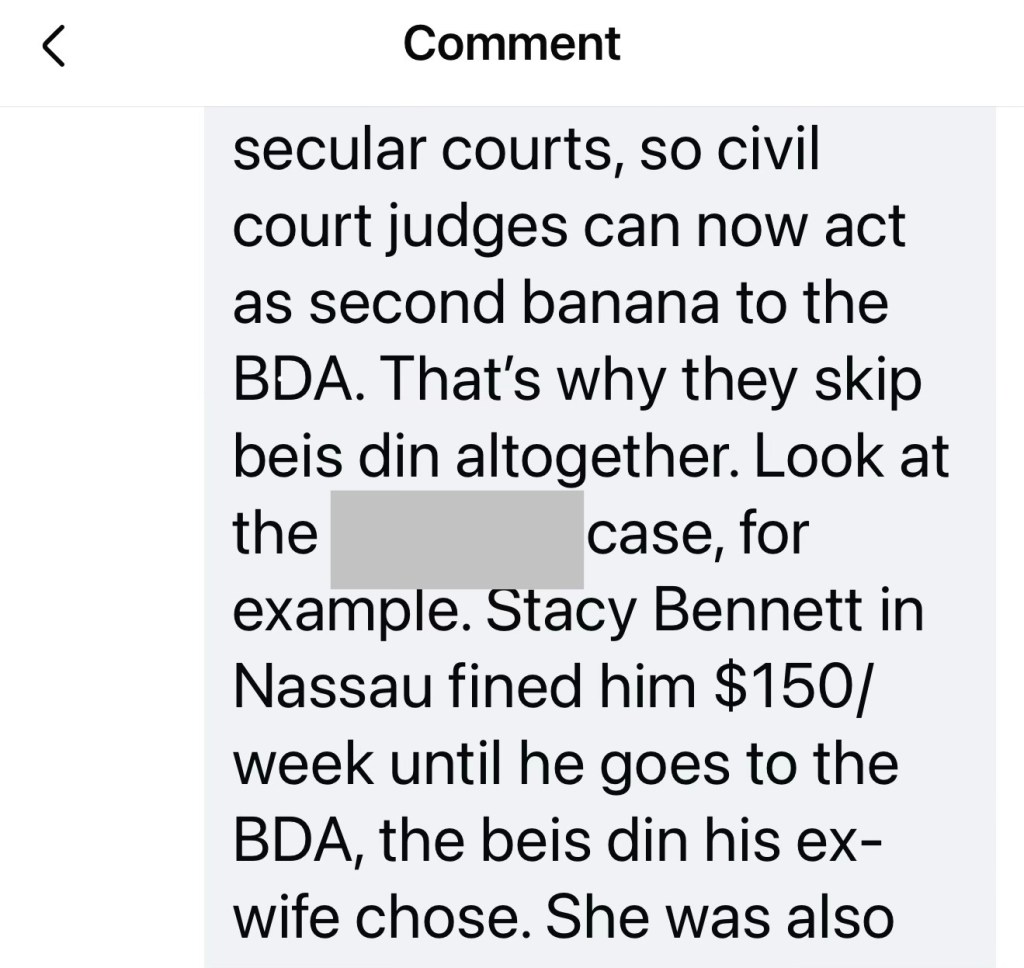
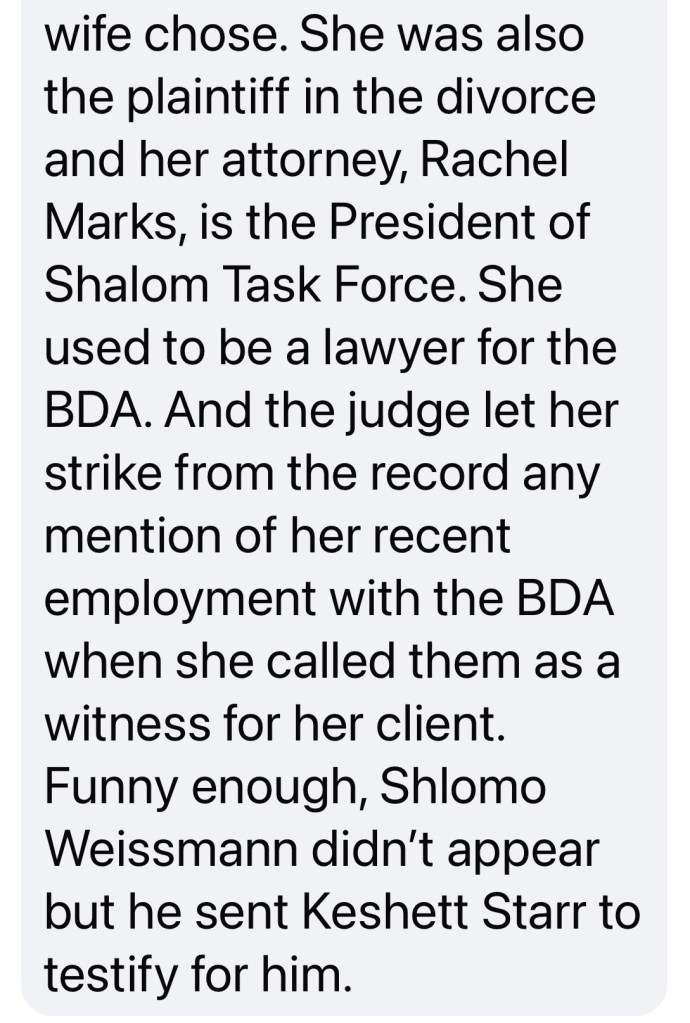

This is a vital question highlighted by a comment posted today.
To help make this highly clear without cutting out any of the vital nuance or detail, let’s break the commenter’s argument down into its core components: The Pattern, The Systemic Breakdown, The Problem with the Boundaries, and The Final Conclusion.
1. The Core Argument: A Deeper Pattern
The commenter’s point is that we cannot look at a single Gett case as just one isolated, bad court decision. It is a much larger, structural issue.
While New York civil law does give judges certain tools to address barriers to remarriage, the commenter argues that the Beth Din of America (BDA) must remain a completely separate, neutral religious forum.
The core of the accusation is a conflict of interest:
- The Cooperation: The BDA is allegedly cooperating with civil litigation in a way that helps put pressure on one party.
- The Pivot: Later on, that same BDA presents itself as the independent religious authority in the exact same dispute.
If a religious tribunal participates in or benefits from a civil pressure strategy, it undermines its claim to be an unbiased, neutral forum.
2. The Systemic Breakdown: Compromised at Every Level
If this characterization is accurate, it means the entire dispute resolution process is compromised simultaneously at three distinct levels:
- The Civil Court Level: The civil court may be using the power of the state to steer a citizen toward a specific religious tribunal. This raises serious questions about basic fairness and potentially violates Constitutional boundaries regarding the separation of church and state.
- The BDA Level: If the BDA is deeply intertwined with the civil litigation process—whether through shared lawyers, witnesses, or outside advocacy groups—its claim to structural neutrality is severely weakened.
- The Religious Ruling Level: If the BDA goes on to issue a seruv (a religious decree of non-compliance/contempt) after being part of this pressure campaign, critics have a strong case. They can argue the seruv isn’t an independent, holy judgment at all, but rather just another gear in the same legal pressure machine.
3. The Boundary Problem: Why This Matters
Both the secular and religious legal systems rely on clear, rigid boundaries to maintain their integrity. When those boundaries blur, the system breaks down.
When these boundaries are ignored, a single, interconnected network forms—one that includes the secular judge, the civil lawyers, the advocacy groups, and the religious tribunal. Once that happens, it triggers three massive problems:
- Fairness: Can a participant truly get a fair hearing when the referee is aligned with the other side’s civil legal team?
- Transparency: Was there full disclosure regarding how closely these groups were working together behind the scenes?
- Reliability: Can the community actually trust the resulting get (religious divorce) or seruv if it was produced by a compromised machine?
4. The Conclusion: The Structural Threat
Ultimately, the commenter’s criticism is far more serious than just saying, “The BDA talked to a civil court.”
The real danger is that if a beis din becomes part of a system that leverages state power to force religious compliance, it ceases to function as a true, neutral religious court. That is why the commenter views this as a profound crisis. It isn’t a minor administrative misstep; it is an existential threat to conflict-of-interest standards, systemic transparency, the religious validity of the rulings, and the community’s trust in the entire institution.
Written with the help of AI.
 Writing by Dr. Dannielle Blumenthal
You must be logged in to post a comment.