Was The New York Times so eager to promote Hamas propaganda laundered through the respected Nick Kristof that it ignored its own reputational guardrails? See below.
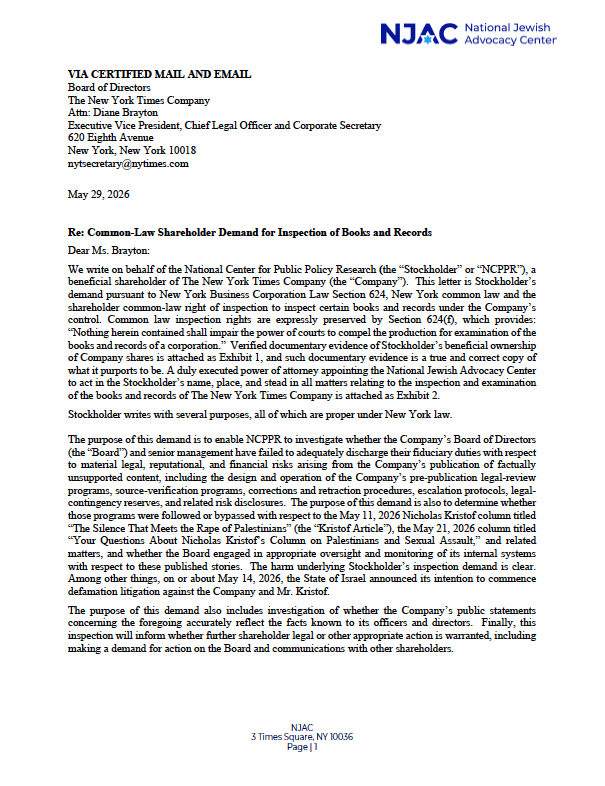
This is a formal legal letter sent by the National Jewish Advocacy Center (NJAC) on behalf of the National Center for Public Policy Research (NCPPR), a shareholder of The New York Times Company.
The letter is dated May 29, 2026, and is addressed via certified mail and email to Diane Brayton (Executive Vice President, Chief Legal Officer, and Corporate Secretary) and the Board of Directors of The New York Times Company.
It is a formal Common-Law Shareholder Demand for Inspection of Books and Records pursuant to New York Business Corporation Law Section 624 and New York common law.
The Stockholder (NCPPR) is demanding to inspect the company’s internal books and records to investigate whether the Board of Directors and senior management failed to fulfill their fiduciary duties regarding material legal, reputational, and financial risks.
The demand stems from the publication of an opinion column by Nicholas Kristof and a subsequent follow-up piece. The document outlines the timeline and specific allegations surrounding these publications:
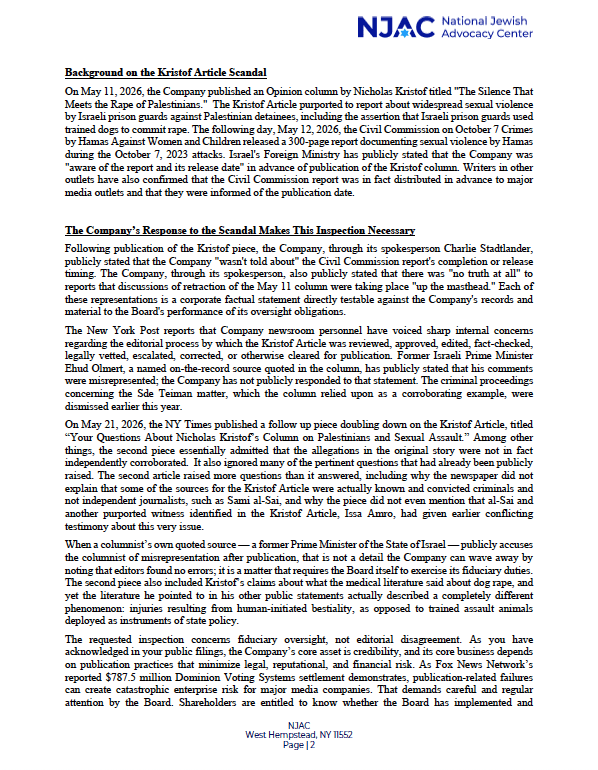
- May 11, 2026 Article: The company published an opinion column by Nicholas Kristof titled “The Silence That Meets the Rape of Palestinians.” The column reported on alleged widespread sexual violence by Israeli prison guards against Palestinian detainees, including an assertion that guards used trained dogs to commit rape.
- May 12, 2026 Counter-Report: The following day, the Civil Commission on October 7 Crimes by Hamas Against Women and Children released a 300-page report documenting sexual violence by Hamas during the October 7, 2023 attacks. The letter notes that Israel’s Foreign Ministry and other media outlets stated that The New York Times Company was aware of this upcoming report and its release date before publishing the Kristof column.
- May 21, 2026 Follow-up Piece: The Times published a follow-up piece titled “Your Questions About Nicholas Kristof’s Column on Palestinians and Sexual Assault.” This second article essentially admitted the original allegations were not independently corroborated, ignored pertinent public questions, failed to explain that some sources were convicted criminals rather than independent journalists (naming Sami al-Sai), and failed to mention conflicting prior testimony from another purported witness (Issa Amro).
- The Medical Literature Discrepancy: The letter states that the medical literature Kristof pointed to in public statements to support his dog-rape claims actually described an entirely different phenomenon: “injuries resulting from human-initiated bestiality, as opposed to trained assault animals deployed as instruments of state policy.”
- Source Misrepresentation: Former Israeli Prime Minister Ehud Olmert, a named source quoted in the column, publicly stated that his comments were misrepresented.
- The letter accuses the company’s spokesperson, Charlie Stadtlander, of making public statements that contradict records, which the inspection aims to test. Specifically:
a. Stadtlander publicly stated the company “wasn’t told about” the Civil Commission report’s completion or release timing.
b. Stadtlander stated there was “no truth at all” to reports that discussions regarding the retraction of the May 11 column were taking place “up the masthead.”
The NJAC argues that this situation poses major corporate and financial risks that require Board oversight rather than being dismissed as an “editorial disagreement”:
- On or about May 14, 2026, the State of Israel announced its intention to commence defamation litigation against the Company and Mr. Kristof.
- Financial Precedent: The letter references Fox News Network’s $787.5 million Dominion Voting Systems settlement as proof that publication-related failures can create “catastrophic enterprise risk” for major media companies.
The stockholder wants to determine if internal pre-publication legal reviews, source-verification programs, correction/retraction procedures, and escalation protocols were followed or bypassed, and whether the company’s public statements accurately reflect the facts known to its officers.
Comments:
“Dear The New York Times:
On behalf of shareholders we are demanding the records. Not to debate your politics. To see whether the Board did its job while the company’s credibility, reputation, and exposure were put at risk.
You told the public there was nothing to see.
Let’s find out.” – Mark Goldfeder, Director, National Jewish Advocacy Center
https://x.com/markgoldfeder/status/2060443802674823519?s=46
“This is quite a development in the Nicholas Kristof scandal [the blood libel dog rape accusations against the Israel Defense Forces]. Not a defamation suit, but a shareholder demand for records related to board oversight regarding reputational damage to the paper for poor reporting. Any lawyers care to weigh in on NY BCL 624 path instead of Delaware 220?” – David Zweig
https://x.com/davidzweig/status/2060468765351895161?s=46
“The public outcry continues. We’re not letting the ‘paper of record’ get away with this!” – Tali Goldsheft
https://x.com/taligoldsheft/status/2060500750510280907?s=46
 Writing by Dr. Dannielle Blumenthal
You must be logged in to post a comment.