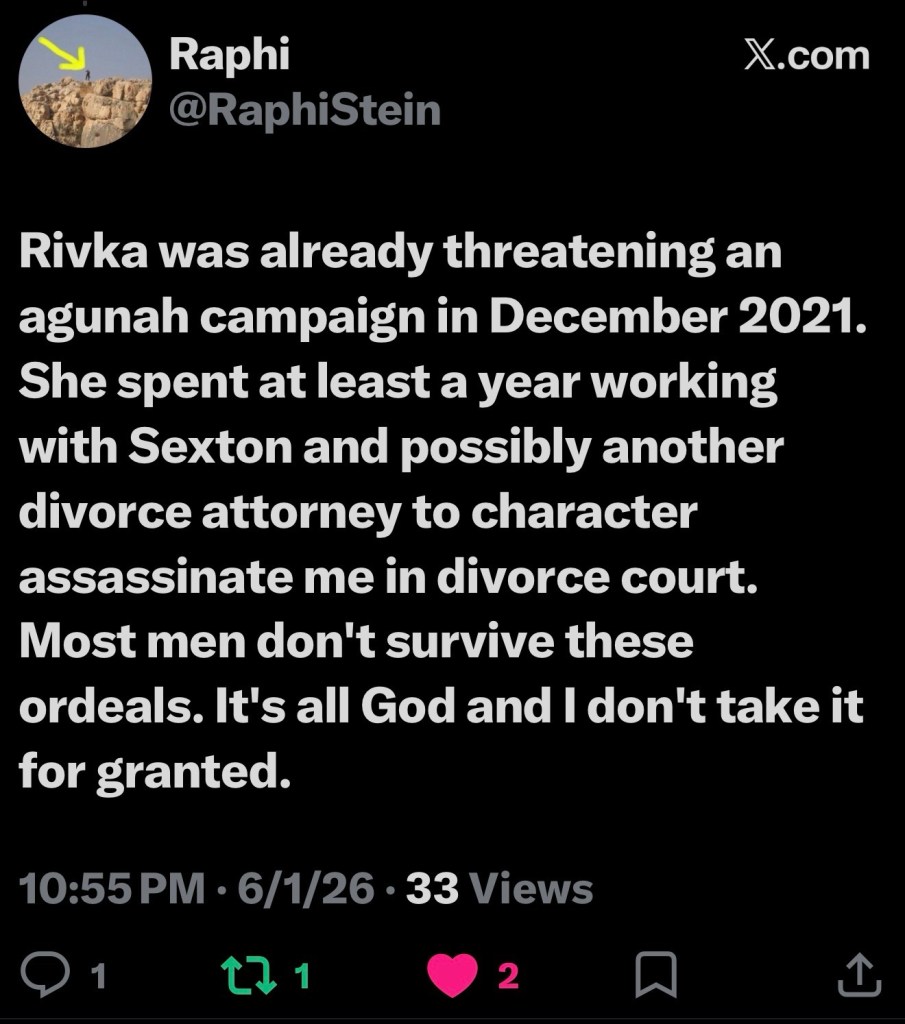
A June 1, 2026 statement by Raphi Stein introduces a crucial development that strongly supports the theory that this entire conflict was engineered from the very beginning, potentially orchestrated by or in coordination with family leadership like the mother-in-law.
On the social media platform X, Stein reveals that Rivka was already threatening an agunah campaign and working with divorce attorneys as early as December 2021—and potentially an entire year prior—to systematically character assassinate him in court. He states:
“Rivka was already threatening an agunah campaign in December 2021. She spent at least a year working with Sexton and possibly another divorce attorney to character assassinate me in divorce court. Most men don’t survive these ordeals. It’s all God and I don’t take it for granted.”
This timeline directly challenges the narrative of a spontaneous matrimonial dispute, pointing instead to a highly calculated, multi-year campaign planned long before the public ever heard the name “Free Adeena.”
Why This Does Not Look Like A Standard Gett Case
At first glance, this might sound like a familiar story: a bitter divorce, a public “Free Adeena” campaign, and a husband labeled a “Gett refuser.” But Raphi Stein’s timeline adds something harder to dismiss.
He says Rivka Kohn met with an agunah lawyer long before the label made ordinary sense, and he treats that meeting as the starting point of a broader plan to shape the divorce narrative in advance.
That timing is the key. If the label was being assembled before there was a clear basis for it, then the case is not just about disagreement in a marriage.
It raises the possibility that the public story was being built first, with the divorce case later made to fit that story.
Why The Time Anchor Matters
The reason the early meetings matter is not that it proves everything by itself.
It matters because it gives the later events a frame.
A timeline can show premeditation, and premeditation matters when the issue is whether someone was trying to set up a husband as a “Gett refuser” before that label was actually justified.
That is a different claim from “the divorce got ugly.”
It suggests an intentional strategy: prepare the narrative early, use it repeatedly, and then keep it alive until it becomes socially and legally powerful.
If that is what happened, the legal questions become much broader than a standard matrimonial dispute.
The Later Harassment Is The Real-World Harm
The part that most strongly moves this beyond ordinary divorce drama is the later harassment.
The harassment by Adina Sash, popularly known as FlatbushGirl, is real.
Clearly, if Rivka Kohn provoked, facilitated, or encouraged it, the harassment is part of the an extensive, all-encompassing, systematic, toxic, years-long war designed to build and harden an abuse narrative to the detriment of the defendant in the case.
The repeated attacks, public shaming, coordinated pressure, and threats to Raphi Stein and his associates open the door for New York laws that treat these as more than protected speech.
Harassment in the second degree covers repeated conduct intended to alarm, annoy, or harass and serving no legitimate purpose.
Stalking law applies to a course of conduct directed at a specific person that is likely to cause fear or threaten safety, livelihood, or emotional security.
Why The Agunah Theory Matters
More and more, it is looking like Adina Sash / FlatbushGirl functioned as a de facto agent of Rivka Kohn, even though the relationship has been described by Sash as pro bono in public.
If a public activist account was used to repeat, amplify, or launder a private family narrative, that suggests coordination rather than independent commentary.
If the campaign was coordinated behind the scenes by Rivka Kohn, then the person behind the curtain may be responsible not only for private conversations but for the foreseeable public consequences of using a proxy.
That opens the door to defamation theories, tortious interference, and potentially a showing of concerted action if evidence supports it.
The Civil Harm If True
Stein is currently the defendant in a civil divorce case that includes custody issues and so his public statements are highly restricted.
However, the “Gett refuser” and associated defamation against him already establish that the civil harm is serious and extensive.
Legally, defamation becomes relevant if false factual claims were published to third parties and caused reputational or economic damage.
Tortious interference becomes an issue if the campaign was used to damage employment, housing, or other economic relationships.
Intentional infliction of emotional distress may also come into play if the conduct was extreme, outrageous, intentional or reckless, and caused severe emotional distress. Certainly any death threat issued, if it occurred, would fall into that category.
The point is not that every ugly divorce creates liability.
The point is that a campaign designed to brand someone a religious wrongdoer, keep the stigma alive for years, and use that stigma as leverage can create concrete legal harm if the facts are substantiated.
The Criminal Harm If True
If the conduct included repeated unwanted contact, threatening messages, or conduct meant to alarm or intimidate, then New York criminal law may also be implicated.
Harassment and stalking statutes are not limited to physical assault; they can cover repeated, directed conduct intended to frighten or harass.
That matters because the public may see the case as only a family-law story, when in fact the alleged pattern can support police reports or protective-order requests if the behavior crosses the legal threshold.
The existence of a social-media campaign does not make the conduct immune from criminal review if the conduct itself satisfies the statute.
Why Custody Is Central
This is also a custody case in substance, even if it is being narrated as a religious dispute.
If the purpose of the campaign was to remove Stein from his children, signal Rivka Kohn’s ultimate control to Adeena Kohn through financial or psychological pressure, and/or create a toxic environment that portrays Stein as the problem, then New York family court will care quite a bit.
Under Domestic Relations Law Section 240 and Section 70, custody turns on the child’s best interests, and there is no prima facie right to custody in either parent.
If the court concludes that one side has used public harassment or third-party proxies to alienate the father and poison the children’s environment, that can affect custody, visitation, communication rules, and the court’s view of parental judgment.
A judge does not have to accept the public narrative at face value; the judge can look at the pattern, the timing, and the consequences.
What This Means For Beis Din
The Beis Din issue is equally important. From the standpoint of winning the civil court case, which includes custody, a neutral Beis Din which considers all issues — as suggested by Stein —is not wanted.
Just as in the Lonna Kin case, in which James Sexton was also the attorney, the husband is a willing participant who acts to resolve the end of the marriage in Beis Din.
However, for the wife to win satisfaction, this cannot happen, for the goal is not resolution but preservation of the “Gett refuser” image. Lonna Kin had her Gett in 2008, but didn’t even bother to call the Beis Din for seven years.
In the case of Stein, public stigma is part of the strategy, designed to drive him out of town and back to Montreal where he will functionally have no access to his children.
Any neutral Beis Din that would examine the claims carefully and compare the allegations to the timeline becomes a threat to the campaign. And that is why Adeena Kohn’s refusal to proceed jointly before a neutral Beis Din — I suspect, controlled by mother Rivka Kohn — can matter.
If one side prefers public pressure, social-media signaling, and proxy amplification over neutral adjudication, the inference is not necessarily guilt on every point.
It does raise a serious question about whether the religious process is being used for truth-seeking or for leverage.
Taking Action
A victim of an orchestrated campaign such as described above would typically need to do the following:
1) Preserve evidence showing Rivka Kohn’s alleged early meetings with legal counsel in which an Agunah/Gett refused strategy was potentially/allegedly contemplated and/or planned. (The October 2020 meeting is already public record.)
2) Preserve the entire harassment record from FlatbushGirl, including screenshots, links, timestamps, and witnesses. This is necessary regardless of the “obvious” and well-saturated public facing nature of her campaign. Public posts can abruptly become inaccessible.
3) Build a clean chronology showing the time gap between the alleged early planning and the later public campaign.
4) Document specific harms: employment, housing, school interference, emotional distress, and the effect on the children.
5) Bring the timeline to family court as a best-interests issue.
6) Bring the timeline to a neutral Beis Din as a credibility and good-faith issue.
7) Consult counsel about defamation, harassment, stalking, tortious interference, and emotional distress remedies.
8) Seek protective relief if there are threats, stalking, or repeated unwanted contact.
Bottom Line
What makes this case different from a standard “Gett refuser” case is the combination of an early timeline anchor, a later harassment record, and the allegation that a public activist account was functioning as a proxy in a longer campaign to preserve the image of Raphi Stein as a “Gett refuser” and cut him off from his children.
If the evidence supports that line of thinking, then the legal and religious implications are substantial.
The case could involve landmark civil liability, criminal review, custody consequences, and serious questions before Beis Din.
Broader Legal Implications and Class Action Potential
The pattern described in this case carries profound legal implications for other fathers who have been targeted by similarly engineered, extrajudicial campaigns.
When public shaming, digital mobs, and weaponized religious labels are deployed as a standard playbook rather than a last resort, it sets a dangerous precedent that subverts due process in both civil and family courts.
For targeted fathers, a substantiated history of pre-planned narrative building can serve as vital ammunition to shift the legal burden, proving parental alienation in custody disputes and exposing aggressive actors to significant civil liability.
Furthermore, if it can be established that a specific attorney or legal operation has systematically weaponized this exact pattern of public harassment, social media intimidation, and proxy campaigns across multiple cases, the scope shifts from individual matrimonial disputes to systemic misconduct.
This opens up the distinct potential for a class-action lawsuit on behalf of all fathers and victims subjected to this coordinated human harassment.
Bringing these victims together under a unified civil action would allow them to target the architects of these campaigns, seeking systemic damages for emotional distress, reputational ruin, and tortious interference on a grander scale.
Disclaimer:
This analysis is based on publicly available information and statements. The author is not a lawyer. Importantly, the post does not allege or establish wrongdoing by Rivka Kohn, Adeena Kohn, Adina Sash / FlatbushGirl, any lawyer, James Sexton, Lonna Kin, or any other person. All statements about intent, orchestration, agency, coercion, or manipulation remain allegations unless supported by admissible evidence or a court or Beis Din finding.
 Writing by Dr. Dannielle Blumenthal
You must be logged in to post a comment.