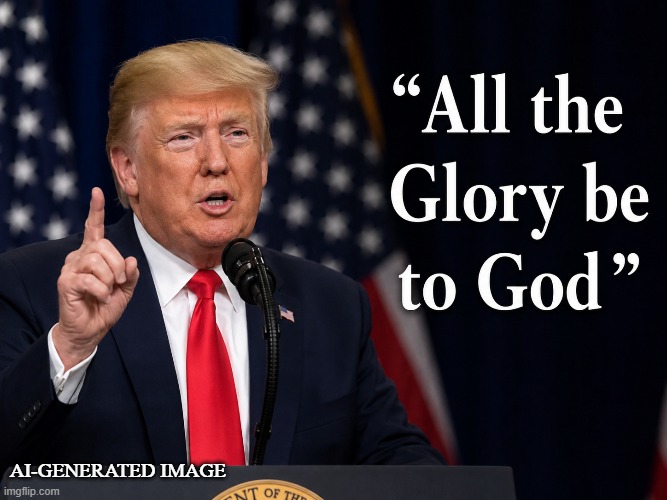
During President Trump’s participation in the June 2026 G7 Summit—which resulted in a U.S.-Iran Memorandum of Understanding that ended the Iran War and reopened the Strait of Hormuz, albeit temporarily as of this writing—a critical leadership misstep revealed fundamental tensions between personal authority and institutional effectiveness. This analysis examines how exceptional transactional leadership can be undermined by theological overreach, drawing on biblical precedents, documented statements, and sociopsychological patterns to identify pathways for sustainable executive excellence.
Hyper-Confident Leadership and Its Adaptive Function
Effective leadership often requires traits that exist on a spectrum with pathological narcissism. Research in organizational psychology demonstrates that many successful executives exhibit what clinicians term “grandiose narcissistic traits”—elevated self-regard, intense confidence in personal capabilities, and belief in one’s exceptional importance. These characteristics frequently serve highly adaptive functions in high-stakes environments.
The Value of Charismatic Authority Under Pressure
- Decision-Making Under Pressure: Supreme self-assurance enables rapid decision-making when others hesitate.
- Risk Tolerance: An elevated self-perception supports taking calculated risks that more modest leaders avoid.
- Charismatic Influence: Exceptional self-regard often translates into compelling public presence and stakeholder confidence.
- Resilience: Ego-driven leaders typically demonstrate remarkable recovery from setbacks and criticism.
Historical Examples of Adaptive Ego
- Steve Jobs exemplified this pattern—his absolute belief in Apple’s revolutionary potential and his own indispensability drove unprecedented innovation. His famous declaration that “we’re here to put a dent in the universe” reflected a hyper-confident mindset that proved strategically effective for decades (Apple Worldwide Developers Conference, 1981).
- Similarly, Winston Churchill’s profound self-perception as Britain’s destined wartime leader enabled him to maintain resolve during the darkest periods of World War II when more modest leaders might have capitulated (Address to the House of Commons, May 13, 1940).
When High Self-Regard Becomes Maladaptive
The same bold traits that enable exceptional leadership effectiveness can become self-limiting when they cross functional thresholds. Organizational psychology identifies specific inflection points where supreme confidence transitions into an institutional liability.
Critical Threshold Indicators
- Reality Distortion: When self-perception becomes disconnected from objective feedback.
- Omnipotence Fantasy: The belief that personal will can control outcomes far beyond reasonable influence.
- Entitlement Escalation: An expectation of deference that exceeds appropriate executive authority.
- Criticism Intolerance: An inability to process legitimate feedback or institutional constraints.
The Trump Case Study: Charismatic Authority in Action
Trump’s presidency demonstrates both the functional value and eventual limitations of an ego-driven leadership style. His exceptional transactional effectiveness stemmed directly from characteristics that exist on the narcissistic spectrum.
Adaptive Phase: Hyper-Confidence as a Strategic Asset
Trump’s early leadership philosophy reflected a supreme self-reliance that proved strategically effective. His 1990 Playboy interview revealed deep self-sufficiency: “I don’t believe in reincarnation, heaven or hell—but we go someplace.” (Interview with Playboy Magazine, March 1990). This raw self-assurance enabled him to tackle challenges that intimidated other leaders.
During the 2015-2016 primary cycle, he reinforced this worldview to CNN’s Anderson Cooper: “I don’t believe you’re just going to go to heaven because you’re a good person. You have to do good works.” (CNN Republican Presidential Town Hall, February 18, 2016).
Strategic Effectiveness of the Trump Formula
- Economic Transformation: Bold self-assurance enabled him to challenge established trade relationships others considered untouchable.
- Judicial Legacy: Absolute belief in his exceptional judgment drove a systematic transformation of the federal courts.
- Diplomatic Innovation: Exceptional self-regard supported breakthrough negotiations like the Abraham Accords that conventional diplomats deemed impossible.
- Crisis Resolution: Supreme confidence in his negotiation abilities directly enabled the recent June 2026 Middle East peace breakthrough.
The Escalation Pattern: From Strategic Asset to Messianic Framing
The critical shift occurs when statements cross the boundary from standard expressions of personal faith, survival, or self-confidence into claims of absolute, exclusive, or divine entitlement over geopolitical realities.
Theological Overreach Escalation
- 2019 Social Media: Publicly embraced being called “like the second coming of God” and “the King of Israel,” responding by declaring himself “the best president for Israel in the history of the world.” (Statements via @realDonaldTrump on Twitter, August 21, 2019). This represented a clear entitlement escalation by elevating personal political status to a divine parallel.
- September 19, 2024: “With your vote, I will be your defender, your protector… Israel would be wiped off the face of the Earth” without him. (Address to the “Fighting Antisemitism in America” Event, Washington D.C., September 19, 2024). Here, the framing extends beyond standard political rhetoric into an omnipotence fantasy, making a foreign nation’s entire existential survival dependent solely on his individual person.
- February 5, 2026: “I’m never going to make it to heaven. I just don’t think I qualify… But all of these good things I’m doing, including for religion. You know, religion is back now hotter than ever before.” (Address at the National Prayer Breakfast at the U.S. Capitol, Washington D.C., February 5, 2026). This positions a theological reality as something subject to transactional negotiation and personal ledger-balancing, mirroring an inflation of personal merit.
Historical Parallels: The Grandiosity-Collapse Pattern
- Howard Hughes: Hughes demonstrated exceptional business acumen driven by a towering ego, achieving remarkable success in aviation, film, and technology. However, his psychological traits eventually escalated beyond healthy boundaries, leading to paranoid isolation and institutional collapse when his omnipotence fantasies became entirely disconnected from operational reality.
- Napoleon Bonaparte: Napoleon’s historic self-perception enabled unprecedented military and administrative achievements across Europe. His effectiveness peaked when his profound confidence remained tethered to strategic reality. His decline began when self-assurance escalated to sovereign overreach—believing his personal will could control variables beyond reasonable military capability, culminating in the disastrous Russian campaign.
Clinical research identifies predictable patterns when an executive’s self-regard exceeds functional thresholds. The same psychological mechanisms that enable exceptional performance can trigger intense institutional limitations when they become pathologically inflated.
- Inflation: Success reinforces belief in personal omnipotence.
- Deterioration: Feedback mechanisms are compromised by entitlement expectations.
- Fantasy: Belief that personal will can bypass systemic realities.
- Resistance: External systems respond with corrective pressure against overreach.
- Injury: Resistance triggers defensive escalation rather than strategic adjustment.
Relevant Biblical Examples
Scripture demonstrates a sophisticated understanding of highly confident leadership patterns, providing examples of both productive self-assurance and warnings about pathological escalation.
- King David exhibited an intense confidence that proved strategically effective—his willingness to face Goliath reflected a powerful self-regard that enabled exceptional achievement. However, David maintained crucial boundaries that prevented a slide into sovereign overreach. When offered the opportunity to build the Temple, David accepted a humbling limitation: “Thou shalt not build an house for my name, because thou hast shed much blood upon the earth in my sight.” (1 Chronicles 22:8) This demonstrated a bold persona operating productively within institutional boundaries.
- Moses demonstrated how vast authority can operate effectively within appropriate boundaries. Despite achieving unprecedented leadership success, Moses maintained a systemic humility that prevented a pathological breakdown. When initially called to lead, his response demonstrated a bold posture tempered by an understanding of his limitations: “Who am I, that I should go unto Pharaoh, and that I should bring forth the children of Israel out of Egypt?” (Exodus 3:11) And yet, even Moses stumbled, striking the rock to bring forth water instead of speaking to it as God told him to (Number 20:11).
- Nebuchadnezzar, the Babylonian king, achieved remarkable administrative success through sheer force of personality, but crossed into dangerous territory when he claimed ultimate, exclusive attribution for his empire. Looking over his kingdom, he declared: “Is not this great Babylon, that I have built for the house of the kingdom by the might of my power, and for the honour of my majesty?” (Daniel 4:30) The immediate institutional consequence: “While the word was in the king’s mouth, there fell a voice from heaven, saying, O king Nebuchadnezzar, to thee it is spoken; The kingdom is departed from thee.” (Daniel 4:31)
- King Herod’s acceptance of explicit personal deification triggered an immediate, severe systemic correction: “And the people gave a shout, saying, It is the voice of a god, and not of a man. And immediately the angel of the Lord smote him, because he gave not God the glory.” (Acts 12:21-23)
Theological Overreach at the G7 Summit
We saw a pivotal moment occurr when President Trump’s leadership traits escalated past functional boundaries at the June 2026 G7 Summit. Following legitimate, historic diplomatic success, his public statement represented a clear manifestation of sovereign overreach:
“Without us, without the United States, there would be no Israel. Without me, there would be no Israel, because no other president was willing to do what I did.”
(Bilateral Meeting with Qatar at the G7 Summit, Evian-les-Bains, France, June 16, 2026).
Unlike standard expressions of national pride or personal achievement, this statement exhibits a distinct shift toward an omnipotence fantasy. It explicitly claims exclusive, solitary control over complex macro-political outcomes, demanding a level of personal attribution that completely eclipses the vast collaborative efforts of the state, allies, and institutional frameworks.
A Rabbinic Prediction
The operational ceiling created by this escalation was accurately predicted by institutional analysts who understood this sociopsychological pattern. HaRav Moshe Shternbuch’s February 18, 2025 assessment demonstrated a sophisticated recognition of these leadership limitations:
“Our yeshuah [salvation] won’t come from President Trump… Today there are many people relying on the new President in America—he will help us, they say. But you should know—these people are delaying the arrival of Moshiach.”
(Rabbinical Address, Jerusalem, February 18, 2025).
This represented a prescient analysis of how executives fail when their sense of self-importance exceeds appropriate boundaries.
A Blueprint for Teshuvah (Repentance/Return to Normalcy)
The path forward does not require eliminating Trump’s hyper-confident traits—which have proven strategically invaluable to the nation—but rather restoring them to a functional framework where they enhance rather than limit institutional effectiveness.
- Attribution & Credit Recalibration: The executive must transition away from an omnipotence fantasy where outcomes are framed as entirely driven by personal will (“Without me, there would be no…”). The solution is publicly reframing exceptional negotiation skills as a stewardship of national power and collaborative statecraft rather than personal omnipotence. This mirrors the King David model, recognizing personal limits within a grander historical and institutional timeline.
- Preserving Reality Testing: To prevent reality distortion, where collaborative variables and systemic constraints are rejected, the executive must actively protect internal feedback mechanisms. This requires surrounding oneself with independent truth-tellers who are empowered to challenge narrative inflation. This aligns with the Churchill model, harnessing massive personal charisma while remaining tightly bound to systemic and institutional realities.
- Building Sustainable Frameworks: To avoid the indispensability trap—where the narrative focuses entirely on individual presence, leaving the system vulnerable upon departure—the drive for a historic legacy must be redirected. The executive should focus on building lasting institutional capabilities, robust policy structures, and successor pipelines. This reflects the recovery of King Nebuchadnezzar, restoring long-term executive authority by explicitly recognizing and respecting the boundaries of supreme power (Daniel 4:37).
Conclusion
Donald Trump’s hyper-confident leadership style has enabled exceptional achievements. The challenge he faces is a classic one: maintaining the immense strategic benefits of a powerful persona while preventing a slide into messianic overreach.
The choice is not between bold confidence and institutional humility, but between pathological escalation and sustainable, charismatic authority.
By channeling his exceptional self-regard away from personal indispensability and toward robust institutional systems, President Trump can transform a potential executive tragedy into a lasting, sustainable legacy.
(Personal time, device, premises, opinion)
 Writing by Dr. Dannielle Blumenthal
You must be logged in to post a comment.