
Introduction
Jews, as human beings created in the image of God, have the right to exist as a free and non-persecuted people. They have equal rights to other human beings, including that of national self-determination. The land of the Jewish nation — religiously, historically, legally, culturally — is the Land of Israel, currently embodied in its modern politically named incarnation, the State of Israel.
From a Biblical perspective this “right” is actually a commandment to settle the land and to keep it from occupation by foreign parties.
A Biblical mandate
Within Jewish tradition, the obligation to settle the Land of Israel—known as Yishuv Eretz Yisrael—is considered a profound, binding commandment. This perspective is fundamentally rooted in the biblical injunction found in Numbers 33:53: “You shall possess the Land and dwell in it, for to you have I given the Land to possess it”.
Core Components of the Commandment
Rabbinic authorities, most notably the Ramban (Nachmanides), interpret this verse as containing two distinct, essential obligations:
National Sovereignty: The instruction to “possess the Land” is understood as a collective duty for the Jewish people to establish and maintain governance over the territory, ensuring it is not left under the dominion of other nations.
Individual Settlement: The directive to “dwell in it” is viewed as an active, positive commandment for individual Jews to reside in the land, cultivating and building it up so it does not remain desolate.
Sovereignty and the Prevention of Foreign Control
The traditional understanding of this commandment also carries significant weight regarding the status of the land under foreign rule. While there is no single, monolithic “anti-occupation” verse, the prohibition against foreign control is derived from these classical interpretations of divine law:
The State of “Desolation”: Sages have historically interpreted the presence of foreign rule as a state of “ruin” for the land. Within this framework, even if Jewish residents are present, the land is considered in a state of desolation as long as it is governed by other nations.
Divine Governance: Biblical passages such as Joel 3:2 warn against nations that have divided the land, while Zechariah 12:3 reflects on the unique, often difficult relationship between the nations of the world and the sovereignty of Jerusalem. These texts are frequently cited to reinforce the spiritual necessity of Jewish self-determination within the Land of Israel.
So then what of “Free Palestine”?
Clearly, then, from a Biblical perspective, “Free Palestine” is not a neutral slogan.
It is also not neutral in the secular world. Today, in the rhetorical environment where it is most loudly invoked, “Free Palestine” often sits inside a framework of anti-Jewish hostility, rejection of Israel’s legitimacy, and open eliminationist aspiration. I am not saying every person who says it means that. I am saying the slogan repeatedly functions as cover for that politics. (ADL, 2026; Britannica, 2026; PA-X, 1993)
That is the point that gets buried whenever mass reporting and public pressure are used to silence criticism. The facts do not disappear because a platform decides the claim is too uncomfortable. The record is there: in charters, in speeches, in slogans, in historical violence, and in the way the phrase itself is often deployed. (Avalon Project, 1988; Jewish Virtual Library, 1964; HRW, 2024)
A slogan with two faces
“Free Palestine” sounds like a rights claim. In some settings, it is. Some people use it to mean an end to occupation, a negotiated settlement, or a Palestinian state alongside Israel. But the phrase also travels easily into much darker political terrain. It can be used as a moral wrapper for anti-Israel delegitimization, denial of Jewish self-determination, and in the most extreme cases, support for violence against Jews. (ADL, 2026; Britannica, 2026; Combat Antisemitism Movement, 2024)
Accordingly, “‘From the river to the sea’ is not a neutral call for freedom; in practice, it has often been used as a slogan for eliminating Israel rather than for peaceful coexistence.” (ADL, 2022; Combat Antisemitism Movement, 2024)
That ambiguity is not incidental. It is what makes the slogan so useful. A phrase can sound humanitarian while carrying a rejectionist program underneath it. That is why the slogan is so often defended as innocent by people who refuse to confront the context in which it is used. (ADL, 2026; JNS, 2024)
What the record says
If you want to understand why I read the slogan this way, start with the voices of Palestinian and Arab leaders themselves, who would never recognize the right of such an entity to operate independently of the Muslim/Arab collective community.
Example 1: Zuheir Mohsen, a senior PLO figure, said in a 1977 interview that the Palestinian people “does not exist” and that the idea was used for “political and tactical reasons” to oppose Zionism. That is not my characterization. That is his. (AP Archive, 1977/2015; Wikiquote, 2024)
Example 2: Awni Abd al-Hadi, associated with the Arab Higher Committee, said there was “no such country” as Palestine and described the land as historically part of Syria. Ahmad Shukeiri made similar claims, dismissing Palestine as southern Syria rather than a distinct national project. Those statements matter because they show that some of the political language around Palestinian identity was explicitly tactical, not timeless or self-evident. (All 4 Palestine, n.d.; Inbari, 2017)
Example 3: Fathi Hammad, a Hamas official, later said Palestinians were “half Egyptians” and “half Saudis.”
Again, that does not prove Palestinian identity is fictitious. It does show how identity has been narrated instrumentally by some of its own leaders. (Hammad, 2012)
The eliminationist strand
The eliminationist core is not hidden if you read the charters.
Example 1: Hamas’s 1988 Covenant says Israel “will exist and will continue to exist until Islam will obliterate it.” It cites a hadith about Muslims fighting and killing Jews until the Day of Judgment. It also rejects peaceful solutions and international conferences as “waste of time and vain endeavors.” That is not ambiguous. It is explicitly eliminationist. (Avalon Project, 1988)
Example 2: The original PLO Charter of 1964 is different in tone but not in direction. It called the establishment of Israel illegal and false and treated Zionism as a colonial and fascist movement to be outlawed.
Later Palestinian diplomacy moved in a different direction, but the original charter still matters because it shows how deeply rejection of Israel was embedded in foundational political language. (Jewish Virtual Library, 1964; PA-X, 1993; Britannica, 2026)
The rhetoric of violence
The record is full of slogans and statements that normalize anti-Jewish violence.
Example 1: During the Nabi Musa riots in 1920, the cry “Slaughter the Jews!” was reported in Jerusalem.
Example 2: In the 1939 Arab revolt, the slogan “The English to the sea and the Jews to the grave!” circulated.
Example 3: In 1948, Arab League secretary-general Azzam Pasha’s language about a “war of extermination” became one of the most famous examples of eliminationist rhetoric in the conflict. (Fondapol, 2024; Britannica, 2026; Knesset, 1948)
Example 4: George Habash later said that killing one Jew far from the battlefield was more effective because it attracted more attention.
This is not a language of liberation. It is a language of terror. (Pacepa & Rychlak, 2013)
Erasing Jewish history
There is also a second move at work: the erasure of Jewish history.
For example, Nabil Shaath, longtime Deputy Prime Minister and Minister of Information in the Palestinian Authority (who also served briefly as its acting Prime Minister), described Jewish history as a “potpourri of legends and fabrications.” (Radio Palestine, April 23, 2017, cited by Inbari, 2017)
That is not a criticism of policy. It is an attempt to strip Jews of historical connection to the land.
Once you do that, Jewish self-determination becomes easier to dismiss as colonial intrusion rather than a national claim rooted in history.
That is why the Canaanite and Greater Syria arguments matter. When leaders like Abd al-Hadi and Shukeiri treat Palestine as merely a southern district of Syria or as a term invented by Zionists, they are not just debating maps. They are contesting historical legitimacy itself. (All 4 Palestine, n.d.; Inbari, 2017)
Palestine as Syria


The historical record also shows that many early Arab and Palestinian political actors did not treat Palestine as a separate national territory at all. In the Ottoman and early Mandate eras, the region was often described as part of Syria or “Southern Syria” and Arab demonstrations in 1920 explicitly carried signs saying “Palestine is part of Syria.” (Source of photos/images below and associated captions: screenshots from Inbari, 2017)
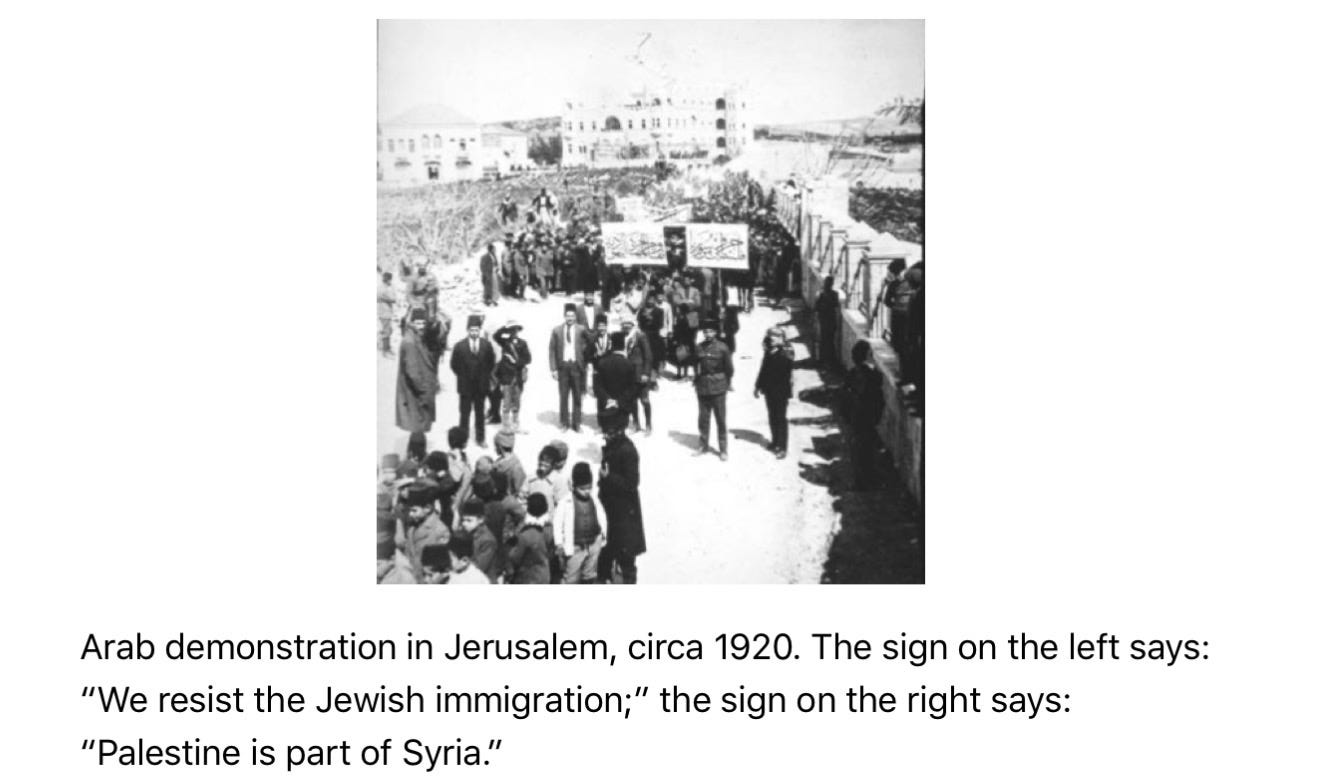
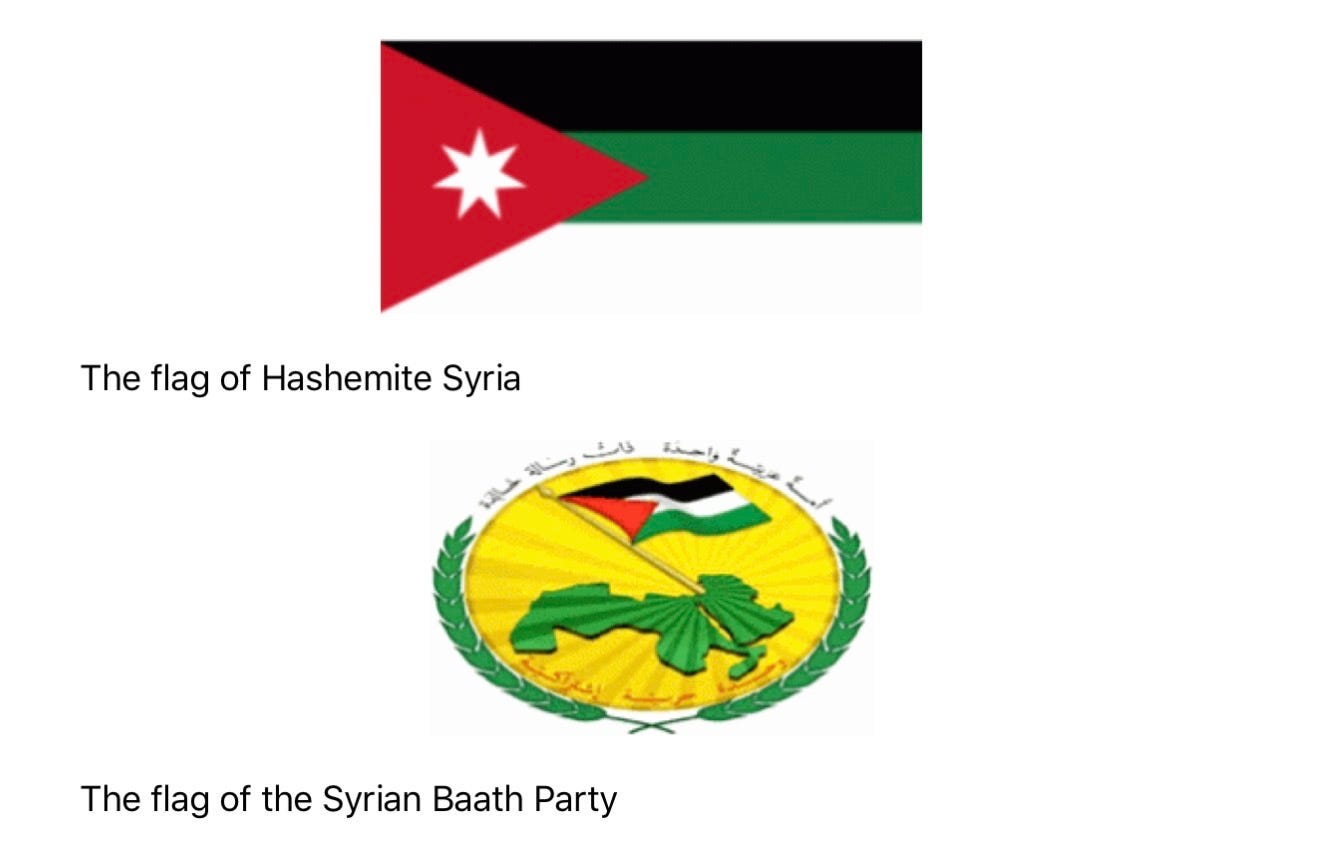
That is a crucial part of the story because it shows the territorial question was fought at the level of identity and naming, not just governance. (Inbari, 2017; Meyer, 2019; Library of Congress, 1920)
Awni Abd al-Hadi said there was no country called Palestine and that the land had long been part of Syria.
Ahmad Shukeiri said the same thing in UN-facing rhetoric: Palestine was southern Syria, not a separate peoplehood.
The Arab Executive Committee later described Palestine as the “unlawfully severed southern part of the one country of Syria” and the Arab Higher Committee’s mouthpiece still favored incorporation into Greater Syria in 1947. (Inbari, 2017; Meyer, 2019)
That matters because it shows the later nationalist story was not the only story. The Palestinian national frame hardened over time, but early Arab political rhetoric often rejected the very existence of Palestine as a separate territorial unit.
Zionist rhetoric, by contrast, insisted Palestine was a distinct and historically meaningful homeland tied to Jewish national restoration.
The dispute was never just about borders. It was about what the land was in the first place. (Inbari, 2017; Meyer, 2019)
The Canaanite claim
One of the more revealing strands in the modern Palestinian national story is the repeated claim that Palestinians descend from the ancient Canaanites. Mahmoud Abbas has said Palestinians are an offshoot of the Canaanite people; Saeb Erekat famously described himself as a “son of the Canaanites”; and Yasser Arafat at times framed Palestinians as descendants of the Jebusites, a Canaanite tribe. The point of this rhetoric is not just to claim deep roots in the land. It is to build a narrative of indigeneity that predates Jewish history and recasts Jewish return as the arrival of an outsider people rather than the return of an ancient one. (Inbari, 2017; Meyer, 2019)
The problem is that this claim does not hold up very well under scrutiny. As Inbari notes, Palestinian family histories usually do not trace themselves to Canaan; they more often point to Arab tribal origins in the Hejaz, Yemen, Iraq, or Syria. In other words, the public political claim of Canaanite descent sits uneasily beside the genealogical stories Palestinians themselves tell about their families. Erekat’s own family, for example, traces to the Huweitat tribe, which migrated from the Hejaz. Even the Kanaan family of Nablus, despite the name, is said to trace its roots to Syria and to identify with the Arab Tamim tribe. (Inbari, 2017; Meyer, 2019)
This is why the Canaanite argument is best understood as political narration rather than settled history. It is part of a broader effort to reverse the burden of indigeneity: to present Jews as latecomers and Palestinians as the original people of the land. That argument becomes even more charged when it is tied to biblical enemies like Amalek, turning an ancestry claim into a war claim. Once the rhetoric moves from lineage to cosmic struggle, the point is no longer historical continuity. It is delegitimization. (Inbari, 2017; Cohen & Boyd, 2019; Meyer, 2019)
The clearest way to say it is this: the Canaanite claim is not neutral heritage talk. It is a strategic attempt to rewrite the historical map of the land in a way that weakens Jewish indigeneity and strengthens a claim of exclusive Palestinian precedence. That is why it matters in a political essay about “Free Palestine.” It is part of the same narrative architecture. (Inbari, 2017; Meyer, 2019)
International law as tool and shield
Here is the contradiction at the center of the rhetoric: the movement frequently invokes international law when it is useful for condemning Israel, but rejects the same legal framework when it implies partition, compromise, or the legitimacy of Jewish sovereignty. In maximalist and Islamist formulations, divine entitlement overrides legal settlement altogether. That is why “international conferences,” negotiations, and partition plans are so often dismissed as illegitimate or “vain endeavors” in eliminationist texts. (Avalon Project, 1988; Jewish Virtual Library, 1964; PA-X, 1993; Britannica, 2026)
This is not a minor inconsistency. It is the strategy. Law becomes a weapon when it is useful and a fraud when it is not. The appeal to legality is selective, while the underlying claim remains total. (PA-X, 1993; Avalon Project, 1988)
The totalitarian connection
Haj Amin al-Husseini’s meeting with Hitler in 1941 is part of the historical record, and it matters. It shows that some Palestinian-Arab elites were willing to align themselves with Nazi power against the Jews of Europe and the Middle East. That is not a footnote. It is one of the clearest examples of the ideological proximity between some strands of Arab nationalism and antisemitic totalitarianism. (Bensoussan, 2024; source cited in provided materials)
The Soviet story is different, but no less relevant. Pacepa’s Disinformationargues that Soviet intelligence deliberately helped globalize anti-Israel and antisemitic propaganda. Cohen and Boyd similarly describe anti-Israel propaganda operations in Soviet contexts. I do not need to overstate the KGB role to make the point: Cold War propaganda helped sharpen, spread, and legitimize a lot of the anti-Israel messaging that later got wrapped in liberation language. (Cohen & Boyd, 2019; Pacepa & Rychlak, 2013)
Operation SIG
Operation SIG fits directly into that history. Cohen and Boyd describe Soviet anti-Israel propaganda operations, and Pacepa claims the KGB helped build and shape a disinformation apparatus aimed at undermining Israel and the West. In that telling, anti-Israel rhetoric was not just spontaneous grievance; it was amplified, organized, and exported. (Cohen & Boyd, 2019; Pacepa & Rychlak, 2013)
That matters because it helps explain the shift in language. Hard rejectionism was increasingly repackaged as liberation, human rights, and anti-colonial struggle. The new vocabulary made the message easier to sell in international forums, even when the underlying political project did not change. (Pacepa & Rychlak, 2013; Cohen & Boyd, 2019)
October 7 made the slogan impossible to sanitize
October 7 tore away the last pretense that “resistance” always means liberation. Numerous documentation exists of murder, rape, hostage-taking, and other serious crimes committed by Palestinian armed groups during the attack.
Gruesomely, mainstream reporting described Hamas militants livestreaming attacks from victims’ homes and, in some cases, taking over victims’ phones and social accounts so families saw the violence and messages through the victims’ own devices.” (BBC News, 2023; The Times of Israel, 2023)
That is why slogans matter so much.
When people chant “Free Palestine” while celebrating October 7, excusing it, or refusing to name civilian targeting, they are laundering atrocity under the vocabulary of rights. (HRW, 2023; HRW, 2024; ADL, 2026, et al.)
That is also why criticism of the slogan gets attacked so aggressively. The slogan depends on moral ambiguity. Once that ambiguity is broken, the darker uses become visible. And once the darker uses become visible, the whole rhetorical frame gets harder to defend. (Combat Antisemitism Movement, 2024; JNS, 2024)
Not Every Person Who Says “Free Palestine” Supports Eliminationism, But Many Do
I am not arguing that every person who says “Free Palestine” is an antisemite or a supporter of terror.
I am saying the slogan is too often used in an environment where denial of the basic humanity of Jews, coupled with anti-Jewish hostility, rejection of Israel’s legitimacy, and eliminationist aspiration are not fringe anomalies but recurring features of the political culture around it. (ADL, 2026; Britannica, 2026; PA-X, 1993)
The Social Media “Moderation” Conundrum
The fact that this slogan has a complex, double-sided reality is why attempts to shut down criticism of it are so frustrating and ultimately work to help the eliminationists.
To pretend the issue is moderation policy is simplistic; it is a way of ducking responsibility. It is not.
The issue is whether we are allowed to describe what the record actually shows: a liberation slogan frequently used to conceal a politics of erasure. (HRW, 2024; Avalon Project, 1988; Jewish Virtual Library, 1964)
Golda Meir and self-determination
Golda Meir is often quoted for saying there was “no such thing as Palestinians.” Whether one treats that as a precise historical claim or a political shorthand, it captures a deeper contradiction: self-determination was being treated as universal in theory, but somehow contingent when it came to Jews.
If self-determination is a legitimate principle, then Jews were entitled to it too. (Meir, widely quoted in political commentary; Britannica, 2026)
The territorial record sharpens that contradiction. There was no Palestinian state created in the West Bank or Gaza while those territories were under Arab control from 1948 to 1967.
At that time, Jordan controlled the West Bank, and Egypt administered Gaza!
If the issue was truly the absence of a Palestinian state, then the obvious question is why Arab rulers did not create one when they held the land. (Britannica, 2026; PA-X, 1993)
Zionism and Jewish self-determination
Zionism is the political expression of the Jewish people’s historic and national connection to the Holy Land of Israel. It is not expansionism in its basic form, and it is not accurately described as a project of conquest for its own sake.
Zionism has always included secular, religious, socialist, liberal, and nationalist strands, and those internal differences do not undermine Israel’s legitimacy.
For religious Jews, the return to the land also carries messianic meaning, but that theological dimension coexists with, rather than replaces, the political claim to self-determination. (ADL, 2022; Knesset, 1948; Britannica, 2026)
Conclusion
The question is not whether Palestinians deserve rights. They do. The question is whether a slogan can be trusted when it has so often been used to obscure rejectionist and eliminationist politics. I do not think it can be trusted without context, history, and honest scrutiny. (Britannica, 2026; PA-X, 1993)
That is why I read “Free Palestine” carefully, not naively.
A slogan can sound like liberation and still carry older projects of erasure inside it. (ADL, 2026; Avalon Project, 1988; Jewish Virtual Library, 1964)
References
ADL. (2022, January 9). Zionism. https://www.adl.org/resources/backgrounder/zionism
All 4 Palestine. (n.d.). Awni Abdulhadi. https://www.all4palestine.org/ModelDetails.aspx?gid=13&mid=533&lang=en
Anti-Defamation League. (2026). Slogan: Free Palestine. https://www.adl.org/resources/backgrounder/slogan-free-palestine
AP Archive. (1977/2015). SYND 13 5 77 Zuheir Mohsen interview on Palestine.
Avalon Project. (1988, August 18). Hamas covenant 1988: The Covenant of the Islamic Resistance Movement. Yale Law School. https://avalon.law.yale.edu/21st_century/hamas.asp
BBC News. (2023, October 16). Family tell of heartbreak after Israel kidnap live-stream. https://www.bbc.com/news/world-middle-east-67124745
Bensoussan, G. (2024, April). Pogroms in Palestine before the creation of the state of Israel (1830-1948). Fondapol. https://www.fondapol.org/en/study/pogroms-in-palestine-before-the-creation-of-the-state-of-israel-1830-1948/
Britannica. (2026). United Nations Resolution 181. https://www.britannica.com/topic/United-Nations-Resolution-181
Britannica. (2026). Palestine Liberation Organization: Intifada and Oslo peace process. https://www.britannica.com/topic/Palestine-Liberation-Organization/Intifada-and-Oslo-peace-process
Combat Antisemitism Movement. (2024, May 28). Understanding the implications of the slogan “From the River to the Sea, Palestine Will Be Free” https://combatantisemitism.org/press-release/understanding-the-implications-of-the-slogan-from-the-river-to-the-sea-palestine-will-be-free/
Cohen, E., & Boyd, E. (2019). The KGB and anti-Israel propaganda operations. Informing Science: The International Journal of an Emerging Transdiscipline, 22, 157-182. https://doi.org/10.28945/4488
Fondapol. (2024, April). Pogroms in Palestine before the creation of the state of Israel (1830–1948). https://www.fondapol.org/en/study/pogroms-in-palestine-before-the-creation-of-the-state-of-israel-1830-1948/
Human Rights Watch. (2023, October 17). Israel/Palestine: Videos of Hamas-led attacks verified. https://www.hrw.org/video-photos/video/2023/10/17/israel/palestine-videos-hamas-led-attacks-verified
Human Rights Watch. (2024, July 17). I can’t erase all the blood from my mind: Palestinian armed groups’ October 7 assault on Israel. https://www.hrw.org/report/2024/07/17/i-cant-erase-all-the-blood-from-my-mind/palestinian-armed-groups-october-7
Inbari, P. (2017, August 10). Who are the Palestinians? Jerusalem Center for Public Affairs. https://www.sfmew.org/wp-content/uploads/2017/07/Who-Are-the-Palestinians.pdf
Jewish Virtual Library. (1964). Palestine Liberation Organization: The original Palestine National Charter. https://jewishvirtuallibrary.org/the-original-palestine-national-charter-1964
JNS. (2024, May 16). “From the river to the sea”: false words as weapons. https://www.jns.org/wire/from-the-river-to-the-sea-false-words-as-weapons/
Knesset. (1948, May 14). Declaration of independence. https://m.knesset.gov.il/en/about/pages/declaration.aspx
Meyer, A. (2019, August 9). The invention of the Palestinian people. Times of Israel. https://blogs.timesofisrael.com/the-invention-of-the-palestinian-people/
PA-X. (1993, September 9). Israel-PLO recognition: Exchange of letters. https://www.peaceagreements.org/view/34/
Pacepa, I. M., & Rychlak, R. J. (2013). Disinformation: Former spy chief reveals secret strategies for undermining freedom, attacking religion, and promoting terrorism. WND Books. http://www.wndbooks.com
Radio Palestine, April 23, 2017
The Times of Israel. (2023, October 17). Hamas launched unique terror tactic: Livestreaming horrors on victims’ social media. https://www.timesofisrael.com/hamas-launched-unique-terror-tactic-livestreaming-horrors-on-victims-social-media/
Wikipedia. (2024). Zuheir Mohsen. https://en.wikipedia.org/wiki/Zuheir_Mohsen
Wikiquote. (n.d.). Zuheir Mohsen. https://en.wikiquote.org/wiki/Zuheir_Mohsen
 Writing by Dr. Dannielle Blumenthal
You must be logged in to post a comment.