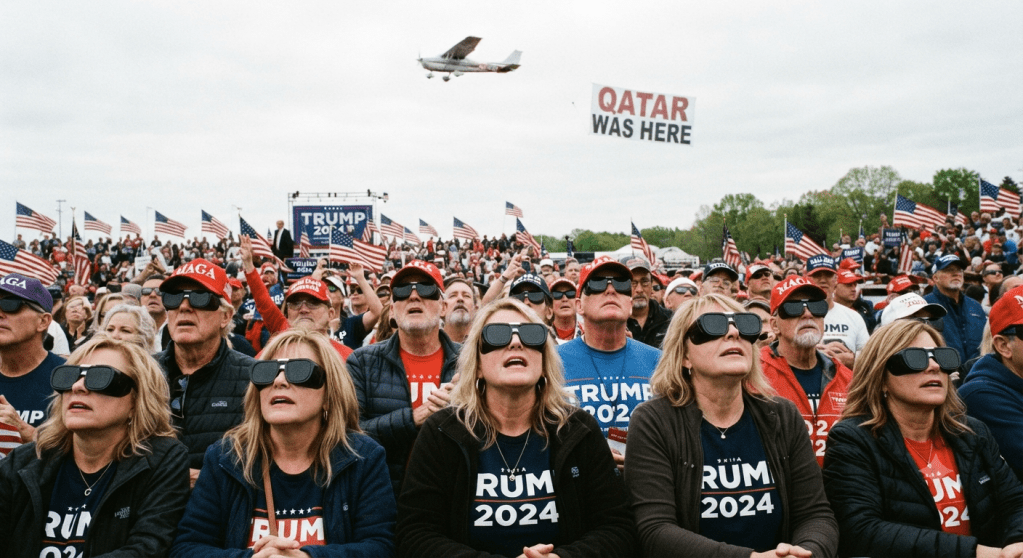
In the heart of the Arabian Peninsula sits a small but extraordinarily wealthy nation that has mastered the art of playing multiple games at once. Qatar presents itself to the world as a modern, diplomatic powerhouse — a mediator, an investor, a cultural patron. Yet beneath this polished image lies a conservative state whose legal and social order is deeply rooted in a political Islamic framework which views total worldwide acceptance of the religion as a pillar of the faith.
As such, political Islam is the lens through which Qatar’s behavior should be understood.
Part I. Qatar’s Grand Strategy: Ideology, Pragmatism, and Influence
Qatar has solved a problem few states have: how a tiny country with an orthodox Islamist governing philosophy became one of the worlds most influential diplomatic players. Understanding this unique trajectory requires examining the structural realities, historical calculations, and conceptual pillars that define Dohas approach to statecraft.
- The Core Thesis: Qatar is neither a traditional ideological state nor simply a pragmatic petro-state. It is an ideological state that pursues its objectives through pragmatic influence rather than military power.
- The Geopolitical Imperative: Sandwiched between regional heavyweights and possessing a minuscule native population, Qatar historically faced profound vulnerability to coercion, annexation, or blockade. Traditional hard power projection was impossible; therefore, absolute survival necessitated a strategy of ubiquitous diplomatic indispensability.
- The Dual Reality: While Qatar engages the West economically and diplomatically, its domestic model remains anchored in a conservative framework rather than liberal secularism. The state projects hyper-modernity through architectural marvels, global sports tournaments, and elite Western branch campuses, yet internal public life, legal codes, and social behavior remain strictly regulated by domestic religious and cultural imperatives.
- Monetizing Sovereign Wealth: Rather than hoarding capital or restricting investments solely to regional security, Qatar channeled its immense liquefied natural gas (LNG) revenues into a diversified, global web of assets. This financial architecture ensures that Western corporations, educational institutions, political campaigns, and media ecosystems maintain a vested stake in Qatars continued stability and prosperity.
Part II. Islam as Faith vs. Islam as Political Order
To accurately evaluate Qatar’s internal framework and its relationship with the West, it is essential to draw a precise, analytical distinction between Islam as a personal faith and Islam as a political ideology. Blurring these concepts invites confusion, whereas keeping them distinct clarifies how an orthodox state can maintain internal religious governance while managing global, cross-cultural alliances.
- Islam as a Personal Faith: Hundreds of millions of Muslims practice Islam worldwide as a deeply personal religion centered on spiritual worship, moral accountability, charity, family life, and individual devotion. The overwhelming majority of these believers have no interest in imposing religious law onto others and live peacefully, productively, and law-abidingly within pluralistic, secular democracies.
- Political Islam (Islamism) Defined: Political Islam treats religion not merely as a matter of private conscience, but as the primary organizing blueprint for government, legislation, public education, and social structure. Within this paradigm, the religious and the political are fundamentally inseparable, and secular separation of church and state is rejected. Legitimate political authority derives its mandate directly from Islamic law (Sharia), rather than from popular sovereignty or secular constitutionalism.
- Spectrum of Islamist Methods: Islamist movements and governments vary drastically in their tactical approaches—ranging from peaceful electoral participation and institutional entryism to revolutionary violence and militant insurgency. Despite these tactical divergences, they share a unified core premise: that public governance must be structurally shaped by Islamic dictates rather than restricted to the private sphere.
- Qatar’s Position within the Tradition: Qatar’s constitutional and governing philosophy firmly occupies this second tradition. Its legal architecture explicitly enshrines Islam as the state religion and Sharia as a principal source of legislation. While its foreign policy deploys high-level pragmatism and cooperates extensively with Western liberal democracies, its domestic order rejects Western secular norms regarding individual autonomy and the absolute separation of church and state. Recognizing this distinction removes false equivalencies, ensuring that a critique of a state’s political-religious model is understood as an analysis of governance structures rather than an assault on a global faith.
Part III. Extremism Doesnt Prevent Pragmatism
Western strategic thinking often operates under the assumption that ideological orthodoxy or domestic conservatism naturally dictates isolationism, irrationality, or diplomatic inflexibility. Doha shatters this conventional paradigm. Qatar demonstrates the precise opposite: a state can maintain a deeply conservative domestic identity while executing an extraordinarily flexible, sophisticated, and pragmatic foreign policy. This calculated divergence between domestic tenets and external maneuvers forms the bedrock of Qatari survival:
- The Illusion of Ideological Consistency: Traditional realpolitik assumes states ally only with those who share their values. Qatar operates on a transactional model where ideological distance at home is treated as entirely separate from diplomatic utility abroad, allowing Doha to partner seamlessly with actors across the global political spectrum.
- Hosting Strategic Military Infrastructure: Even while nurturing a domestic system anchored in Islamic jurisprudence, Qatar hosts vital Western military assets—most notably Al Udeid Air Base, the forward headquarters of United States Central Command (CENTCOM)—making itself an indispensable military anchor for the very superpower whose cultural norms it rejects.
- Mediating with Radical and Pariah Actors: Qatar leverages its ideological positioning to maintain open communication channels and hosting privileges for groups and regimes isolated by the West, including Hamas, the Taliban, and regional adversaries like Iran. This grants Doha unique utility as an indispensable global mediator, turning potential liabilities into diplomatic leverage.
- Capitalizing on Western Markets: Rather than retreating from Western economic systems, Qatar funnels billions into premier Western real estate, corporate equities, and financial institutions. These paradoxical alignments are neither contradictory nor accidental; they are masterclasses in risk mitigation. By intertwining its security and wealth with Western defense and global capital, Qatar ensures that its internal order remains shielded from external pressure.
Part IV. Influence Is Qatars Real Foreign Policy
For a geographically compact state wedged into a volatile, high-stakes neighborhood dominated by larger regional powers, traditional hard power projection is structurally impossible. Qatar cannot rely on military might to secure its borders or dictate terms. Consequently, influence has become Qatar’s true foreign policy—its primary, indispensable instrument for achieving national security, international relevance, and diplomatic immunity.
Doha has systematically mastered the art of converting its massive liquefied natural gas (LNG) wealth into deep-seated political capital and strategic leverage. Rather than deploying armies, Qatar deploys capital, institutions, and relationships through a calculated, cumulative rhythm:
- Every investment creates access: By acquiring premier commercial real estate, corporate stakes, and financial assets across Western capitals, Qatar embeds itself within the economic lifelines of powerful nations, ensuring its financial health is inextricably linked to that of its partners.
- Every donation creates relationships: Through multi-million-dollar philanthropic commitments to universities, think tanks, and cultural institutions, Doha establishes enduring networks of goodwill and professional interaction among elite opinion-makers.
- Every university partnership creates legitimacy: Branch campuses of elite Western institutions operating within Qatar project an aura of progressive enlightenment, wrapping the state in academic credibility while carefully insulating domestic culture.
- Every lobbying contract creates influence: By retaining top-tier legal, public relations, and political lobbying firms, Qatar maintains a continuous, institutionalized presence inside the halls of foreign legislative and executive branches.
- Every media investment shapes narratives: Funding and empowering global broadcasting networks allows Doha to project its own perspective onto international events, framing conflicts and diplomacy on its own terms.
- Every diplomatic mediation creates dependence: By positioning itself as the indispensable broker in complex international crises—hosting talks between global adversaries and insurgent groups—Qatar ensures that foreign governments depend on Doha to maintain channels of communication they cannot access themselves.
Through this multi-front architecture, Qatar achieves what military force never could: an outsized global footprint where its friends, partners, and beneficiaries become the ultimate guardians of its sovereignty.
Part V. Qatar’s Vast Network of Purchased Influence
Qatar’s influence operations represent a vast, highly coordinated, and multi-sector strategy designed to cultivate legal soft power, institutional credibility, and systemic leverage. Since the 2017 Gulf diplomatic crisis—when neighboring states blockaded Doha—Qatar dramatically accelerated its foreign engagement, pouring hundreds of millions of dollars into structured public relations and lobbying campaigns across Western democracies.
Political Influence and Registered Lobbying
- Qatar maintains an extensive network of registered agents under the Foreign Agents Registration Act (FARA), deploying law firms, political consultancies, and public relations powerhouses to manage its image and secure access.
- Financial disclosures indicate that Qatar has spent well over $200 million on these efforts, maintaining hundreds of documented interactions and meetings with political decision-makers, executive branch officials, and legislative staff.
- This machinery routinely leverages a revolving door of former U.S. officials, underwrites sponsored congressional travel, and injects funding into prominent policy institutions—such as historical support for the Brookings Institution and its Doha Center—to shape foreign policy discourse in Washington.
Higher Education and Academic Partnerships
- Qatar stands as one of the largest foreign donors to American higher education, utilizing state-backed entities like the Qatar Foundation to funnel billions of dollars into prestigious U.S. institutions.
- Through the sprawling 14-square-kilometer Education City complex in Doha, institutions such as Weill Cornell Medicine, Georgetown University, Carnegie Mellon, Texas A&M, and Northwestern have established flourishing branch campuses.
- While participating universities defend their programs through rigorous contractual safeguards and academic independence, critics have repeatedly scrutinized transparency and reporting compliance under Section 117 of the Higher Education Act, arguing that such massive endowments create structural dependencies and subtle vectors for narrative alignment.
Global Media and Narrative Control
- The Al Jazeera Media Network serves as Doha’s premier crown jewel in international public diplomacy, providing massive global reach across dozens of countries and multiple languages.
- Originally conceived to challenge state-run media narratives across the Middle East, Al Jazeera provides independent reporting while functioning as an effective instrument of Qatari soft power, successfully projecting Doha’s perspective onto major regional upheavals, diplomatic standoffs, and international conflicts.
Entertainment, Culture, and Sports Diplomacy
- Beyond traditional politics and media, Qatar extends its footprint deeply into global popular culture and entertainment. Commercial vehicles like the Qatar Investment Authority and beIN Media Group have executed major acquisitions—such as taking control of Miramax—while the Doha Film Institute underwrites international cinema and cultural festivals.
- This cultural portfolio is anchored by high-profile mega-events, including the 2006 Asian Games and the monumental hosting of the 2022 FIFA World Cup, utilizing the universal appeal of sport and entertainment to burnish national prestige and deflect external scrutiny.
Part VI. Disturbing Allegations the Media Ignores
Beyond Qatar’s transparent and legally registered influence infrastructure lies a darker, highly controversial tier of covert operations and tactical cynicism. These explosive allegations originate primarily from two specific public sources: the sworn legal testimony of Canadian businessman Alan Bender given during an October 2019 federal civil lawsuit, and the extensive public commentary and livestream broadcasts delivered by Imam Mohammed Tawhidi in late 2019. While defenders and official bodies dismiss these claims, analysts study them as a window into the alleged operational underbelly of state-backed influence.
The Cheap Cost of Political Complicity
- According to Alan Bender’s sworn testimony, Qatari officials frequently boasted about the absolute ease and affordability of purchasing American political influence.
- In a striking comparative remark, Bender testified that while European figures—such as British officials—demanded exorbitant sums in the millions, American politicians were viewed with stark cynicism:”The best thing money can buy are American officials because they are the cheapest of the cheapest costing officials in the world.”
- Bender specifically alleged that some U.S. political figures accepted financial payouts as low as $50,000, framing the American political apparatus as uniquely susceptible to transactional exploitation.
Deep Cultural Disdain and Managing the Public
- The alleged contempt held by Qatari strategists extended far beyond elected officials down to the American populace itself.
- According to testimonies and reports from Qatari-funded advisory circles, officials were explicitly counseled that they “shouldn’t worry too much about the opinion, or general opinion, of the people… because American public is just naive people who read the headlines.”
- This worldview regards ordinary citizens not as engaged democratic participants capable of substantive scrutiny, but as passive targets easily managed through surface-level media narratives and PR saturation.
Derogatory Nomenclature and Ideological Framing
- Internal discussions among Qatari operatives reportedly relied on severe and derogatory nicknames to describe prominent Western figures, revealing a deep-seated cultural and religious animus.
- Donald Trump was colloquially dismissed as “the orange man,” Jared Kushner was subjected to offensive lineage slurs (“the descendant of pigs and apes because he’s Jewish”), and Christian lawmakers and senators were routinely branded as “Crusaders,” merging modern political maneuvering with historical religious conflict frameworks.
Targeted Proxies and the “Trojan Horse” Strategy
- Among the most contentious allegations involve specific U.S. lawmakers. Rep. Ilhan Omar was allegedly singled out by Qatari officials as a meticulously cultivated asset who had been “groomed” and “funded” long before her entry into formal electoral politics.
- Witnesses claimed officials referred to her as their primary “Trojan horse” and the “jewel of the Crown.” Highlighting this transactional dependency, Bender cited a stark, highly publicized remark:”If it wasn’t for our money, she will be another black Somali refugee working part-time at Starbucks.”
- Imam Tawhidi aggressively amplified these assertions during his November 27, 2019 livestream from Budapest, maintaining that Omar “works for Qatar, is made by Qatar, is fully funded by Qatar, and is the jewel of the crown of Qatar,” while further alleging the existence of a coordinated Washington network involving figures like Linda Sarsour and Rashida Tlaib.
Clandestine Surveillance, Untraceable Payments, and Neutralization Tactics
- The testimony outlined sophisticated operational tradecraft designed to ensure complete deniability and absolute leverage. Financial transfers allegedly bypassed standard banking oversight, utilizing untraceable channels such as PayPal, direct cash deliveries in bags, or casino chips.
- Furthermore, Bender testified that Qatari intelligence systematically collected compromising material (“dirt”) and covertly recorded interactions with every American official who sought financial assistance, noting:”The Qatari intelligence have taped secretly all their conversations with every American official who asked the Qataris for money.”
- Media manipulation was reportedly enforced through both carrots and sticks: journalists and major outlet personalities were allegedly kept on lucrative payrolls explicitly to suppress damaging exposés (with Bender stating, “If you don’t publish, we pay you”), while direct intimidation and payoffs were alleged against critics—such as Tawhidi’s public allegation that journalist Vicky Ward received $500,000 in a Manhattan hotel room to remain silent, prompting Tawhidi to declare on air:”I’m not an Imam you can pay $500,000 to shut up…”
- Opponents who resisted were allegedly targeted with aggressive neutralization campaigns, including coordinated cyberattacks, smear campaigns, and malicious legal framing.
Part VII. Why the Contempt Matters
When evaluated independently, the explosive quotes and sensational allegations from the Bender deposition and Tawhidi livestream risk being dismissed as isolated anecdotes or unverified political gossip. However, when viewed through the prism of Qatar’s overarching grand strategy, they take on profound analytical significance. The true importance of these allegations lies not merely in the offense given by specific remarks, but in what they reveal about Qatar’s foundational, operational worldview.
Institutions as Systems to Be Manipulated
- Rather than viewing Western democratic governance, legislative bodies, and academic institutions as sacred or resilient public pillars, Qatari operational thinking allegedly treats them as mechanical vulnerabilities to be penetrated, co-opted, or bypassed.
- Respect for democratic norms is entirely absent; instead, institutions are evaluated strictly by their susceptibility to leverage and financial input.
Politicians as Commercial Investments
- The stark assertion that American officials are “the cheapest of the cheapest” reframes political lobbying from a traditional exercise in advocacy into a low-cost procurement market.
- In this perspective, elected representatives are not independent leaders responding to constituents, but transactional assets whose compliance can be bought, managed, and monetized.
The Media and Academia as Compliance Vectors
- The allegations surrounding payroll-suppressed journalism and multi-billion-dollar academic endowments demonstrate a systematic effort to control the intellectual and informational environment.
- By neutralizing investigative journalism and funding elite universities, Doha ensures that critical oversight is gently muffled long before it can reach the public square.
Public Opinion as Managed Noise
- Dismissing the American electorate as “naive people who read the headlines” completes the strategic loop. If the public can be easily distracted or pacified through mass media narratives and cultural diplomacy, then covert maneuvers and elite capture can proceed largely unimpeded by public backlash.
Ultimately, these controversial testimonies bridge the gap between Qatar’s visible, legally compliant soft power and its reported clandestine ambitions. They illustrate that Doha’s outward-facing diplomacy of mediation and investment is paired, in private estimation, with a profound cynicism toward the very Western systems that shield it.
Conclusion
Qatar’s extraordinary trajectory defies simple categorization. Its story is neither a straightforward tale of ideological extremism nor a conventional narrative of neutral state diplomacy. Instead, Doha represents a sophisticated, highly disciplined model of modern statecraft: a sovereign entity rooted internally in an orthodox political-Islamic framework while operating externally with ruthless, transactional pragmatism.
Comprehending the full reality of Qatar requires discarding two deeply ingrained but obsolete assumptions that frequently distort Western foreign policy analysis:
- First, the assumption that domestic ideological conservatism inevitably leads to international isolation, economic insularity, or irrational diplomacy. Qatar proves that a state can maintain strict internal religious and social controls while embedding itself at the very center of global financial, military, and diplomatic networks.
- Second, the comforting assumption that close institutional partnership, massive foreign investment, and diplomatic alignment necessarily reflect a shared foundation of liberal-democratic values. As both its documented multi-front influence operations and its alleged covert machinery indicate, transactional engagement is often designed not to foster ideological convergence, but to manufacture strategic dependence.
Ultimately, Qatar demonstrates how a geographically diminutive state facing profound regional vulnerabilities can successfully project outsized global power. By converting its vast liquefied natural gas revenues into a dense web of political lobbying, elite academic partnerships, media control, cultural sponsorship, and diplomatic mediation, Doha has constructed an environment where its Western partners become the unwitting custodians of its security. As the international arena continues to shift, the Qatari model stands as a permanent reminder that in modern geopolitics, influence is not merely bought—it is systematically engineered.
Important Disclaimer Regarding Third-Party Claims
This content makes reference to allegations, testimony, and public commentary originating from Canadian businessman Alan Bender and Imam Mohammed Tawhidi. These claims, which include assertions regarding foreign influence over American political figures and institutions, are unverified and unsubstantiated.
While these accounts are cited within certain investigative reporting and legal filings, they have not been validated by independent corroborating evidence or official government investigations. Such claims remain allegations and should not be treated as established facts.
This information is shared strictly in the public interest, to promote transparency and awareness regarding serious public allegations concerning foreign influence. Readers are advised to exercise caution and critical judgment when evaluating this information, recognizing the unverified nature of these sources.
References
Foundation for Defense of Democracies. (2026, June 3). Mapping Qatar’s $400 billion footprint in the United States. https://www.fdd.org/analysis/2026/06/03/mapping-qatars-400-billion-footprint-in-the-united-states/
Influence Watch. (n.d.). Al Jazeera. https://www.influencewatch.org/organization/al-jazeera/
ISGAP. (n.d.). Qatar and the Muslim Brotherhood funding of higher education. https://isgap.org/follow-the-money/
OpenSecrets. (2026). Government of Qatar lobbying profile. https://www.opensecrets.org/federal-lobbying/clients/summary?cycle=2025&id=D000051433
Shuker, A., & Admoni, Y. (2025, March 24). Qatar’s influence operations: Diplomacy, propaganda, and financial leverage. Jerusalem Institute for Strategy and Security. https://jiss.org.il/en/shuker-admoni-qatars-influence-operations/
The Free Press. (n.d.). Qatar’s influence-buying in America is even worse than we thought. https://www.thefp.com/p/qatars-influence-buying-in-america
The Washington Examiner. (2026, January 3). What to know about Qatar’s sprawling web of influence. https://www.washingtonexaminer.com/in_focus/3916768/what-to-know-qatar-web-of-influence/
Variety. (2025, November 28). Qatar forges Hollywood ties as it pursues film industry ambitions. https://variety.com/2025/film/global/qatar-hollywood-ties-2022-world-cup-film-industry-ambitions-1236594646/
Ibish, H. (2023, October 20). The reckoning that is coming for Qatar. The Atlantic.
Bokat-Lindell, S. (2022, December 14). The Qatar World Cup is peak “sportswashing.” But will it work? The New York Times.
Wearing, D. (2022, November 16). A game of two halves: how “sportswashing” benefits Qatar and the west. The Guardian.
Snell, J. (2022, December 1). Qatar proves that sportswashing works. New Statesman.
Bard, M. (2025, May 14). Universities are selling out to Qatar, and selling off their integrity. JNS.org.
Schectman, S., Kalin, S., & Brown, E. (2025). How Qatar spent billions to gain influence in the U.S. The Wall Street Journal.
Block, F. (2025, April 28). Qatar and China are pouring billions into elite American universities. The Free Press.
Marcus, K. L. (2026, January 28). Does Qatar fund antisemitism at American campuses? The Wall Street Journal.
Associated Press. (2019, July 10). While Trump praises Qatar, education officials seek scrutiny.
Politico. (2022, June 17). He tried to reform the way a top D.C. think tank gets money. Now the FBI is looking into him.
Reuters. (2014, August 20). German minister accuses Qatar of funding Islamic State fighters.
Council on Foreign Relations. (2017, July 12). How Al Jazeera amplifies Qatar’s clout. https://www.cfr.org/backgrounders/how-al-jazeera-amplifies-qatars-clout
Lynch, E. A. (2022). Al Jazeera and Qatari soft power. In Isolating Qatar. Lynne Rienner Publishers.
Reuters. Qatar’s $24 million lobbying push.
The Wall Street Journal. (2024, January 7). As Qatar mediates the world’s disputes, its U.S. lobbying sows legal problems.
Haberman, M. (2025, May 12). Trump, pressed on Qatari jet, says only “stupid” people reject gifts. The New York Times.
Rod, M. (2025, July 22). Conservative commentator Bill Bennett registers as Qatar lobbyist. Jewish Insider.
U.S. Department of Justice. (2025, July 3). FARA registration filing.
Inside Higher Ed. (2026, January 28). Enhanced monitoring “politicizing” college donations. https://www.insidehighered.com/news/global/us-colleges-world/2026/01/28/enhanced-monitoring-politicizing-college-donations-qatar
Chafin, J. (2024, March 17). Qatar’s ties to US universities scrutinised amid rise in antisemitism. Financial Times.
Korn, A. V., & Viswanatha, M. (2020, October 20). Top universities took billions in unreported foreign funds, U.S. finds. The Wall Street Journal.
U.S. Department of Education. (2025). Foreign funding reporting portal announcement. https://www.ed.gov
U.S. Congress. Section 117 of the Higher Education Act. https://www.congress.gov
National Association of Scholars. (n.d.). Shadows of influence. https://www.nas.org/report/shadows-of-influence/full-report/
NPR. (2026, February 12). U.S. colleges received more than $5 billion in foreign gifts. https://www.npr.org/2026/02/12/nx-s1-5711359/us-colleges-5-billion-in-foreign-gifts
Quincy Institute. (2025, September 8). Soft power, hard influence: How Qatar became a giant in Washington. https://quincyinst.org/research/soft-power-hard-influence-how-qatar-became-a-giant-in-washington/
Responsible Statecraft. (2025, September 10). After bombing, time to demystify the “Qatar lobby”. https://responsiblestatecraft.org/qatar-lobby-israel/
Business Insider. (2023, March 15). Saudi money is flowing to US media and entertainment. https://www.businessinsider.com/saudi-arabia-qatar-uae-investment-hollywood-media-entertainment-mbs-khashoggi-2023-3
CBS News. (2016, March 3). Movie studio Miramax sold to Qatar media group. https://www.cbsnews.com/news/movie-studio-miramax-sold-to-qatar-media-group/
Haaretz. (2025, December 5). Qatar is gaining a foothold in Hollywood—and with it, influence over the U.S.
The Hollywood Reporter. (2021, August 5). Ron Meyer to rep Qatar as it eyes Hollywood investments. https://www.hollywoodreporter.com/business/business-news/ron-meyer-qatar-1234993388/
The Hill. (2025, June 6). Qatar’s US influence strategy goes much deeper than you think. https://thehill.com/opinion/international/5334791-qatars-us-influence-strategy-goes-much-further-than-you-think/
The Wrap. (2023, October 31). Qatar’s starring role in Gaza crisis complicates Hollywood. https://www.thewrap.com/qatar-hollywood-israel-gaza/
Brandeis Center. (n.d.). Qatari funding. https://brandeiscenter.com/tag/qatari-funding/
DC Transparency. (n.d.). Donations from Qatari lobbyists raise ethical concerns on Capitol Hill. https://dctransparency.com/donations-from-qatari-lobbyists-raise-ethical-concerns-on-capitol-hill/
Qatar Ministry of Foreign Affairs. Qatar’s Foreign Policy | Cooperation, dialogue and mediation. https://imo.gov.qa/priorities/foreign-policy
Qatar Government Communications Office. Foreign Policy. https://www.gco.gov.qa/en/media-centre/in-focus/foreign-policy/
U.S. Department of State. 2023 Report on International Religious Freedom: Qatar. https://www.state.gov/reports/2023-report-on-international-religious-freedom/qatar
Council on Foreign Relations. How Al Jazeera amplifies Qatar’s clout. https://www.cfr.org/backgrounders/how-al-jazeera-amplifies-qatars-clout
Swiss Federal Institute of Technology / SWP. Qatar’s Foreign Policy. https://www.swp-berlin.org/10.18449/2023RP04/
Humanists International. Qatar – Freedom of Thought Report. https://fot.humanists.international/countries/asia-western-asia/qatar/
U.S. Department of State archive. Qatar religious freedom report. https://2009-2017.state.gov/documents/organization/171743.pdf
Direct to the People (Imam Mohammed Tawhidi). (2019, November 27). Imam of Peace says Ilhan Omar is Asset of Qatar on Twitter Livestream. https://www.youtube.com/watch?v=ur_8dWJvK4A
United States District Court, Middle District of Florida. (2019, October 23). Videotaped Deposition of Alan Bender in Pittard et al. v. Al Thani et al. (Case No. 8:19-cv-1784).
AI image.


You must be logged in to post a comment.