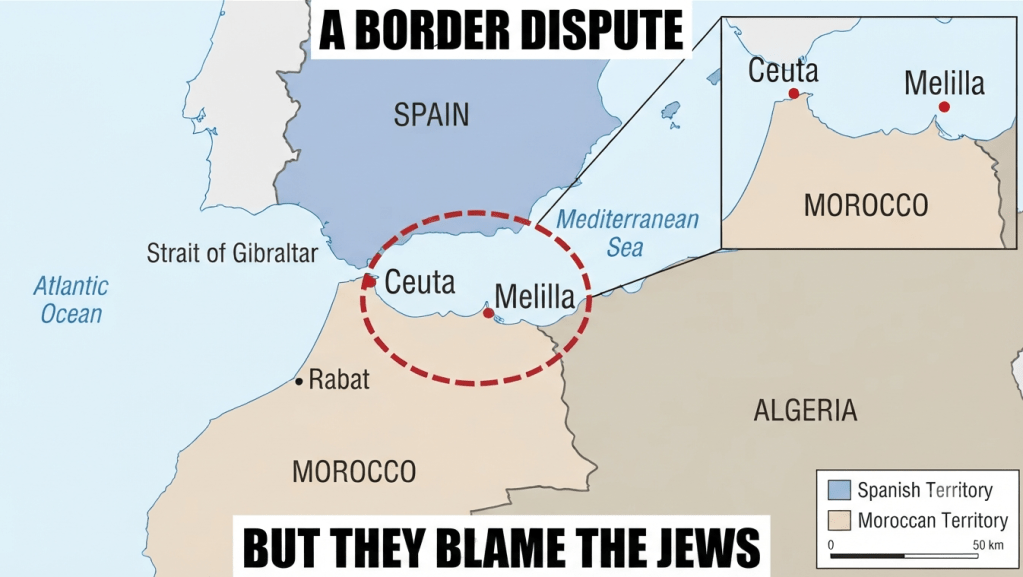
Introduction
When roughly 60,000 people suddenly rushed across the heavily guarded borders of Ceuta—a small piece of Spain located on the coast of North Africa—it looked like a terrible accident. If you only watched the news for a few minutes, you might have thought it was just a random wave of people looking for a better life.
But if you look closer at how governments actually play power games, you see the truth: this was a planned trick. It was a classic move where a government uses desperate people like a tool to force another country to give in to its demands.
Yet, instead of talking about how Morocco engineered this crisis on purpose, a loud group of politicians in Europe, internet influencers, and shock-jocks immediately jumped to a fake story: they blamed Israel.
Let’s break down what actually happened, why Morocco pulled the trigger, and why certain people are so lazy that they try to blame Israel for everything.
I. The Ground Truth — What Actually Happened at the Southern Gate of Europe
To understand this mess, you have to look at a weird map problem that has existed for hundreds of years.
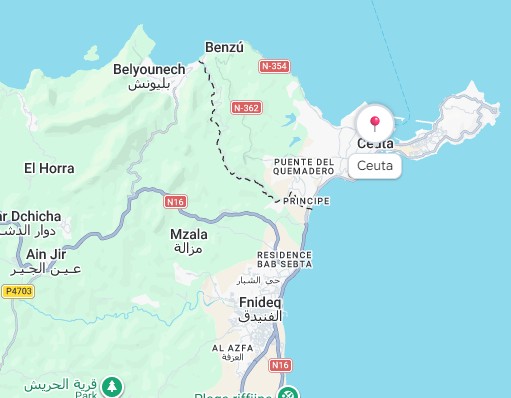
Ceuta and another city called Melilla are part of Spain, but they are not physically connected to Europe. They sit right on the top edge of Africa, completely surrounded on land by the country of Morocco. Morocco has never accepted that Spain owns these cities. They want them back. But because Morocco cannot start a war with Spain without fighting all of NATO, they use a different weapon: border control.
When Morocco and Spain are getting along—especially when Spain supports Morocco’s claims over the Western Sahara, a disputed territory—Morocco acts like a good neighbor. Their border guards stop people from crossing into Spain.
The moment Spain does something Morocco doesn’t like, however, Morocco flips a switch.
The spark for this latest crisis was Spain getting friendly with Algeria, Morocco’s bitter rival in the region. When the Spanish Prime Minister went to visit Algeria to patch things up, Morocco got furious.
To remind Spain who is really in charge of the border, Morocco’s guards suddenly stopped watching. In less than 48 hours, tens of thousands of people crossed into Ceuta, creating a massive emergency for Spain.
This wasn’t an accident or a weather event. It was a calculated power play, and we’ve seen it before.
In 2021, Rabat deliberately loosened border enforcement around Ceuta as a punitive measure against Madrid for secretly treating Polisario Front leader Brahim Ghali in a Spanish hospital. While the acute surge saw a massive influx of individuals—with estimates varying from the initial shock waves up to broader regional totals—the crisis ultimately peaked and subsided as thousands were swiftly repatriated or chose to go back home amid mounting humanitarian pressure.
Similarly, more than two decades ago, Morocco masterminded the 2002 takeover of Isla de Perejil, sending a small unit of personnel to the disputed islet to test Spanish resolve and leverage its position regarding Western Sahara. This sparked a tense, non-violent standoff that concluded when Spanish commandos executed a surprise morning raid to clear the territory, which was subsequently restored to an unpopulated status quo through American diplomatic intervention.
II. The Narrative Laundering Machine — Why Do They Blame Israel?
When complex, localized geopolitical realities collide with deep-seated ideological biases, lazy actors inevitably resort to their favorite reflex: blaming Jerusalem, and especially Netanyahu.
To understand how a North African territorial squeeze by a Muslim-majority kingdom became twisted into an anti-Israel conspiracy, you have to look at how modern information warfare operates.
It is a masterclass in what intelligence analysts call “narrative laundering”—taking an unrelated event, injecting a pre-packaged villain, and laundering it through political figures and digital echo chambers until it looks like established fact.
1. The Spark: Seizing on Diplomatic Jabs
The narrative machinery swung into full gear immediately after Israeli UN Ambassador Danny Danon posted a blunt critique on X. Danon called out Spain’s relentless hypocrisy—noting that Madrid never misses a chance to lecture Israel on international norms while simultaneously maintaining its own colonial enclaves on the coast of North Africa.
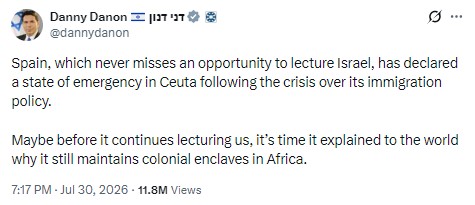
Instead of addressing the uncomfortable reality of Moroccan border manipulation or Spain’s own diplomatic missteps, Spanish Transport Minister Óscar Puente and various regional politicians pounced on Danon’s post.
They shared it publicly, heavily implying—and in some cases outright claiming—that Israel and the United States had somehow orchestrated or stoked the migration surge to punish Madrid for its hostile stance toward Jerusalem.
2. Stripping Agency from Regional Players
It’s easy to say nasty things about Israel. The harder thing is to understand what’s going on and admit when they have absolutely nothing to do with a problem.
In this case, conspiracy theory literally collapses under the weight of basic geographic and political literacy.
To claim that Israel engineered a massive demographic flood across the Strait of Gibraltar requires ignoring the actual sovereign actor involved: Morocco.
It strips a powerful, sovereign, Muslim-majority North African kingdom of its own independent agency, strategic calculations, and long-standing regional ambitions.
Morocco does not need a foreign script to manage its borders. It’s plainly obvious that its leaders use the migration tap as a deliberate, indigenous instrument of statecraft to exert pressure on Spain.
Reducing these complex geopolitical moves to a puppet show directed by Jerusalem is not just lazy—it exposes an obsessive, pathological exploitation of the old trope that Jews secretly control the world.
3. The Utility of the Scapegoat
For European politicians facing domestic anger over border failures, and for anti-Israel commentators looking for a fresh angle, blaming the Jewish state is a convenient deflection.
It requires zero analytical heavy lifting, panders to existing prejudices, and distracts the public from the gritty, unpalatable truth: that Western borders are vulnerable to state-level coercion, and European governments are often too paralyzed or divided to confront it honestly.
III. The Attention Economy Rewards Lazy, Dishonest Psyops Like This
Why did alternative media figures—ranging from domestic conspiracy commentators like Alex Jones to fringe digital operators—leap onto this manufactured bandwagon?
To understand their involvement, you have to look past the political rhetoric and examine the economic and psychological incentives driving the modern attention economy.
1. The Algorithmic Incentive Structure
Alternative media moguls and independent digital shock-jocks do not survive on nuanced tradecraft, slow-burn geopolitical analysis, or geographic accuracy; they survive on monetizable outrage.
Complex statecraft—such as Morocco using migration as leverage against Spain to contest regional hegemony and Western Sahara policies—is inherently nuanced, geographically obscure, and frankly, boring to a mass digital audience.
It requires patience to explain and specialized knowledge to understand.
By contrast, a grand unified conspiracy theory is instantly digestible. Blaming a single, pre-packaged external villain requires zero analytical heavy lifting and provides an immediate emotional payoff for the audience.
2. Who’s Paying Them? The Narrative Laundering Loop
You do not necessarily need a direct wire transfer from a foreign intelligence service when algorithmic capitalism and ideological laziness do the work for you.
The mechanics operate in a predictable, symbiotic loop:
- The Narrative Seed: Domestic shock-jocks and influencers drop a sensationalized, anti-Israel or anti-Western conspiracy theory to capture clicks, boost engagement metrics, and feed their followers’ pre-existing biases.
- The Amplification Echo: Once that narrative seed is planted on platforms like X, Telegram, or TikTok, foreign information-laundering networks and state-backed bot farms hyper-distribute it.
- The Exploitation: Hostile actors leverage these domestic Western voices to manufacture deeper internal divisions, weaponize existing polarization, and shield actual state perpetrators (like Rabat) from accountability.
Ultimately, blaming Israel for a North African border squeeze is a great way to make money. It trades hard geographic and political realities for viral outrage, proving that in the digital age, a good conspiracy is always more profitable than the boring, brutal truth.
IV. Conclusion — Cutting Through the Noise
When we strip away the layers of partisan spin, state-level manipulation, and algorithmic outrage, the Ceuta border crisis yields a vital lesson in modern information warfare: Geographical reality is routinely sacrificed on the altar of narrative convenience.
What occurred on the North African coast was not a spontaneous humanitarian accident, nor was it a proxy operation orchestrated by Jerusalem.
It was a cold, calculated exercise in statecraft by Rabat—a textbook leveraging of migration to pressure Madrid in response to shifting diplomatic alignments in the Maghreb.
Yet, rather than facing the uncomfortable realities of North African realpolitik and European border vulnerability, a predictable coalition of political opportunists, domestic shock-jocks, and foreign information-laundering networks chose the path of least resistance. They manufactured and sold a scenario designed to deflect accountability and reinforce pre-existing biases against Israel.
Critical thinkers benefit from a solid anchor in the ground truth. When we allow complex geopolitical phenomena to be hijacked by fake news (or fake alternative news, influencers, and amateur social media pundits), we surrender our analytical clarity to the very forces trying to manipulate us.
AI-generated image.
 Writing by Dr. Dannielle Blumenthal
You must be logged in to post a comment.