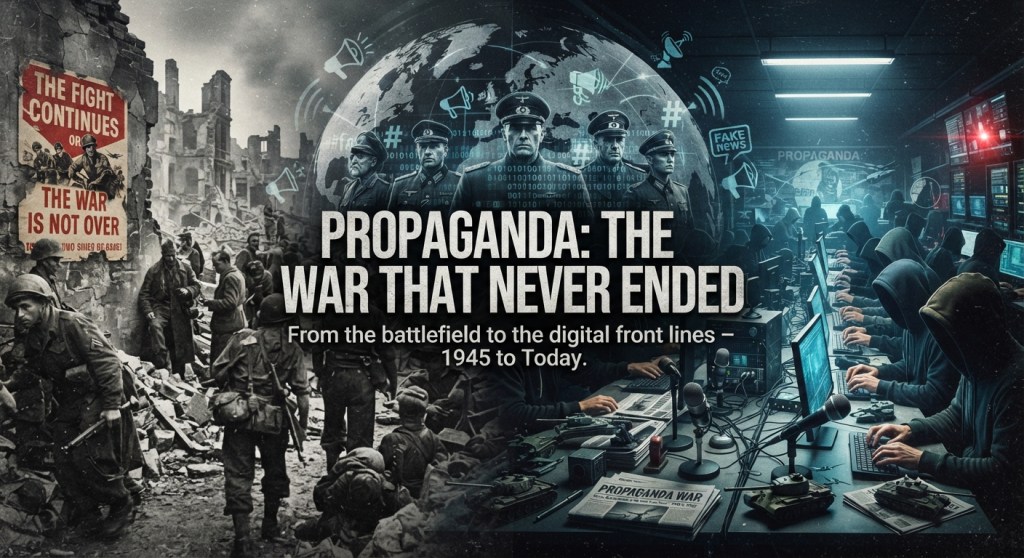
The world is best understood as a contest of competing interests—states and movements advancing their power, security, and influence relative to rivals. That contest did not pause in 1945. The defeat of Nazi Germany removed one adversary and immediately opened another struggle, conducted through occupation, covert action, proxy forces, political subversion, and the shaping of public perception. What followed was not a durable peace but the construction of a geopolitical order whose patterns continue to shape the present. This chapter examines how that order took form: Soviet expansion across Eastern Europe, Western intervention in Iran, the strategic use of regional conflicts, the rise of communist China, and the adaptation of rivalry into information and influence operations. The historical record points to a consistent pattern. Great powers rarely act as disinterested liberators. They pursue advantage, and the consequences of those pursuits frequently outlast the calculations that produced them.
From Overt to Covert Power
The end of World War II did not inaugurate a durable peace. It opened a new contest for power—one waged not only through conventional armies but through occupation, covert action, proxy forces, political subversion, and the manipulation of public consciousness.
The wartime alliance between the United States and the Soviet Union had always been one of necessity rather than trust. Nazi Germany’s defeat in 1945 removed the common enemy that had held the coalition together. Almost immediately the partnership fractured. Washington largely demobilized, brought home millions of servicemen, and sought to convert wartime victory into a stable international order. Moscow moved in the opposite direction. The Soviet Union emerged from the war devastated but militarily dominant across much of Eastern and Central Europe, and it used that position to construct an empire of dependent states.
This was not merely the beginning of the Cold War. It was the formation of a geopolitical pattern whose consequences would shape the Middle East, Asia, and the wider world for generations.
Soviet Expansion and the Politics of Fear
As the Red Army advanced westward through the final stages of the war, it did more than defeat Nazi forces. It established physical control over the territories through which it passed. Poland, East Germany, Czechoslovakia, Hungary, Romania, Bulgaria, and other states found themselves increasingly subject to Soviet political and military influence. In the years that followed, independent institutions were dismantled, opposition figures were intimidated or eliminated, elections were manipulated, and communist governments loyal to Moscow consolidated power.
Winston Churchill later described this division as an “Iron Curtain” descending across Europe. The phrase endured because it captured a reality: much of the continent had been separated into two hostile political worlds. On one side stood liberal democracies aligned with the United States. On the other stood regimes bound to Moscow through military occupation, ideological conformity, secret-police systems, and economic dependence.
The Soviet advance was also marked by grave abuses against civilians. In Germany, especially during the final offensive and early occupation period, Red Army soldiers committed widespread sexual violence against women and girls. Historians have offered varying estimates, with some placing the number of German women assaulted in the hundreds of thousands or even far higher. The scale of the crime remains morally staggering, even if exact totals remain contested.
This history matters because it complicates the sanitized narrative of liberation that has often accompanied discussion of the Soviet war effort. The defeat of Nazi Germany was necessary and just; that truth does not erase the crimes committed by Soviet forces as they advanced into Europe. Occupation, whatever ideological language accompanies it, can become a system in which civilians are reduced to instruments, trophies, or collateral damage.
The Soviet model did not depend solely on tanks. It relied on political warfare. Moscow understood that a state could be weakened without direct invasion: by financing factions, infiltrating institutions, amplifying grievances, cultivating ideological allies, and transforming local disputes into strategic liabilities for rival powers. This was the essence of subversion—not simply persuading populations, but reshaping the political conditions under which they made choices.
Israel and the Logic of Proxy Conflict
The establishment of Israel in 1948 became one arena in which Soviet strategic calculation collided with the emerging Cold War order. Soviet leaders initially viewed the new state with interest. Some in Moscow hoped that Israel, with its influential labor movement, socialist institutions, and early left-wing political currents, might develop into a friendly—or at least nonaligned—state outside the Western orbit.
That expectation did not hold. Israel’s political and strategic orientation increasingly tilted toward the West, particularly as the Cold War hardened and regional conflicts deepened. Soviet policy adjusted accordingly. What had begun as cautious interest gave way to support for Arab states and, over time, varying forms of political, military, and diplomatic support for Palestinian nationalist movements.
This shift should not be romanticized. Great powers rarely enter foreign conflicts as disinterested champions of liberation. Moscow’s involvement was shaped above all by its own strategic interests: undermining Western influence, competing with the United States, expanding its network of partners, and turning the Middle East into a pressure point against its principal adversary.
The Israeli–Palestinian conflict, with its deep historical, territorial, national, and human dimensions, cannot be reduced to a Soviet creation. But the Soviet Union recognized its strategic utility. A conflict that generated instability, inflamed regional opinion, divided Western allies, and placed the United States under continuous diplomatic and military pressure was valuable to Moscow regardless of whether a lasting settlement became more difficult.
That logic is central to understanding proxy warfare. The objective is not always victory for one’s partner. In some cases the objective is permanent friction: a conflict intense enough to drain an adversary’s resources, polarize its public, damage its alliances, and make stability appear unattainable. A prolonged crisis can become a weapon in its own right.
Oil, Overthrow, and the 1953 Iran Coup
If Soviet expansion demonstrated the effectiveness of military occupation and political subversion, the Western intervention in Iran demonstrated a different but equally consequential form of power: covert regime change.
In 1953 the United States and the United Kingdom helped orchestrate the overthrow of Iranian Prime Minister Mohammad Mossadegh in Operation Ajax. Mossadegh was a nationalist leader whose central political project was the nationalization of Iran’s oil industry. For decades British interests had exercised extraordinary influence over Iranian petroleum through the Anglo-Iranian Oil Company. Mossadegh’s move challenged not only a commercial arrangement but an entire system of external control over Iranian resources.
To British officials, nationalization threatened a vital economic asset. To American policymakers it raised fears that political instability might create an opening for Soviet influence. These concerns converged into a covert operation designed to remove Mossadegh and strengthen the authority of Shah Mohammad Reza Pahlavi.
The operation succeeded in its immediate objective. Mossadegh was overthrown. The Shah returned to power with strengthened authority. Western oil interests regained access, and Washington secured a more dependable anti-Soviet partner in a strategically vital region.
Yet this was a tactical victory with profound long-term costs. The restoration of the Shah helped solidify a system increasingly associated with autocracy, inequality, corruption, and repression. His regime’s security apparatus became infamous for its brutality. For many Iranians the United States was no longer merely a foreign power with interests in their country; it was the outside force that had helped extinguish a democratic movement when that movement threatened Western access to oil.
That grievance did not disappear. It accumulated. By the time the Iranian Revolution erupted in 1979, opposition to the Shah had drawn together religious conservatives, nationalists, leftists, students, and ordinary citizens with sharply different visions for Iran’s future. Ayatollah Ruhollah Khomeini and the Islamist movement ultimately emerged victorious, but the revolution’s anti-Western energy had deeper roots than any single cleric or ideology. It was fed by decades of perceived humiliation, intervention, and political dependency.
The 1953 coup did not mechanically cause the Islamic Revolution. History is rarely that linear. Yet it became one of the revolution’s most powerful symbols—a clear illustration of how foreign intervention can generate the very radicalization it seeks to prevent. An action that appears rational within the narrow horizon of immediate interests can create grievances that later transform the strategic environment altogether.
China’s Revolution and the Expanding Authoritarian Sphere
The geopolitical map was also changing dramatically in Asia. In 1949 Mao Zedong’s Communist Party defeated Chiang Kai-shek’s Nationalists in the Chinese Civil War and established the People’s Republic of China. The result was one of the most consequential political transformations of the twentieth century: the world’s most populous country entered the communist camp.
The Chinese Communist victory emerged from a complex civil war shaped by domestic conditions, Japanese occupation, peasant mobilization, Nationalist weaknesses, military strategy, and foreign involvement. Soviet support mattered, particularly in the postwar struggle over Manchuria and the transfer of Japanese equipment captured in the region. But China’s revolution cannot be accurately understood as a simple Soviet operation. Mao’s movement was rooted in its own revolutionary ideology, political organization, and capacity to exploit the failures of its opponents.
Still, from Washington’s perspective the result was unmistakable. The communist world had expanded dramatically. A Soviet Union entrenched in Eastern Europe was now joined by a revolutionary Chinese state with continental scale, immense population, and ambitions of its own. The Cold War was no longer confined to Europe. It had become global.
In the decades since, the nature of authoritarian coordination has changed. The Soviet Union collapsed in 1991, but Russia reemerged as a revisionist power under Vladimir Putin. China evolved into an economic and technological giant under one-party rule. Iran, shaped by its revolutionary identity and its long confrontation with the United States, developed its own regional network of armed partners and aligned militias.
These states are not identical, and they do not form a perfectly unified ideological bloc. Their interests diverge in important ways. They lack the simplicity of a formal, comprehensive military alliance comparable to NATO. Yet they increasingly cooperate where their interests converge: in diplomatic coordination, military and security relationships, energy trade, sanctions evasion, technology, cyber capabilities, and opposition to a U.S.-led international order. Their shared interest is not necessarily the creation of a harmonious alternative world system. It is often the weakening of the system that already exists.
The New Battlefield: Information and Perception
Modern geopolitical competition is not fought only through territory, weapons, or trade. It is also fought through perception.
Authoritarian states have learned that democratic societies possess an inherent vulnerability: their openness. Free speech, political pluralism, independent media, and digital communication are strengths. Yet they can also be exploited by actors willing to weaponize division, spread disinformation, amplify conspiracy theories, or cultivate distrust in democratic institutions.
The objective is not always to make citizens believe one specific falsehood. Often the aim is more corrosive: to convince them that nothing is trustworthy, every institution is corrupt, every election is illegitimate, and every source of information is propaganda. A population that has lost confidence in the possibility of truth becomes easier to manipulate.
This is psychological warfare in its contemporary form. It does not require a foreign power to control a newspaper or seize a radio station. It can operate through anonymous accounts, state-backed media, cyber operations, manipulated videos, coordinated online campaigns, and the amplification of existing domestic anger. Foreign actors need not invent every grievance. They merely need to identify the fractures already present and widen them.
The most effective information operations are therefore subtle. They do not always demand loyalty to a foreign regime. They encourage citizens of a target country to distrust one another, scapegoat vulnerable groups, reject democratic compromise, and interpret every disagreement as evidence of national betrayal.
The result is a strategic paradox. A democracy can possess overwhelming military strength and still be weakened internally if its citizens become convinced that their own institutions are irredeemably illegitimate.
Conclusion
The postwar era reveals a durable pattern: competing interests seeking relative advantage through force, subversion, proxies, and the manipulation of perception. Soviet occupation demonstrated the power of physical control. Western covert action showed how regime change could secure short-term gains while generating lasting hostility. China’s revolution expanded the authoritarian sphere. Today’s coordination among revisionist states, and their exploitation of open societies through information operations, continues the same contest by updated means. The battlefield now includes elections, news feeds, university campuses, financial networks, cultural narratives, and the confidence of citizens in their own institutions.
Understanding this history is not an exercise in fatalism. It is a necessary corrective to the assumption that power struggles end when one side declares victory. The contest continues.
AI image.


You must be logged in to post a comment.