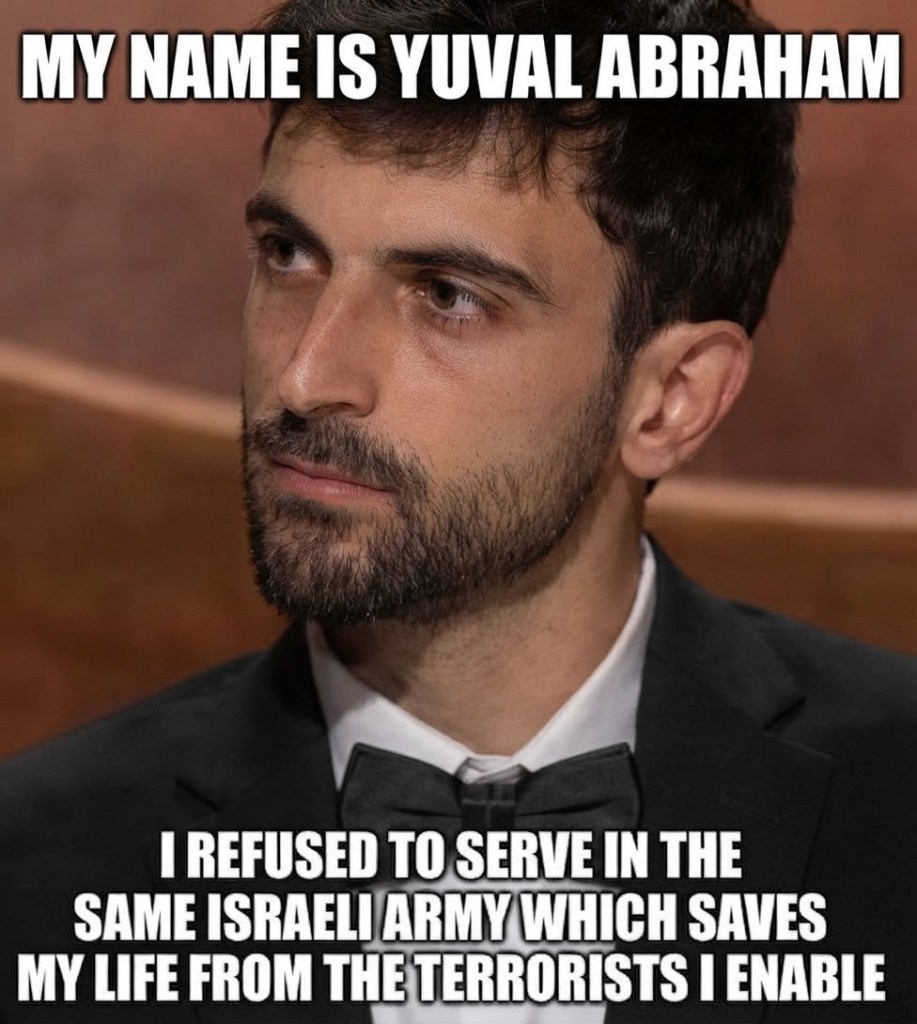
Hollywood may applaud Yuval Abraham, but their applause is not artistic. It is political, just as his movies are interventions meant to harm and impair Israel, made during an existential war for Israel.
As such, he arguably belongs in an Israeli jail.
Abraham, an Israeli filmmaker, refused to serve in the IDF. And ever since, his body of work frames Israel, its military, and its legal institutions through a single accusatory lens.
His first celebrated film, “No Other Land,” presents Masafer Yatta in the southern Hebron Hills as evidence of systematic Israeli dispossession. It depicts Firing Zone 918 as a manufactured military pretext for expelling Palestinians and treats Israeli land-use enforcement as ethnic cleansing.
But Masafer Yatta is not a legal vacuum. It is in Area C: territory placed under Israeli civil and security administration in the Oslo framework pending a final-status agreement. The issue was litigated for more than two decades. In 2022, Israel’s High Court of Justice rejected challenges brought by residents of several hamlets and permitted enforcement of the firing-zone designation in relevant areas. Israeli policy is not arbitrary or lawless.
Abraham’s latest post–October 7 documentary, “NAZA,” goes much further. Built around accounts from 24 anonymous purported military and intelligence insiders—with identities, voices, and appearances obscured—it alleges that Israel systematically accepted mass civilian killing through its Gaza targeting practices.
The IDF has categorically rejected those allegations. It says the unnamed individuals’ identity, service, role, access, and claimed involvement cannot be independently verified. It has also rejected the specific claim that it planned, authorized, or carried out a Gaza strike while anticipating 500 civilian deaths.
This is the critical distinction: anonymous testimony can justify inquiry; it is not self-authenticating proof. A film that presents fiercely contested claims as established fact—while omitting the IDF’s denial, relevant legal history, operational realities, and counterevidence—does not simply criticize policy. It functions as wartime political propaganda.
Israel’s Penal Law does not criminalize dissent, uncomfortable reporting, or opposition to a war. Section 103 requires proof that, during actual fighting, information was disseminated with intent either to cause public panic or to impair state security.
The possible penalties are up to five years in the first circumstance and up to ten years in the latter.
Intent, knowledge, falsity, and causal context can and should be established in a court of law.
In this case, Abraham belongs on trial.
When Israelis use unverifiable allegations to portray their own country as deliberately murdering civilians—at the very moment Israel is fighting enemies committed to its destruction—this is the deliberate weaponization of cinema to damage Israel’s security and legitimacy.


You must be logged in to post a comment.