Disclaimer: This post is an analysis of thematic continuity between material that appeared in the Q drops from 2017 to 2020 and the language and priorities expressed in President Trump’s address to the United Nations General Assembly on September 22, 2026. It is neither an endorsement of the Q drops, a pro-Trump statement, nor a critique of the President. Its purpose is solely to examine observable overlap in diagnosis and emphasis.
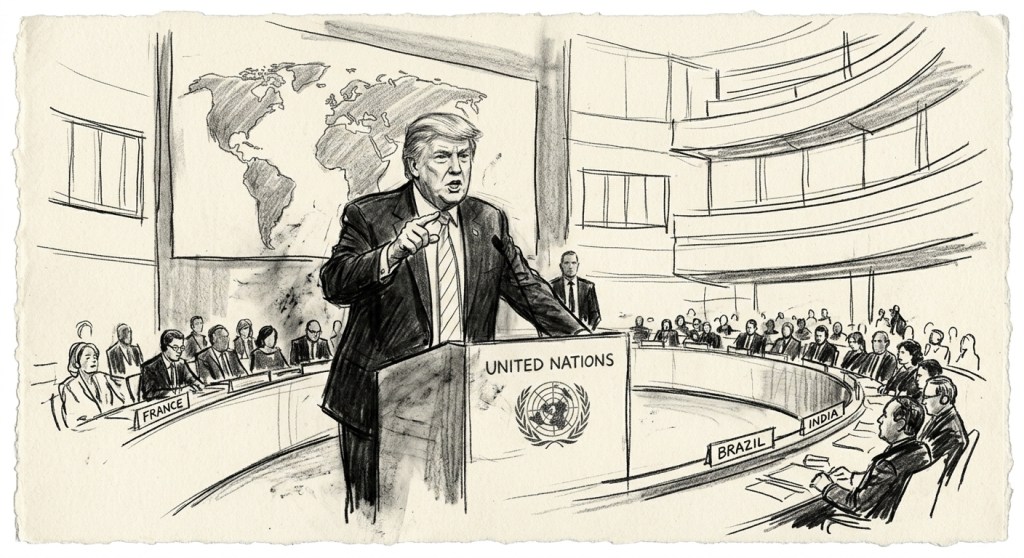
On September 22, 2026, President Donald Trump stood before the United Nations General Assembly and delivered a speech that was part victory lap, part policy declaration, and part ideological broadside. He celebrated American economic and military strength, claimed credit for ending multiple wars, detailed aggressive action against Iran and Venezuelan cartels, and announced new security arrangements involving Greenland.
The most consequential passages, however, were those aimed at the institution hosting him and at the broader project of global governance.
Those passages were not new ideas. They were the public, institutional expression of themes that had appeared in the Q drops years earlier. The Q archive, compiled from 2017 onward, contained relatively few explicit references to the United Nations, artificial intelligence, or “globalists.” When those subjects did appear, the framing was consistent: skepticism toward centralized international institutions, concern that advanced technology could become a tool of elite control, and insistence that national sovereignty must take priority over transnational agendas.
Trump’s 2026 address did not need to quote the drops. It expressed similar concerns at presidential scale.
Theme #1: The United Nations as Unelected Globalist Bureaucracy
Q’s mentions of the UN were sparse but pointed. On December 19, 2017, when an anon speculated that “the left is grubbing for justification to take over with UN troops,” Q replied: “No UN troops. Fake.” On January 5, 2019, Q asked why the UN had for decades pushed donor countries to contribute 0.7 percent of GDP to foreign aid and answered his own question: “The corruption (infiltration) at the top (WW) has spread like cancer.”
Trump went further and made the critique operational. He declared that the United Nations “must stop imposing the far left agenda of globalist bureaucrats who nobody ever elected.” He said his administration had cut the UN budget by 15 percent in 2026 and eliminated more than 4,000 positions. He condemned the International Maritime Organization for pursuing a global carbon tax on shipping and stated the principle without qualification: “There is no global government. And while I’m president, there will be no global taxes.”
He also attacked the International Criminal Court as a “rogue institution” with no jurisdiction over Americans and called on other member states to withdraw. He accused UN human-rights officials of focusing on American immigration enforcement and “transgender utilization” while remaining silent about the persecution of Christians and the crimes of the world’s most repressive governments. Mass migration, he argued, was being promoted by “globalists” who were eroding historic cultures and national inheritance. “There is no human right to illegal immigration,” Trump declared, “but there is a right to remain a sovereign nation.”
Q questioned the motives and legitimacy of UN mechanisms. Trump treated international bureaucracy as a political force to be confronted through funding cuts, institutional withdrawal, and an explicit defense of national sovereignty.
Theme #2: Globalism Versus Sovereignty
This was the clearest and most sustained point of continuity. On November 11, 2017, Q wrote: “Families combined (TRI) = NWO,” then asked whether China, Russia, and others were coordinating with the American president to eliminate it. On March 10, 2018, Q clarified: “NWO [N does not refer to ‘New’]. The Nazi order.” On January 5, 2019, Q defined the larger struggle as “A war against GLOBALISM. A war to retain SOVEREIGNTY,” arguing that narratives of racism and fascism were deployed against those seeking to “END GLOBALISM in favor of NATIONALISM,” defined in terms of heritage, culture, preservation, and security. On January 23, 2020, after British political developments, Q asked: “Globalism dead?”
Trump’s speech was saturated with the same binary. Globalist bureaucrats, global taxes, global migration schemes, and global attempts to regulate technology were all presented as threats to the right of nations to govern themselves. Sovereignty was not an abstract slogan. It was the practical foundation for border control, cultural continuity, military independence, and economic policy.
The speech repeatedly returned to the claim that America had reasserted power in its own hemisphere, secured its borders, and refused to subordinate its interests to unelected international bodies.
Theme #3: Artificial Intelligence as a Domain of Control
Q treated advanced AI as a strategic weapon in the hands of elite networks. On February 18, 2018, Q referenced “PROJECT DEEPDREAMv2[A]].” On November 11, 2019, Q highlighted a Google whistleblower under the headings “Project DeepMind?” and “AI Manhattan Project,” linking the technology to planetary surveillance and earlier “Project DeepDream” efforts. On May 4 and 5, 2020, Q claimed that DARPA, Facebook, Twitter, and Google were coordinating the development of an AI tool intended to counter the reach of Q supporters, framing the issue as information warfare. On October 17, 2020, Q pointed to reporting about a DARPA-funded AI-driven information-warfare system allegedly used to target pro-Trump accounts.
Trump addressed the same technology under a different name and with a comparable concern about control. He rejected the term “artificial intelligence” as misleading—“the use of the word artificial makes intelligence fake”—and instead called it “superintelligence,” or “SI.” More importantly, he declared that the United States “totally rejects any attempt to construct a globalist scheme to control” the technology.
He argued that some of the same figures who previously warned of climate catastrophe were now generating alarm about AI. He framed the issue as a strategic contest: “whoever wins SI wins.” The United States was already leading, he said, and would remain so, with Justice Department intervention if necessary.
Q portrayed AI as a potential instrument of surveillance, information warfare, and narrative control. Trump rejected the prospect of globalist regulatory capture and asserted that AI would remain a central arena of American national power. Both treated the technology not as neutral, but as decisive in the contest between national power and transnational control.
The What-If: What If Q and Trump Were Aligned?
The relevant “what-if” is not whether Q was formally connected to Trump, received inside information, or accurately described a hidden chain of command. The public record does not establish those propositions.
The question is whether Q and Trump shared an ideological frame visible in public language, recurring themes, and policy emphasis.
Under that interpretation, Q was not important because it accurately predicted discrete events. It was important because it assembled a worldview that aligned tightly with Trumpworld: the United States had been weakened by an international managerial order; national sovereignty had been subordinated to global institutions; elite networks exercised excessive influence over information, finance, technology, and security policy; and Trump represented a counterforce willing to break the consensus.
Trump’s UN address supplied the public-policy version of that worldview. The overlap appears in the preceding sections: institutional skepticism, national sovereignty, border control, technological competition, and resistance to supranational authority.
This does not prove that Q+ was Trump. It does suggest that Q’s most durable themes were not politically alien to Trumpism. They were an intensified, cryptic, and conspiratorial form of arguments Trump later made openly before the world’s most prominent international institution.
A Different Reading of Russia and China
If Q and Trump are understood as sharing a broad anti-globalist frame, the usual map of international politics changes. Russia and China no longer appear only as foreign adversaries, strategic competitors, or authoritarian threats. In the Q-inflected worldview, they become ambiguous actors in a larger struggle against a Western-led transnational order.
That is the significance of Q’s November 2017 question about whether “China, Russia, and others” were coordinating with Trump against the “NWO.” The question did not merely flatter Trump. It proposed a different geopolitical axis: that conflict among great powers might be secondary to a more fundamental conflict between sovereign states and global institutions.
In that framework:
- Russia can be interpreted not primarily as a rival power, but as a state resisting NATO expansion, Western financial pressure, cultural liberalization, and supranational governance.
- China can be interpreted not merely as an economic and military competitor, but as a civilizational state asserting national control over technology, industry, borders, and political authority.
- Europe can appear divided: formally allied with the United States, but often portrayed in Q-style rhetoric as captured by post-national bureaucracy, migration policy, climate regulation, and elite administrative institutions.
- International bodies such as the UN, the ICC, the World Health Organization, and climate-governance mechanisms can be cast as instruments through which national sovereignty is diluted without direct democratic consent.
This reading is politically powerful because it replaces the familiar “democracy versus autocracy” framework with a competing binary: nationhood versus globalism.
It is also analytically hazardous. Russia and China do not oppose transnational power in a principled or uniform way. Both project power beyond their borders, use international institutions when useful, and pursue their own state interests. Nor does shared opposition to a UN policy, an international court, or a global tax proposal establish a coordinated anti-globalist alliance. The “what-if” is an interpretive lens, not proof of a hidden coalition.
What It Suggests About America
The resonance between Q themes and Trump’s rhetoric points to something larger than Q itself: a substantial American constituency has come to view the central institutions of post-Cold War global governance with suspicion rather than reverence.
For that constituency, the question is not whether international cooperation is ever necessary. The question is who decides, under what authority, and with what practical ability citizens retain to reverse those decisions.
The appeal of this perspective rests on several anxieties:
- Democratic accountability can weaken when power shifts from elected legislatures to treaty bodies, regulatory networks, courts, multinational companies, and expert institutions.
- Migration, climate policy, trade, public health, war, and digital governance are increasingly addressed across borders, while ordinary voters may feel they possess little practical control over the decisions.
- Technology platforms and AI systems can concentrate informational power in the hands of governments, corporations, and professional gatekeepers.
- American elites can appear more committed to abstract international norms than to border enforcement, industrial capacity, social cohesion, national independence, or the lived concerns of citizens.
- Criticism of international institutions can be dismissed as extremism before the institutional critique itself is seriously considered.
Trump’s UN speech drew strength from this mood. His language did not ask Americans to see sovereignty as a dated relic. It treated sovereignty as the condition that makes self-government possible: control over borders, taxation, military commitments, law enforcement, culture, and technological development.
The Q phenomenon translated those anxieties into a maximalist narrative of infiltration, secret coordination, and hidden enemies. Trump’s speech stripped away much of that esoteric structure and expressed the underlying sentiment through the language of presidential policy.
Reinterpreting Trump’s Moves
Viewed through this lens, Trump’s actions can be read less as disconnected provocations and more as components of a coherent sovereignty-centered program.
- Cutting or restructuring UN operations
- Conventional interpretation: Budget pressure, institutional conflict, or unilateralism.
- Q-alignment interpretation: Resistance to unelected international bureaucracy and a reassertion of national control.
- Attacking the International Criminal Court
- Conventional interpretation: Protection of U.S. troops and rejection of foreign legal jurisdiction.
- Q-alignment interpretation: Refusal to recognize a transnational authority over American citizens and American military power.
- Opposing global taxes or climate mandates
- Conventional interpretation: Economic nationalism and deregulatory politics.
- Q-alignment interpretation: Rejection of mechanisms that could establish supranational fiscal authority.
- Treating AI as a strategic contest
- Conventional interpretation: Competition with China and concern about regulation.
- Q-alignment interpretation: Resistance to the capture of civilization-shaping technology by global institutions or elite networks.
- Hard-line border policy
- Conventional interpretation: Immigration restriction and domestic political mobilization.
- Q-alignment interpretation: Defense of sovereignty, cultural continuity, and the right of a people to determine national membership.
- Pressure on allies and skepticism toward multilateral commitments
- Conventional interpretation: Transactional diplomacy.
- Q-alignment interpretation: An effort to compel allies and international institutions to recognize that American commitments are conditional on American interests.
- Engagement with adversaries such as Russia or China
- Conventional interpretation: Strategic bargaining, inconsistency, or accommodation.
- Q-alignment interpretation: A willingness to negotiate across ideological lines when doing so could weaken a globalist consensus, reduce the risk of permanent conflict, or preserve American freedom of action.
This is an interpretive framework, not an endorsement. It presents Trump’s moves as parts of a broader challenge to the post-1945 and post-Cold War international architecture.
Enacting “America First”
The key distinction is between a foreign policy of permanent blocs and a foreign policy of contingent sovereignty.
Under the first model, America’s allies and enemies are determined largely by regime type, institutional membership, shared ideology, and inherited alliances. Under the second, every relationship is judged by whether it advances American power, independence, borders, productive capacity, security, and freedom of action—in short, whether it puts America first.
Trump’s UN speech leaned decisively toward the second model. He asserted American military primacy in the Western Hemisphere, threatened severe action against Iran, claimed active involvement in resolving the Russia-Ukraine war, urged withdrawal from the ICC, opposed global control of AI, and rejected international taxation.
The resulting foreign-policy outlook is not necessarily isolationist. It permits alliances, trade, deterrence, negotiations, and international cooperation. But it makes each of those commitments conditional rather than permanent. International institutions are treated not as inherently legitimate sources of authority, but as arrangements that must remain subordinate to the interests and sovereignty of the nation-state.
The Necessary Caution
The evidence supports a claim of thematic continuity, not a claim of secret operational coordination. Similar rhetoric, parallel policy priorities, and shared criticism of global institutions do not establish that Q was Trump, represented Trump, or possessed privileged access to government decision-making.
This distinction matters because Q’s posts mixed recognizable concerns about surveillance, bureaucracy, media power, sovereignty, and elite influence with broad unsupported allegations and conspiratorial claims that contributed to polarization and cult-like political dynamics.
The “what-if” does not require accepting Q as literal intelligence. It asks whether Q identified and amplified an American political demand that Trump later expressed openly: that national governments should answer first to their own people rather than to an international class of officials, institutions, courts, corporations, and experts.
Trump’s 2026 UN address does not prove that the Q drops were prophetic in the narrow sense. It does show that the worldview beneath many of their recurring themes—sovereignty over globalism, suspicion of centralized international authority, and anxiety about elite control of technology—has moved from anonymous message boards to the podium of the United Nations.
AI image.


You must be logged in to post a comment.