We are entering a new era of public accountability—powered by citizens, not DOGE.
An independent researcher has built a comprehensive audit of Rep. Ro Khanna’s finances. The same checks can—and should—be built directly into Congress’s financial disclosure systems. Potential conflicts could be flagged automatically.
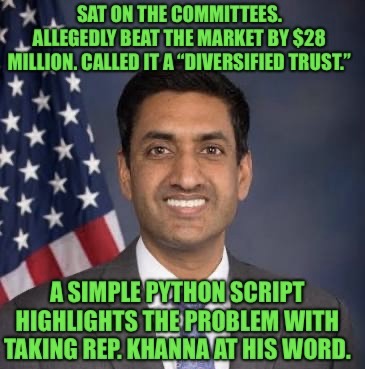
According to a new complaint submitted by Kevin Bass (https://x.com/kevinnbass/status/2051626873436647618?a=1V_ZBYHbiUAMkLe_oHw&s=46), trades associated with Khanna’s family trusts allegedly outperformed the market by approximately $28 million. See six areas of concern:
- 624 allegedly late STOCK Act trade reports.
- Defense-sector stock purchases preceding defense legislation and federal contracts.
- More than 1,200 pharmaceutical-company trades near government drug-pricing actions.
- 186 trades coinciding with major SEC Form 8-K disclosures, plus 86 allegedly matching same-day corporate insider activity.
- Campaign contributions from former government officials who subsequently became lobbyists.
- Missing asset disclosures alongside margin-backed options trading.
Khanna serves on three House committees:
- House Armed Services Committee: Ranking Member of the Cyber, Information Technologies, and Innovation Subcommittee; member of the Seapower and Projection Forces Subcommittee. Their work encompasses defense spending, Pentagon technology, military innovation, and procurement.
- House Select Committee on Strategic Competition Between the United States and the Chinese Communist Party: Ranking Member, with responsibilities involving U.S.-China technological competition, semiconductors, AI, export controls, and strategic supply chains.
- House Committee on Oversight and Government Reform: Member of the Economic Growth, Energy Policy, and Regulatory Affairs Subcommittee and the Cybersecurity, Information Technology, and Government Innovation Subcommittee. Its broader oversight jurisdiction encompasses federal agencies and government operations, relevant to the pharmaceutical and healthcare policy issues raised in the complaint.
Khanna has maintained his innocence — says his money is handled through a diversified trust.
But the larger problem is institutional: Congress has not developed an effective technical infrastructure for independently monitoring its members’ financial activity. Nor do they necessarily have the technical expertise to build it.
Enter citizen participation.
Bass used conventional, reproducible tools—including Python scripts, optical character recognition (OCR), automated retrieval of House Clerk and IRS records, GitHub, and OpenTimestamps—to assemble and document the audit.
These are not proprietary AI conclusions or black-box algorithms. They are techniques others can inspect, reproduce, improve, and contribute to.
That is meaningful government efficiency: not simply doing less, but making government more accountable to the people it serves.
Disclaimer: Personal time, device, opinion, and premises.


You must be logged in to post a comment.