A long time ago, when I was a brand consultant in private industry, I remember that clients were rarely interested in building long-term brand equity—the tangible financial and commercial value a company gains from customer trust, recognition, and loyalty—whereas we, as consultants, were constantly urging them to do so.
What clients wanted was beautiful brochures, print materials, glossy graphics, and copy that told them a flattering story about themselves.
Yet what we tried to impress upon them is that when you build a strong relationship with customers—rooted in a promise you make and keep every single day, even when it’s inconvenient—they will forgive you when you make a mistake.
Financial research backs this up: companies with high brand equity consistently outperform the broader market on a risk-adjusted basis, command stronger pricing power, and weather downturns with lower volatility because loyal customers do not abandon them at the first sign of trouble.
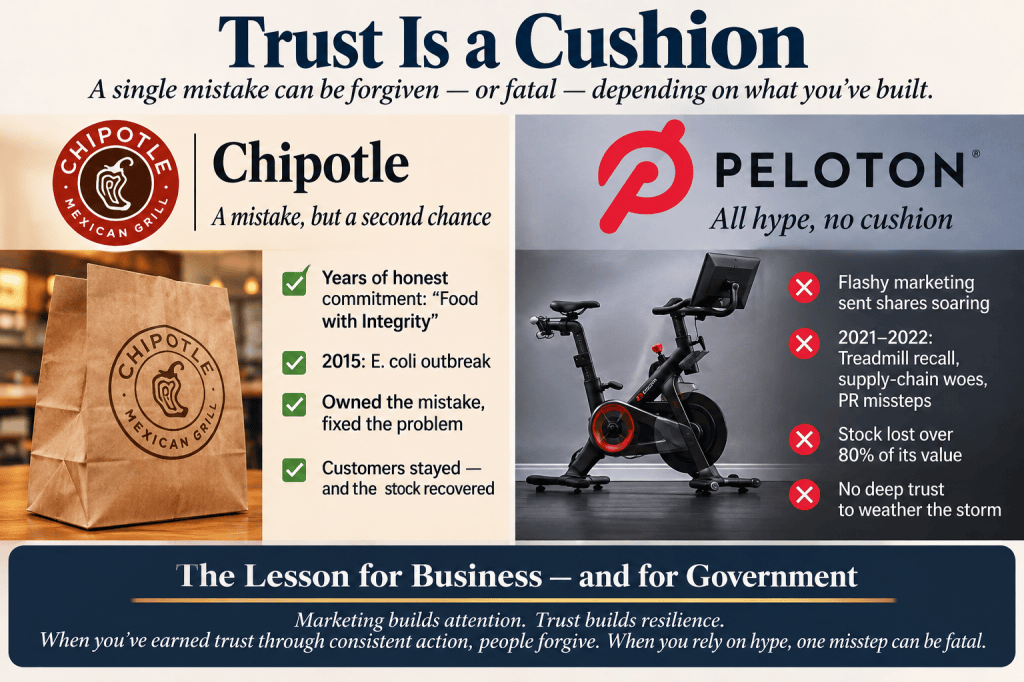
Look at Chipotle after its 2015 food-safety outbreaks: because the company had spent years keeping an honest, daily promise around transparent sourcing and quality, customers forgave a serious operational failure once leadership owned the mistake and fixed it—allowing the stock to recover and eventually hit new highs.
By contrast, when a company relies on glossy hype rather than deep customer trust, a stumble can be devastating. Peloton built a dazzling, aspirational image that sent its stock soaring, yet when it hit operational missteps—a treadmill recall, inventory blunders, and tone-deaf messaging—it lacked the durable goodwill to cushion the blow, losing more than 80 percent of its market value.
Trust acts as a protective cushion on Wall Street just as much as it does on Main Street.
It is worth remembering that lesson now, as we watch politicians try to erase the mistakes they make all the time. People understand that governing is hard. What they don’t understand is a failure to consistently communicate the purpose of governing, their individual roles within the system, and how the system is accountable to them.
In the end, branding and governing share the same dynamic: shortsightedness leads to financial loss and social fractures.
What about you, and your personal brand? Regardless of your industry or role, make a valuable promise every single day, and then show up and keep it. Others will notice.
While you may not see the fruit of your labor right away, know that trust is the only business currency more important than time.
You will see reward down the road, not the least of which is that you’ll be proud of the person you see in the mirror when you brush your teeth each day.
Public domain. AI image.


You must be logged in to post a comment.