I would not be here if my grandmother (Bubbie) had believed what she was told.
That is the sentence I keep coming back to. Everything else — Operation Paperclip, the declassified files, the allegations about “Dr. Green” and “Steve Rabel,” the whole sprawling mythology of Josef Mengele in America — everything else is secondary. The heart of this is simpler and more Jewish: keeping faith and pressing forward despite how everything looks.
Part of that is marriage. Part of it is telling the story. Part of it is documenting it in the record and not discounting things because we aren’t fully sure.
This is the story of how my family kept going.
The Curse
My paternal grandmother, Mathilda Stroli, née Mandel, was born January 22, 1922 in Cluj, to parents born in 1893 and 1899.
After Hungarian forces occupied Cluj in spring 1940, anti-Jewish persecution escalated. In April 1944, between Pesach and Shavuot, Mathilda and her family were forced into the Cluj ghetto for three weeks. In May 1944, she was deported on the very first transport from Cluj to Auschwitz-Birkenau.
She was 22.
On her first day in Auschwitz, she got her period. She had no sanitary supplies. She whispered her distress. A female supervisor told her plainly: they put something in your food to stop your periods.
Imagine that. You have been torn from your home, packed into a cattle car, stripped and shaved and numbered. And now you are told your daily bread — the little that keeps you alive — is being used to turn off your womanhood.
Mathilda believed they were poisoning them. She believed they were going to die. She did not say it out loud. She had her younger sisters with her — Piri Pearl and Vicki — and other young women from Cluj. She swallowed her terror and put on an encouraging, optimistic face so she would not frighten them.
For three months in Auschwitz, her period never came.
In the fall of 1944 she was selected and sent to Salzwedel work camp. The food there was poor quality, but different. On the exact day she arrived and ate different food, her cycle returned. For her, that was proof. Her body told her the truth.
Historians today will tell you that starvation, rapid weight loss, trauma and terror alone stop menstruation. They call it amenorrhea. That is medically true. Survivors across many camps also reported being told about bromide or chemicals in the food. That is also true. I don’t need to resolve the toxicology to honor what my grandmother knew: her body was being used against her.
She was liberated at Salzwedel on Saturday, April 14, 1945 — she always said by American Jewish soldiers. Her testimony was recorded in Toronto in 1999 by the USC Shoah Foundation.
And at some point in Auschwitz, Dr. Josef Mengele looked at her and said in German what she would hear for the rest of her life: “You stinking Jew, you will never have a child.”
That was meant to be the end. A curse on her future. A final selection — not of her body that day, but of all the children she would never have.
The Answer: Marriage As An Act of Faith
My father, Alexander Stroli, tells it as his mother told it to him. I want you to hear his voice.
“When my mother came out of Auschwitz at the end of ’45, she was liberated. Dr. Mengele, that evil doctor, told her in German, I’ll translate it roughly, ‘You stinking Jew, you will never have a child.’ Okay?
So when she came back to Cluj, your great-grandfather Shia was already engaged to Halaya. My father was there. My mother arrived. So Shia proposed a shidduch for my father with my mother. In other words, his sister with his wife’s brother.
So my mother went to him. She told me the story herself, so I’m telling you exactly as it happened. She said, ‘I wanna tell you something. I know that I have the approval of my parents to marry you, but I have to tell you, this German doctor did things to me in concentration camp where he told me, and he called me a stinking Jew, I will never have children.’ And you know what my father’s answer was? Never to be forgotten.
And he said, ‘Well, the Germans tried it their way. It didn’t work. Let’s try it my way, see if it works.’”
“Let’s try it my way.”
That is not a medical opinion. That is not a rebuttal. That is faith.
My grandfather had no way of knowing if he was right. My grandmother had every reason to believe Mengele was right. She had been told by a man with absolute power over life and death that her body was ruined. She had three months of her body confirming it.
They married anyway in 1946. They pressed forward despite how everything looked.
My father was born. Two names —Avraham and Moshe — after the dead, to bring their memory back into the world. My father was the first grandchild of his generation on both sides. He was proof that the curse did not hold.
That is why I am here. Because of the faith of two people when everything said not to have it.
God won; the Nazi scientists failed.
The Second Act of Faith: Telling the Story
My grandmother could have chosen silence. Many did, and I do not judge them.
She chose to tell. She told my father. She told the USC Shoah Foundation in Toronto in 1999. She told about the food and the period and the terror she hid from her sisters.
Telling is also an act of faith. When you tell, you say: someone in the future will need this. Someone will listen. My life did not happen for nothing.
I am that someone in the future. I needed it. I need to tell it to my children. The telling is the bridge between her body in Auschwitz and my body typing this now.
When we stop telling because we are afraid we will be dismissed — “you are misremembering, it was just malnutrition” — when we discount our own lived memory because it is not fully documented, we do Mengele’s work for him. We end our own future.
Keeping faith means telling the story even when you know some will pick it apart.
The Third Act of Faith: Putting It In the Record Without Discounting
This is where this project becomes bigger than my family.
Because there are things we know happened but cannot fully prove, and things we suspect happened that we cannot yet prove, and the temptation is to throw them out.
I have felt that temptation while researching this blog.
The archive is clear on some things:
SS physician Josef Mengele arrived at Auschwitz on May 30, 1943 and fled on January 17-18, 1945. After Germany surrendered, he was captured by U.S. forces and held in two American-run POW camps in Bavaria, Schauenstein and Helmbrechts, and mistakenly released in June 1945 under false papers as “Fritz Hollmann,” with another brief detention and release in August 1945. The U.S. Department of Justice Office of Special Investigations, in In the Matter of Josef Mengele (October 1, 1992), concluded U.S. authorities failed to identify him because his name was not yet on the central wanted lists and he lacked the SS blood-type tattoo. He escaped to South America in July 1949 without U.S. assistance.
Operation Paperclip was also real. Authorized by President Truman in 1945 and run by the Joint Intelligence Objectives Agency, it brought more than 1,600 German scientists, engineers and technicians — many with Nazi ties — to America. They worked at Fort Bliss, White Sands, NASA, the CIA. Wernher von Braun is the most famous. Their biographies were sanitized.
For years I heard Paperclip got its name because clerks marked the files of the most evil Nazis with paperclips. The documented truth is more cynical: at Kransberg Castle, codenamed Dustbin, clerks used paperclips to mark files that needed to be pulled from the pile for special handling — scientists who were inadmissible under Truman’s order because they were active Nazis, whose files needed to be rewritten with false, cleaned biographies. The paperclip was not a badge of evil. It was a tool of cover-up.
Officially, Mengele was never part of Paperclip. Officially, he died in Brazil in 1979, where his remains were later identified.
Officially is a powerful word. It is also, as my grandmother taught me, not the final word.
Because then there are the accounts that are not in the official record.
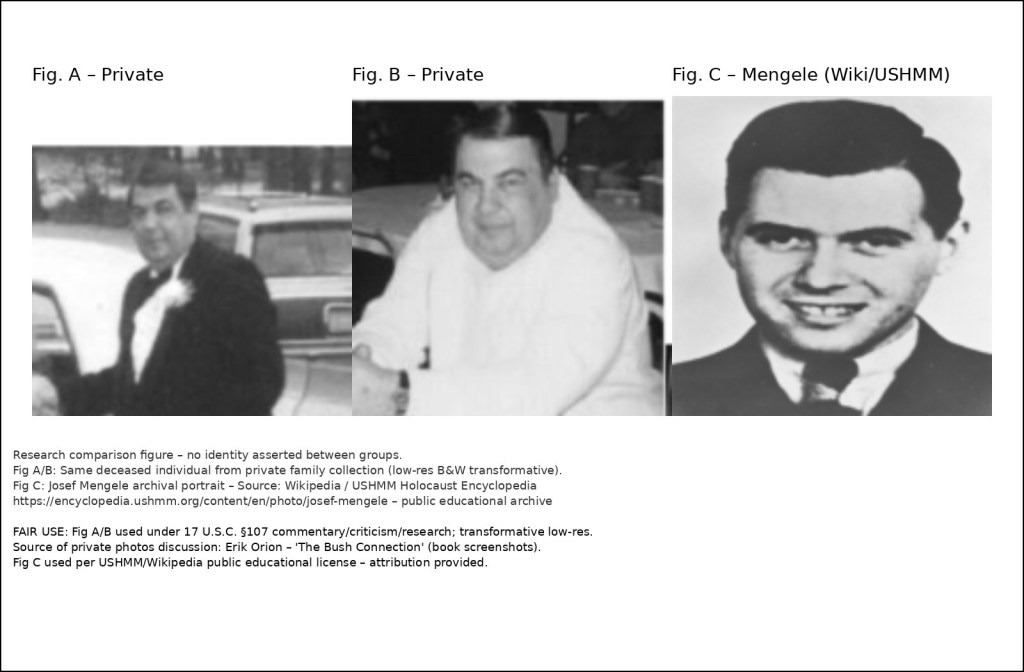
Erik Orion (pseudonym), author of The Bush Connection, claims Mengele lived for decades in America as “Steve Rabel” in Clifton, New Jersey and Florida, as part of a vast alleged confession by Otto Skorzeny involving Nikola Tesla’s stolen technology and George H.W. Bush being “George H. Scherff Jr.” These claims are not supported by mainstream evidence or forensic identification of Mengele’s remains, and the claim about President Bush is not presented as fact.
Frida Halliday’s account is different. She says in her own published testimony that she and her twin sister Claire were enrolled as toddlers — from age 2, from 1963-1969 — by their mother, who met a man she calls “Dr. Green” through the Rosicrucian Temple in San Jose, into a “behavior modification” program at Stanford / SRI, which she describes as CIA torture experiments. She identifies “Dr. Green” as Mengele. Her core memory, dated to 1965 when she was four, is screaming “GET AWAY FROM MY SISTER!” and being thrown down stairs, breaking her bones.
This testimony has not been corroborated by declassified MK-Ultra records, SRI archives, or Stanford records linking Mengele to SRI. The alias “Dr. Green” appears in other survivor literature but has never been forensically or legally tied to Mengele.
And yet — it is documented fact that the CIA did conduct non-consensual experiments on children and adults during MK-Ultra, and that Stanford and SRI did conduct behavior modification research with government funding.
Here is where my principle applies: not discounting things because we aren’t fully sure.
If I had applied the standard of “fully sure” to my grandmother, I would have thrown out her story. I would have said, “Amenorrhea is explained by malnutrition, you must be misremembering the chemical part.” I would have lost the most important truth: that she experienced her food as poison, and that experience shaped how she protected her sisters.
If I apply “fully sure” to Paperclip, I would have said, “There is no official paper with Mengele’s name on it, so America would never bring Nazis here.” But America did.
So I do not discount Frida Halliday because I cannot prove it. I preserve her account, in her own words. I label it as unverified. I check it against what is documented. I leave it in the record so that someone in the future — perhaps with a declassification we do not have today — can review it analytically, the way someone today can review my grandmother’s USC Shoah testimony.
Documenting is an act of faith. You say: I do not know what will be needed later. I will not be the one who decides what is too strange to preserve. I will put it in the record, clearly labeled, and let the future judge.
That is what the USC Shoah Foundation did for my grandmother in 1999. That is what I am trying to do here.
What Keeping Faith Looks Like
Fundamentally, this blog is about one mitzvah that makes all the others possible: believing in God and therefore pressing forward despite how everything looks.
It looked like my grandmother would never have a period again. She did.
It looked like she would never have a child. She had my father.
Marriage was the first act of faith. My grandfather saying, “Let’s try it my way.” He could not prove it would work. He tried anyway.
Telling the story was the second act of faith. My grandmother saying, “I will tell what they did to us in our food, even if no one believes me.” She could not prove the chemistry. She told anyway.
Documenting is the third act of faith. Saying, “I will put this in the record — my grandmother’s testimony, the OSI report on Mengele, the JIOA paperclip memos, Frida’s account of Dr. Green — even when I am not fully sure what it all means, because discounting is also a choice, and I will not be the one to erase.”
If you are reading this because your family told you “you will never,” or because you have a story that feels too strange to be believed, or because you are holding a piece of paper that does not match the official story — keep going.
The Germans tried it their way. It didn’t work.
Let’s try it our way.
Sources & Fair Use
- Mathilda Stroli, USC Shoah Foundation Visual History Archive, Toronto, 1999.
- Family oral history, Alexander Stroli.
- U.S. Department of Justice, Office of Special Investigations, In the Matter of Josef Mengele (Oct. 1, 1992).
- Operation Paperclip: National Archives JIOA records; Annie Jacobsen, Operation Paperclip (2014).
- Frida Halliday, official Substack account @fridahalliday — Notes: “If I Make My Bed in Hell, You Are There. In 2016, I began to recall my early childhood when my twin sister Claire and I were used as guinea pigs in CIA mind control experiments at Stanford Research Institute during the 1960’s”; summary notes: “Says Josef Mengele hired by Stanford Research Institute 1960” and “Alleges being MK-Ultraed at Stanford Research Institute at the youngest age then trafficked out of Moffett AFB”.
- Erik Orion, The Bush Connection (Independently published, April 4, 2021) — non-fiction history book detailing Bush family’s connection to Nazi war criminals per publisher description, ISBN 9798565414974. Claims cited from publisher listing: “HITLER’S SS GESTAPO MERGED WITH THE AMERICAN OSS TO FORM THE CIA” and “DR. JOSEF MENGELE IS THE ZODIAC KILLER, THE REAL BOSTON STRANGLER AND THE REAL 2001 ANTHRAX MAILER KILLER”.
- Figs A/B: low-resolution excerpts used under 17 U.S.C. §107 for commentary, criticism, and research on public claims in Erik Orion – The Bush Connection. Transformative use. Fig C: USHMM / Wikipedia public educational license with attribution.


You must be logged in to post a comment.