Free to republish with attribution.
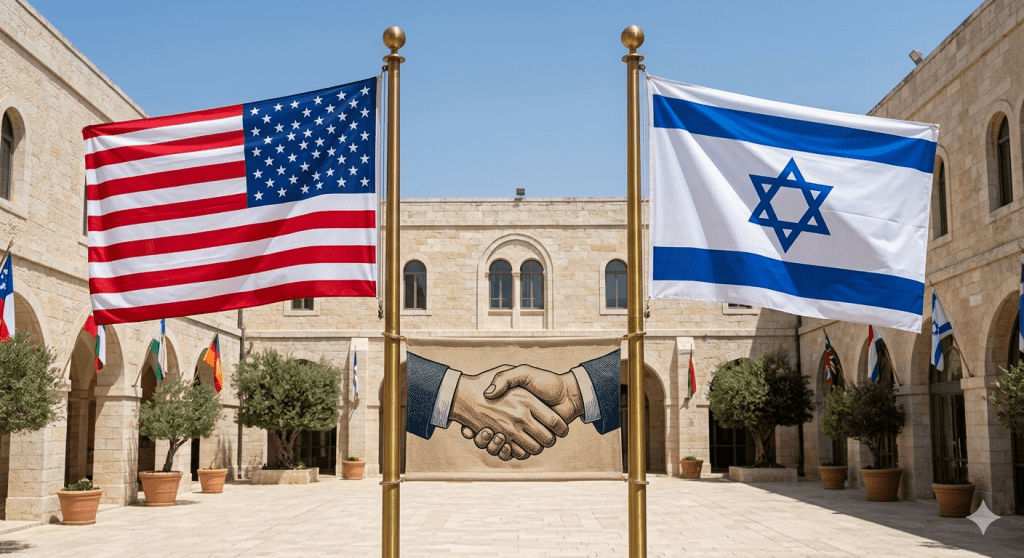
THE FEAR IS REAL
For Jews watching the rise in antisemitic rhetoric and anti-Israel political messaging, it is understandable to feel uneasy. Certainly the headlines can make it seem as if the U.S.–Israel relationship is weakening, becoming transactional, or drifting into uncertainty.
THE REALITY IS DIFFERENT
But that is not the same thing as the underlying reality. The truth is that the relationship between the U.S. and Israel not only remains strong but is getting stronger.
The key is to look at the transition from aid to partnership, embodied and embedded in American law, defense policy, intelligence coordination, and supportive political practice.
DOGWHISTLING vs. MARRIAGE
Remember, public messaging is often designed to signal something to a specific audience. It’s a vote tactic.
Law is different. Law creates structure. And when you look at the structure, the U.S.–Israel relationship is still very strong.
- The NDAA and Why It Matters
The first thing to understand is the National Defense Authorization Act, or NDAA. The NDAA is the annual law that authorizes defense programs and sets policy for the Pentagon.
It is not just a budget document; it is one of the most important vehicles Congress uses to shape military priorities, procurement, technology development, and defense cooperation.
When U.S.–Israel provisions are placed inside the NDAA, they are not symbolic gestures. They are built into the architecture of American defense policy.
That is exactly what is happening now.
- The FUTURES Act – Defense & Technology Cooperation
One major provision is the FUTURES Act, which is part of the FY27 NDAA. Its purpose is to formalize a U.S.–Israel Defense Technology Cooperation Initiative.
That means the Pentagon would have a designated lead to coordinate joint work on advanced defense areas like artificial intelligence, quantum computing, cyber, autonomous systems, and missile defense.
This is not a temporary political statement. It is an institutional mechanism designed to make cooperation easier, faster, and more durable.
The provision directly undermines the “stop giving aid to Israel” rhetoric because it explicitly changes the relationship from a simple aid framework to a partnership framework.
In the old political shorthand, people complained about the U.S. “giving aid” to Israel.
Due to enemy propaganda, no amount of explanation was sufficient to help the public understand how the relationship actually works.
Much of the military assistance has historically been tied to American-made defense goods and services, which means a large share of the value flows back into the U.S. defense industrial base.
Israel also contributes technology, operational experience, and innovation that the U.S. wants access to.
So this is not a one-way transfer. It is a strategic exchange.
Israel is simply indispensable to the USA, and educated people know it.
- Intelligence Sharing
The second major provision is in the Intelligence Authorization Act. Section 622 expands and protects U.S.–Israel intelligence sharing, while making it harder for any administration to quietly reduce or suspend that cooperation.
That is important because intelligence cooperation is one of the strongest signs of trust between states.
Countries do not share sensitive intelligence casually.
When they do, it usually reflects a relationship that is operationally serious and strategically durable.
COMMON CONCERNS
Objection #1: The Vote on the Bombs
This is where many people will ask: what about the vote where Democrats voted against sending bombs to Israel?
That vote is real, and it matters politically. But it is also important to understand what it does not mean.
A vote on a specific weapons transfer in a particular moment is not the same as voting to end the U.S.–Israel alliance.
It is a signal of frustration with a particular policy, often motivated by concerns about the use of certain weapons, the humanitarian situation, or the direction of the conflict. It does not erase the broader institutional framework.
The same Congress that has seen those votes is also advancing defense technology cooperation, intelligence sharing, and long-term security architecture inside the NDAA.
Those provisions are not dependent on a single vote or a single news cycle. They are structural. And structure is what makes the relationship durable.
So the vote shows that there is political disagreement about certain weapons and tactics. That is real. But it does not mean the alliance is collapsing. The alliance is still being built into law in ways that are harder to reverse than a single vote on a shipment of munitions.
Objection #2: Intelligence and the “Spying” Concern
You hear worries about the media reporting that “Israel spied on the U.S.”
Of course both sides deny this.
Logically, every sovereign state conducts intelligence and counterintelligence. That is normal.
The more important question is whether the relationship is governed by secretive, one-way extraction or by formal, reciprocal, legally structured cooperation.
What is being built here is the second model.
Information is being shared, managed, and institutionalized rather than hidden and hoarded.
That does not eliminate all risk, but it does mean the relationship is less defined by suspicion than by interdependence.
In other words, the concern is not that the two countries know things about each other. Of course they do.
The concern is whether that knowledge sits inside a system of rules, oversight, and mutual benefit. These provisions push the relationship toward the latter.
WATCH THE MOVIE, REMEMBER IT’S A SHOW
On the surface, U.S. politics can look volatile.
“AMERICA FIRST”
On the Republican side, President Trump and Vice President Vance project an America First image to emphasize independence.
(For their part, Democrats emphasize distance from Israel to satisfy their own constituencies.)
Within the Administration, the President alternates between saying he wants a deal and saying Israel has every right to defend itself.
He sends JD Vance to sound more confrontational, while Marco Rubio sounds more conventional and diplomatic.
That kind of messaging is meant to keep the press off balance and reassure different voter blocs at the same time.
But that messaging layer does not define the actual strategic relationship. It is performance. The machinery underneath is still moving in the same direction.
IRAN NEGOTIATIONS
The same is true of the Iran negotiations. Diplomatic language creates room for maneuver, but it does not mean the U.S.–Israel relationship is weakening.
If anything, the existence of negotiations can create political cover for continued pressure on Iran while preserving the appearance of restraint. The optics and the operational reality are not the same thing.
TAKING OUT THE OPPOSITION
That is why the political fight around individual lawmakers should not be confused with the strength of the alliance itself.
Ro Khanna has been a visible critic, and AIPAC has targeted him.
Thomas Massie opposed deeper alignment, and Trump went after Massie. He lost his seat in Congress.
Either way, though these fights matter politically, they do not determine the long-term structure of the relationship.
Massie is leaving Congress. Khanna remains a critic. Yet the legislative trend continues.
THE ALLIANCE IS STRONG AND BIPARTISAN
Republicans and Democrats alike stand with Israel. That is the crucial point.
The vital 2027 legislation is not being advanced by one fringe faction.
It is moving through a bipartisan congressional process.
That means the institutional logic of the relationship still enjoys support across party lines, even when the public debate is noisy and polarized.
WHY JEWS SHOULD BE REASSURED — ALTHOUGH NEVER COMPLACENT
The U.S.–Israel relationship is not dependent on one president, one Congress, or one party’s messaging discipline.
It is supported by layers of defense cooperation, intelligence ties, shared strategic interests, and long-standing bureaucratic channels.
Those layers are harder to break than a campaign slogan or a cable news segment.
For Jews worried about antisemitism, that distinction is important.
The rise of hostile rhetoric is real, and it should not be minimized.
But public anger, partisan signaling, and social media theater do not automatically mean the alliance is collapsing.
In fact, the very existence of these formal defense and intelligence provisions shows that the relationship is still being reinforced where it counts most: in law and in institutions.
FOCUS ON ACTION
That is the real story. Not the noise. Not the posturing. Not the headlines. Not even a single vote on weapons.
The U.S.–Israel relationship remains strong because it is built on shared values, mutual gain, and the results that come from structural cooperation.
It is not built in the imaginary bubble of X and other social media platforms.
It’s easy and cheap to buy off social media influencers and send in the bots.
So, my dear fellow Jews, take a moment to step back. Readjust your glasses.
This is not the Holocaust 2.0. Far from it.
Never be fooled by the loudest voices in the room.
(AI image.)
 Writing by Dr. Dannielle Blumenthal
You must be logged in to post a comment.