There is a necessary conversation about abuse in the Jewish community.
There is also a different conversation that is being smuggled in alongside it—one about whether Torah and halacha remain binding authorities at all.
Those are not the same conversation.
No serious person denies that abuse exists or that it must be addressed.
Halacha itself recognizes harm, coercion, and the obligation to protect the vulnerable.
The question is not whether abuse should be confronted. The question is whether that effort is being conducted within a halachic framework—or used to replace it.
Historically, movements that sought to displace Torah did not present themselves as anti-Torah.
Sabbatai Zevi and his successor Jacob Frank, for example, framed their projects as higher moral or spiritual insight which elevated the status of women in Judaism.
In practice, they normalized transgression, and in particular elevated sexual boundary violations.
For example, the Frankists told Jewish wives that the Torah wanted them to sleep with other men.
This was called “sexual hospitality.”
They dismissed all opposition as a sign of Jewish corruption (“Erev Rav”).
The mechanism was consistent: redefine virtue, delegitimize critics, and relocate authority.
That mechanism is visible again.
In current activist spaces, several patterns are difficult to ignore:
• Halacha is treated as authoritative only when it aligns with predetermined conclusions; otherwise it is reinterpreted beyond recognition or dismissed as unjust.
• Due process and evidentiary standards are reframed as tools of oppression rather than safeguards against error and abuse of power.
• Rabbinic authority is characterized as inherently suspect unless it produces specific outcomes.
• Public pressure, reputational harm, and external leverage are used in place of internal halachic adjudication.
A predictable objection is: “Are you saying abuse victims should be ignored?”
No.
The opposite.
A system without standards of evidence, procedure, and accountability does not protect victims—it produces arbitrary outcomes, false positives, and loss of trust. That harms real victims first.
Another objection: “Halacha has failed, so it must be bypassed or overturned.”
That claim defies logic.
First, often the people making this claim either don’t know halacha or don’t care to observe it.
Second, failures of individuals or institutions to apply halacha correctly are not evidence that halacha itself is optional. If anything, they argue for more rigorous application, not abandonment.
Third, where an individual engages in forum-shopping for greatest advantage, between the secular courts and the Jewish courts, they are not prioritizing halacha.
A third objection: “External pressure is necessary to force change.”
But external pressure from actors who do not recognize Torah authority—or who are antisemitic—does not reform halacha; it displaces it.
Once authority is ceded outward, the standard is no longer halachic by definition.
What emerges from these trends is not a corrected system, but a parallel one—often described in halachic language, but without allegiance to halachic method, sources, or constraints.
That is not reform.
It is a replacement framework.
All of this helps to show that a seemingly “feminist” approach to domestic relations in the Jewish community might not be feminist at all.
Feminism is about fairness. It’s not about hating on men. Feminists love and value their fathers, their husbands, and their sons—and vice versa.
In a Jewish context, from a hashkafic standpoint, it is unquestionably the man who leads.
The man is commanded to learn Torah.
The man teaches Torah to his children or obtains a Jewish education for them.
The man leads the community.
The man is the head of the household.
These are not sexist constructs. These are gender roles that the Torah prescribes and outlines, in theory and in practice.
The antinomian movement currently hiding under the guise of Jewish religious feminism does not admit its true objective—which is to displace and disempower men in every possible way.
It does not begin by openly rejecting Torah.
It begins by asserting moral urgency—to eliminate domestic abuse.
It moves on to argue that abuse is perpetuated by rabbinic “enablers,” who are men.
It expands the circle of designated targets to include any men and women who don’t join in to attack their designated target of the day.
Opponents are defined as “domestic abuse enablers.”
Lies, misinformation, disinformation, propaganda and vile rumor are dressed up as truth and shopped around with pseudohalachic urgency.
These are the kinds of behaviors which pose as religious but tear the community apart from the inside.
And their destructive nature would be the same whether talking about weaponized feminism, civil rights, Zionism, or any other ideology.
It is entirely possible—and necessary—to hold two positions at once: 1) A moral wrong (abuse) must be addressed seriously and effectively, and 2) Torah is not negotiable.
Once either of those is abandoned, the result is not justice.
It is instability, loss of legitimacy, and ultimately harm to the very people the system is supposed to protect.
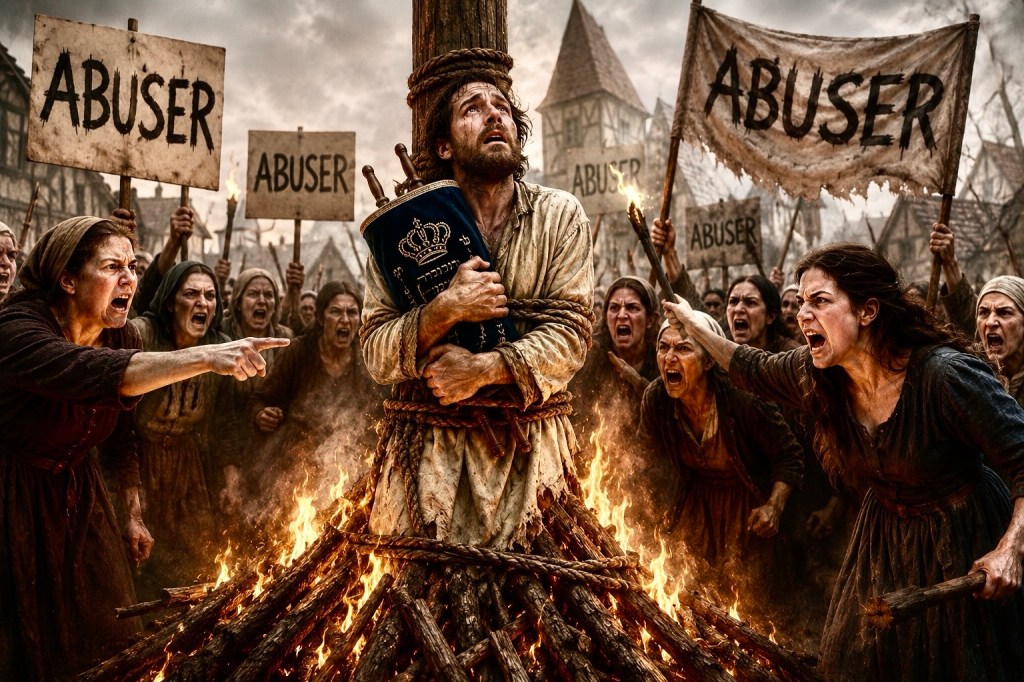
It is the sight of men figuratively burning at the stake, as evil women laugh and jeer.
The issue is not “whether to act.” It is whether the authority guiding that action remains Torah—or something else.
To combat abuse, of any kind, the Jewish community is best served when we follow our traditions.
We may each be imperfect Jews, but we can also recognize the primacy of halacha, and take small but positive steps forward to improve things together.
(Free to reuse with attribution. AI image)


You must be logged in to post a comment.