In his most recent article, commentator Lee Smith examines JD Vance’s political trajectory, highlighting a core tension between personal ambition and governance.
Smith shows how Vance—
❌ Fuses his personal brand with scapegoat politics against Israel and the Jewish people, including deflecting policy setbacks onto them.
❌ Overall practices a self-first approach rather than humble accountability.
This contrasts sharply with the traditional Trump leadership model. Although also does his fair share of blame-shifting, and can be fickle and petty, ultimately the President:
✅ Takes personal responsibility for solving our problems—even when they seem intractable.
✅ Anchors himself in deference to God.
✅ Lionizes hard work, not complaining.
Smith raises the recent appearance of Vance on the Joe Rogan podcast, in which Vance baselessly alleged that:
- Israeli-funded plot undermined his Iran negotiations.
- Some Israelis seek “endless war” for its own sake.
- Jeffrey Epstein was likely a Mossad operative involved in a pedophile blackmail ring used to extort American officials.
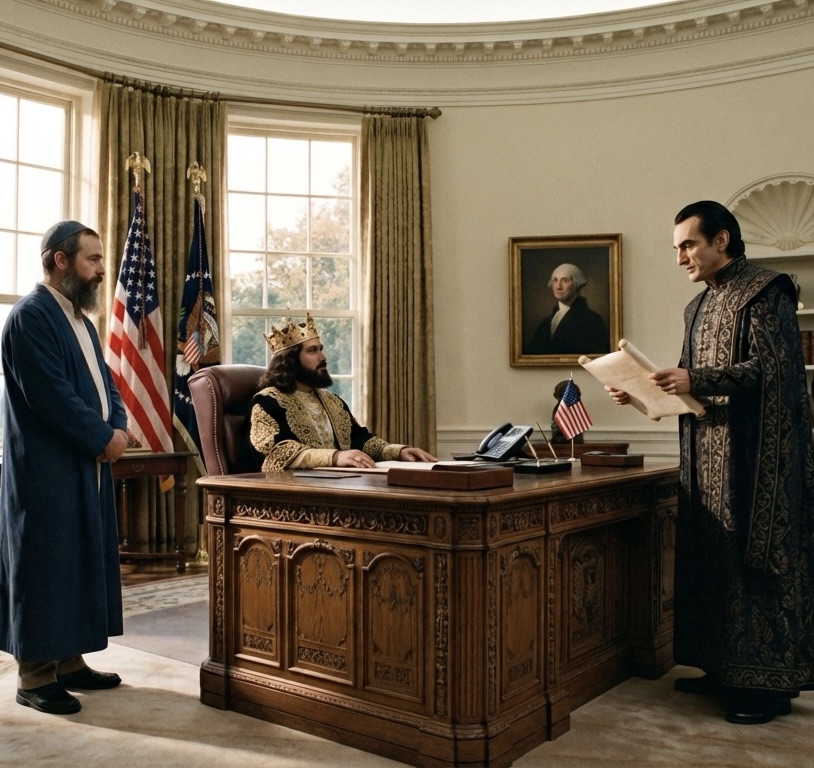
This strategy finds an alarming historical parallel in the ancient story of Achashverosh and Haman.
The narrative, documented in the Book of Esther, presents a clear contrast in leadership archetypes:
👑 The Beneficent Monarch (Achashverosh): King Achashverosh represents the caring ruler of the people who is ultimately loyal, yet also also susceptible to flattery, hasty decrees, and sycophantic advisors.
😡 The Self-Serving Vizier (Haman): Haman’s agenda was entirely driven by personal offense and a lust for absolute power. His obsessive focus on eliminating Mordechai—who represented a moral and political obstacle—was a self-serving tactic designed to consolidate his own position, ultimately leading to the ruin of himself and his household.
😇 The Servant of the Kingdom (Mordechai): Conversely, Mordechai was the one focused on the kingdom and saving the king. Despite Haman’s accusations, Mordechai acted out of loyalty to the realm, uncovering a plot against the monarch and prioritizing the long-term stability of the people.
Concluding his analysis, Lee Smith presages a significant political fall for Vance, arguing that a platform built on privileged grievance and conspiracy will alienate the base needed for success.
This, too, mirrors the fate of Haman, whose spectacular rise was matched only by the totality of his downfall, brought about by his own overreach and the very hatred he sowed.
Modern leaders must choose their model. Will they follow the path of the servant-leader, or the path of the self-serving vizier whose grievance politics mask a deeper character flaw?
Check out Smith’s insightful article—truly a must-read.
https://www.tabletmag.com/sections/news/articles/vance-big-crashout
 Writing by Dr. Dannielle Blumenthal
You must be logged in to post a comment.