On the somber Jewish holiday of Tisha B’Av, July 23, 2026, during which we mourn the destruction of our two ancient Holy Temples, there was a tragic stabbing attack in New York City. A visibly Jewish man (wearing a kippah) and an Asian man were targeted in an assault accompanied by the words “Allahu Akbar.”
Responding to this terrible news, I shared commentary calling on NYC Mayor Zohran Mamdani’s to take responsibility for the violent antisemitism he is provoking with his nonstop rhetoric against Israel.
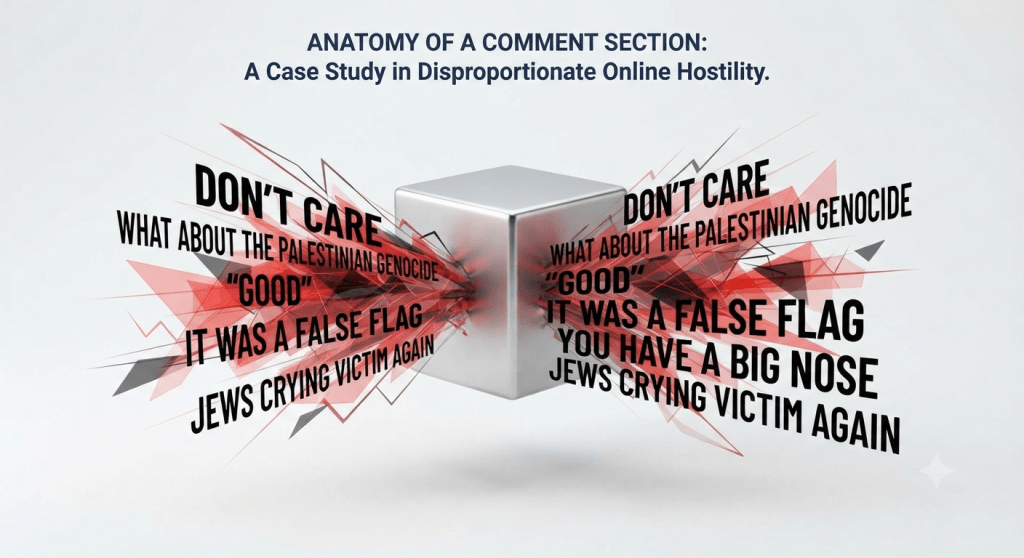
The response was not a debate on public safety. Instead, it provided a clear look at how contemporary hate manifests online. While many engaged thoughtfully, a significant wave evidenced predictable and hostile patterns:
- Hostile Deflection: Responding to a targeted domestic hate crime against Jews by immediately invoking unrelated international geopolitics (“What about the Palestinian genocide?”), outright celebrating the violence (“Good”), or weaponizing the multi-victim nature of the attack to minimize the antisemitic targeting.
- Denial and Conspiracy: Dismissing real-world trauma through apathy (“Don’t care”) or fabricating narratives to evade accountability, such as claiming a targeted hate crime was a “false flag.”
- Classic Bigotry: Trolling that quickly resorts to physical mockery (such as targeting physical traits) and revives age-old tropes to minimize pain (“Jews crying victim again”).
When violent acts against Jewish individuals are excused away as mere “mental health” crises while online commentators rush to justify or mock the targeting of Jews, it signals a deeper normalization of antisemitism in public discourse.
It should be noted that simultaneously, the digital backlash exposed a parallel wave of violent, extremist anti-Muslim rhetoric, where fringe commentators used the assailant’s religious phrasing to generalize and target an entire community rather than the national security threat posed by the ideology of political Islam.
Unfortunately, we hear anti-Muslim rhetoric from conservative voices close to President Trump, such as Laura Loomer. Currently in Ukraine to interview President Zelensky, she said: “One thing I really love about Ukraine is I haven’t seen a single Muslim here.”
This is deeply problematic since Loomer is also a strongly pro-Israel voice around the Trump administration.
The rhetoric creates enemies where none need exist.
Polarization is unhealthy. Documenting it matters because the vitriol proves the very point being made: extreme hostility, whether antisemitic or Islamophobic, isn’t hidden anymore; it is loud, organized, and entirely normalized.
Most Americans are moderate and not hateful. We should reject this type of talk.
AI image.


You must be logged in to post a comment.