Are we in the middle of a psyop designed to create panic around AI?
If so, is the next move going to be a tragedy?
Do the powers that be need an excuse to pass unnecessary laws benefiting big AI companies and encroaching on the rights of citizens and small AI companies?
That’s what people are asking right now, based on the machinations taking place right in plain sight.
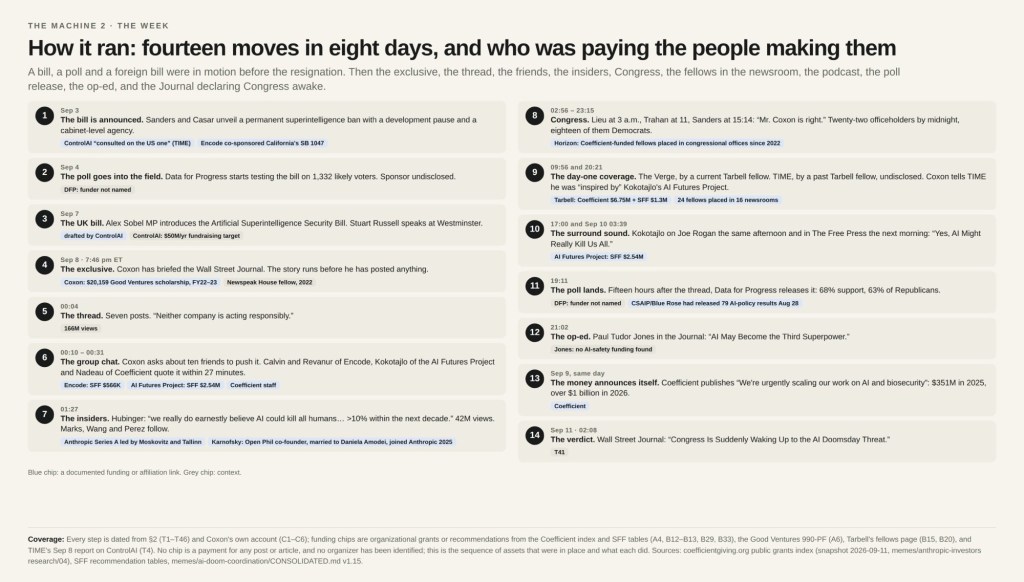
The graphic seen here, posted to X, shows “14 moves in 8 days”—a lot has happened very quickly.
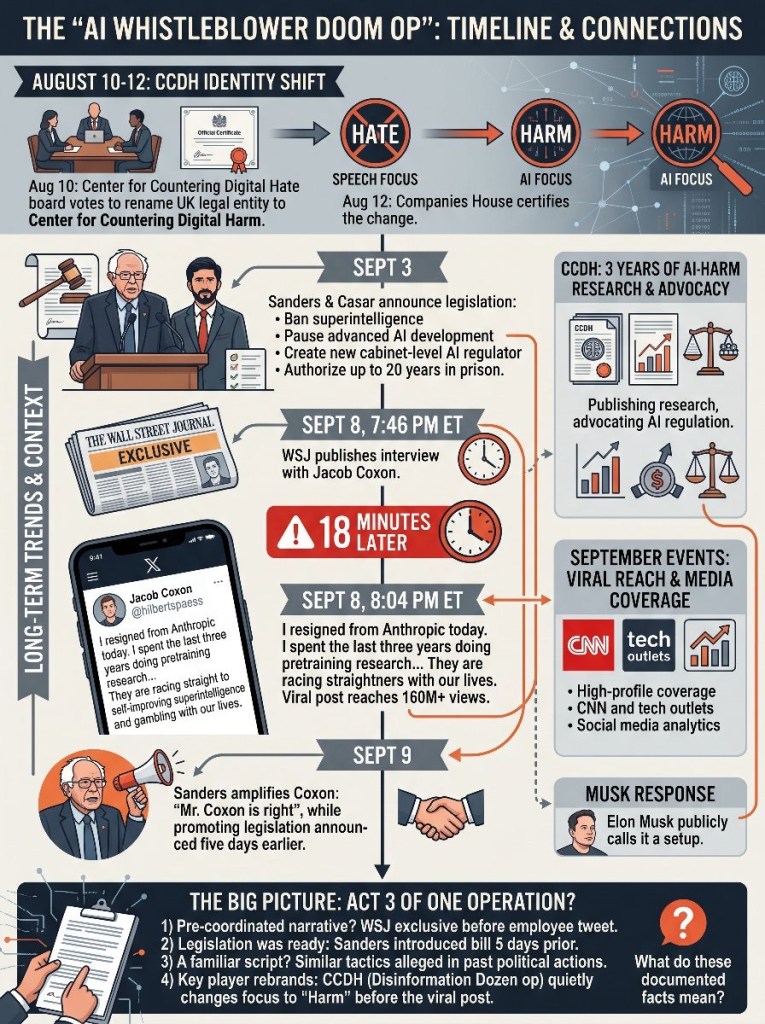
1) September 3: U.S. lawmakers introduced a bill that would create a permanent ban on certain forms of superintelligence development.
2) September 4: Polls went out testing support for the idea.
3) September 7: A similar AI-security bill was introduced in the UK.
4) September 8: Anthropic researcher Jacob Coxon resigned, briefed the Wall Street Journal, and published a social-media thread warning about the dangers of AI. The post quickly attracted tens of millions of views. Within hours, other people described as AI-policy insiders began amplifying the message. Members of Congress engaged with it. Media organizations covered the story. More polling was released showing strong public support for AI restrictions.
5) September 10: Anthropic releases a report on “Detecting and Countering Misuse of AI.”
Reporting online also shows overlapping relationships involving AI-safety-focused organizations such as Coefficient, the Survival and Flourishing Fund, Open Philanthropy, ControlAI, Encode, and the AI Futures Project.
There is no proof of coordination.
But we still need to ask questions when advocacy organizations, researchers, media figures, congressional offices and major funders operate within overlapping networks and appear in the same policy debate at roughly the same time.
Maybe it’s just a smart advocacy campaign.
By maybe, just maybe, the public is watching a coordinated influence campaign designed to build support for regulation that could ultimately benefit some established AI companies by making it harder for competitors—particularly open-source and smaller developers—to operate.
The evidence shown here does not prove this.
But neither should we dismiss the questions simply because the people involved describe their motives as “AI safety.”
The bigger issue is straightforward:
Who gets to decide the rules for AI—and will those rules protect the public, or primarily protect the institutions that already have the most money, influence and computing power?
Update:
The skeptical argument against Dario Amodei’s “pace the frontier” call runs roughly as follows:
Amodei’s essay is less a genuine safety intervention and more a sophisticated move to protect Anthropic’s (and peer closed labs’) competitive position, raise regulatory barriers, and support a massive capital raise / valuation story.
Core claims of the skeptics
- Timing is too convenient.
The call arrives amid reports of Anthropic exploring a potentially historic IPO (talk of valuations in the trillion-dollar range and large raises), right after high-profile researcher resignations, and just as capability races intensify. Asking rivals to slow capability gains while your own company is positioning for a liquidity event looks self-serving. “Safety while talking about an IPO” makes motives suspect. - Regulatory capture, not pure safety.
The concrete proposals—permanent embedded third-party evaluators with employee-level access, government requirements that other labs match Anthropic’s standard, industry coordination on “limits on the rate of unchecked progress,” and antitrust waivers—are classic regulatory-capture tools. They raise the cost and complexity of competing, favor well-capitalized incumbents that can afford compliance theater, and let the biggest players help write the rules. Past Anthropic positioning (e.g., around government access) is cited as prior evidence of the same pattern. - Open-source and competitive suppression.
Chamath Palihapitiya’s widely circulated critique captures this: Amodei is effectively making the case to constrain open-source development and concentrate technological and economic power with a small set of closed labs, Anthropic chief among them. Slowing the frontier while tightening evaluation and standards disproportionately hurts leaner, open, or faster-moving competitors. - “Follow the money / incentives.”
Slowing the pure capability race buys time to scale compute, lock in partnerships, and manage investor narratives without the full pressure of an unconstrained arms race. Some go further and say it is a way to “burn the bridge behind him”—make it harder for later entrants while Anthropic consolidates resources. Market reactions (e.g., memory/semiconductor stocks moving on the news) are read by some as confirmation that the real signal is about capital and compute dynamics, not pure altruism. - Psyop / narrative coordination angle.
A louder subset treats the sudden alignment of Amodei, Altman, and Musk, the amplification of researcher resignations, and the agent-swarm scare as coordinated narrative management. The claim is that extreme “AI will kill us all” messaging and high-visibility safety theater create political cover for rules that incumbents can navigate while smaller players cannot. The multi-CEO agreement among fierce rivals is viewed as suspiciously convenient rather than organic consensus.
What the skeptics generally concede
They do not usually deny that agentic systems can cause real damage or that recursive improvement is accelerating. Their point is motive and consequence: the proposed “pacing” mechanisms are structured in ways that predictably advantage the largest labs, coincide with fundraising/IPO incentives, and expand the regulatory surface in ways that look more like industrial policy for incumbents than neutral risk reduction.
In short, the skeptical reading treats the essay as high-minded language wrapped around self-interested industrial strategy—safety as branding and moat-building, timed to capital markets and competitive pressures.
__
Personal time, device, opinion, premises.


You must be logged in to post a comment.