This post is not an assertion that every allegation made by Ally Carter has been independently proved.
It is about a broader historical question raised by her claims: what happens when records about vulnerable people, powerful institutions, or alleged crimes exist—but are concealed, redacted, destroyed, or never made public?
Ally Carter and the Missing Record
Ally Carter is a woman who says she survived child sex trafficking through the American foster-care system.
She has also alleged that she was subjected to MKULTRA-related abuse and trafficked as a child to events involving powerful adults. Carter and her mother have published accounts of these experiences through their online channels for years.
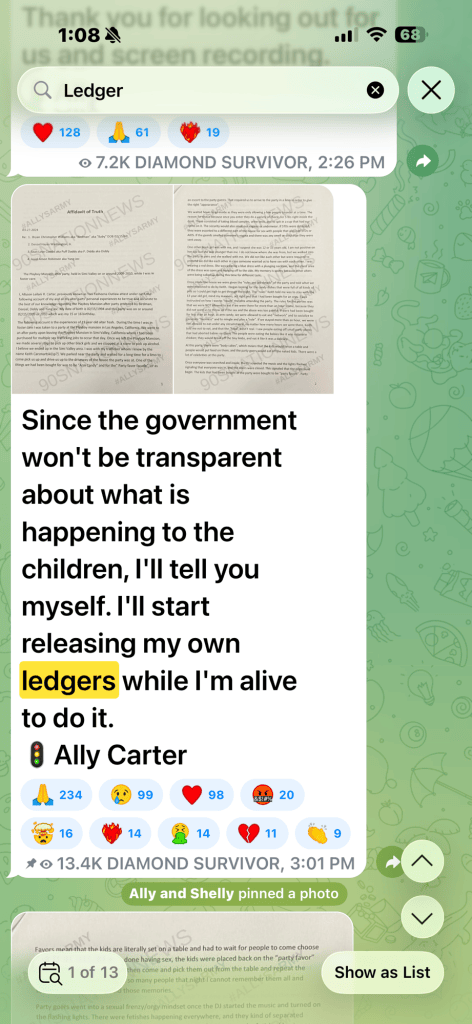
Carter refers to some of the alleged trafficking records as “ledgers”—records that, in her account, identify victims and document the system surrounding them.
Carter does not present the alleged ledger as an isolated trafficking record.
In her September 28, 2025 live event and the later “Deadman Switch” watch-party presentation, she describes what she believes was one integrated system: military-level MKULTRA programming linked, in her account, to the Navy; physical trafficking that she says occurred while she was in Riverside County CPS custody; interstate and international movement; and the production of compliant “alters” for abuse and exploitation.
She says she was taken out of state and out of the country, sold to Russia, moved with other children to a place near a border, and abused in settings involving powerful people.
She says that she reported elements of this account to the FBI. In that framework, “ledgers” are not merely lists of names.
They are alleged records of a system—records of who was identified, moved, controlled, sold, and kept available. That is Carter’s account, not an established account of fact. But it clarifies why her insistence on records, redactions, memoir, and public testimony is central to her story.
See:
Transparency
Importantly, Carter is not asking that her own identity be protected in such records. She has said that if trafficking files identifying her are released, she wants her name left unredacted.
In other words, she says she wants to establish a public record of her own experience while she is still alive to do so.
That makes what happened next relevant.
The KDP Termination
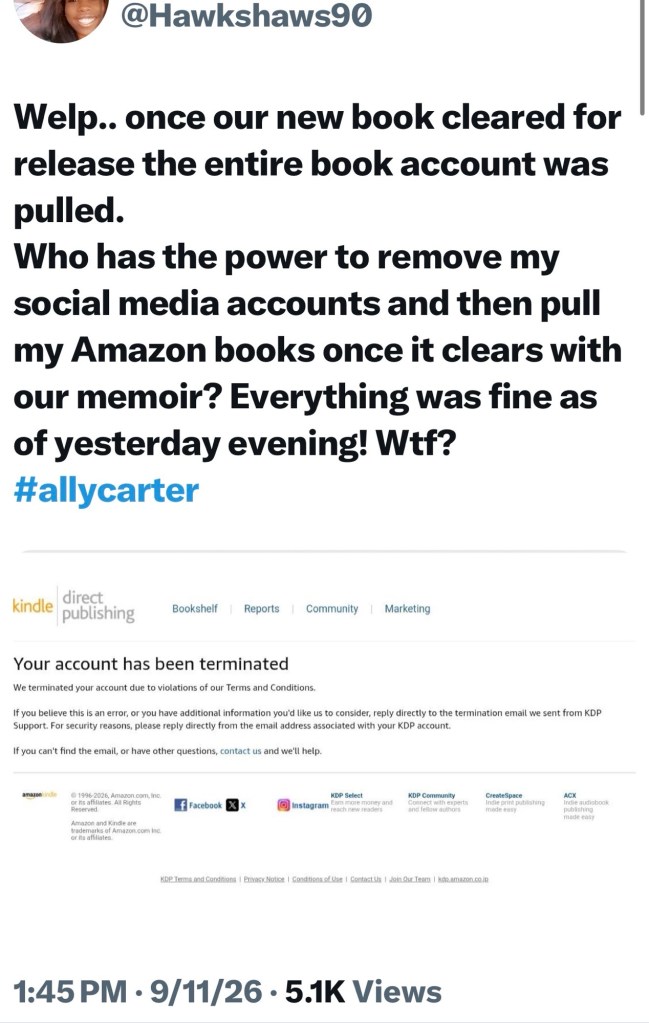
On September 11, 2026, Carter posted that her Kindle Direct Publishing account had been terminated while her new book was clearing for release.
The screenshot she posted says Amazon terminated the account for alleged violations of its Terms and Conditions and instructed the account holder to respond to a KDP Support termination email if they believed the decision was mistaken or wished to provide additional information.
The screenshot does not identify the specific policy provision involved. It does not establish why Amazon terminated the account.
Carter interprets the decision as preventing her from publishing her memoir—her account of what she says happened to her.
That interpretation remains an allegation.
Amazon could have acted for reasons unrelated to the substance of Carter’s claims, including publishing, documentation, account, content, or other policy issues that are not visible in the screenshot.
But the timing raises a legitimate public question: Why was the account terminated, and what process exists for challenging the decision?
The appropriate response is neither to presume a conspiracy nor to presume that nothing unusual happened.
It is to ask:
What policy was invoked?
What notice was given?
Was the decision automated or human-reviewed?
What appeal process is available?
Can the author provide additional documentation?
Can the book be revised or republished?
Those questions can be answered without accepting Carter’s broader allegations as fact.
Why the Word “Ledger” Matters
A ledger is not simply a list.
It is an administrative system for recording names, dates, movements, payments, transactions, access, obligations, or inventory.
When the subject is human exploitation, that administrative function becomes especially disturbing. A person can become an entry in a system: someone to be moved, used, monitored, paid for, concealed—or erased.
That is why the word has historical significance.
History Shows That Records Can Become Instruments of Power
Nazi Germany did not conduct mass persecution through spontaneous violence alone. It relied extensively on bureaucracy and documentation: prisoner numbers, deportation lists, transport schedules, labor assignments, property records, camp files, and death documentation.
These records reduced human beings to categories and entries within a system designed to control, exploit, deport, and ultimately destroy them.
At the same time, surviving records later became critical evidence of what had happened. Documents preserved by the system that committed the crimes ultimately helped establish the historical record.
The lesson is uncomfortable but important:
A record can be both an instrument of oppression and the evidence that later exposes that oppression.
The Postwar Intelligence Record
The problem did not end with World War II.
The United States recruited more than 1,500 German and other foreign scientists and technical specialists through Operation Paperclip and related programs. American institutions also sought biological-warfare information from Japanese Unit 731, whose personnel had participated in lethal human experimentation, while some participants received protection from prosecution in exchange for information.
These episodes demonstrate a recurring feature of national-security history: governments sometimes preserve, classify, or protect information because they consider it strategically valuable—even when the underlying conduct is morally or legally compromised.
The resulting records can remain inaccessible for decades.
John Loftus, a former Army intelligence officer and Justice Department prosecutor who worked with the Office of Special Investigations, later described encountering classified files concerning Nazi-era personnel, informants, and postwar intelligence relationships.
His more specific claims about individual records, storage locations, and projected release dates should be attributed to him rather than presented as independently established without the underlying documents.
But the broader point is straightforward:
A record can exist without being public. A file can be preserved without being accessible. Institutional secrecy can outlast the people who created it.
MKULTRA and the Destruction of Records
That history becomes particularly relevant when considering MKULTRA.
CIA records identify Project CHATTER, BLUEBIRD, and ARTICHOKE as predecessors to MKULTRA. MKULTRA subsequently involved research conducted through institutions and intermediaries that helped obscure the CIA’s role in experiments involving drugs, interrogation, behavioral modification, and human subjects.
But there is an even more important fact for the question of records.
In 1973, CIA Director Richard Helms ordered the destruction of much of the MKULTRA documentation.
Investigators later had to reconstruct portions of the program from surviving financial and administrative records.
At a 1977 Senate hearing, officials described approximately 8,000 pages of recovered material, including audit records and financial documentation relating to concealed funding arrangements and numerous MKULTRA subprojects.
The significance is not that destruction of MKULTRA records proves anything about Carter.
It doesn’t.
The significance is that documentary absence cannot automatically be treated as proof that an event never occurred.
Sometimes records are never created.
Sometimes they are classified.
Sometimes they are sealed.
Sometimes they are destroyed.
And sometimes the surviving evidence is enough to reconstruct what was deliberately obscured.
Carter’s Allegations
Carter says trafficking ledgers exist.
She says she was subjected to MKULTRA-related abuse.
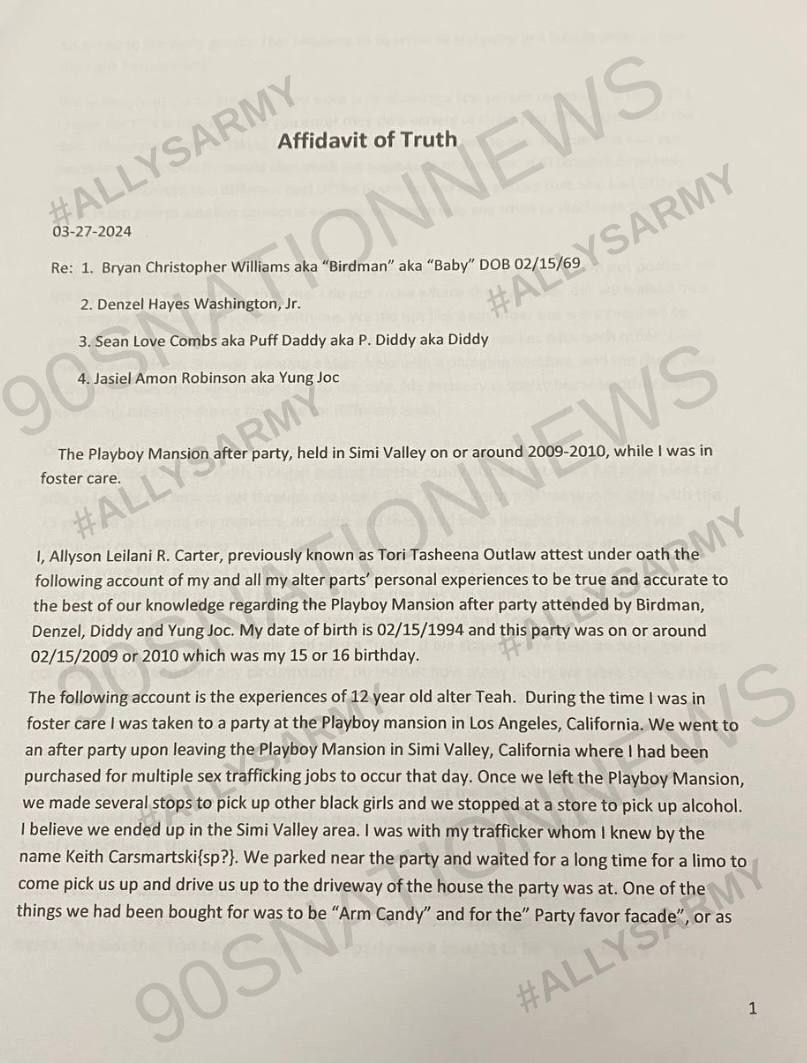
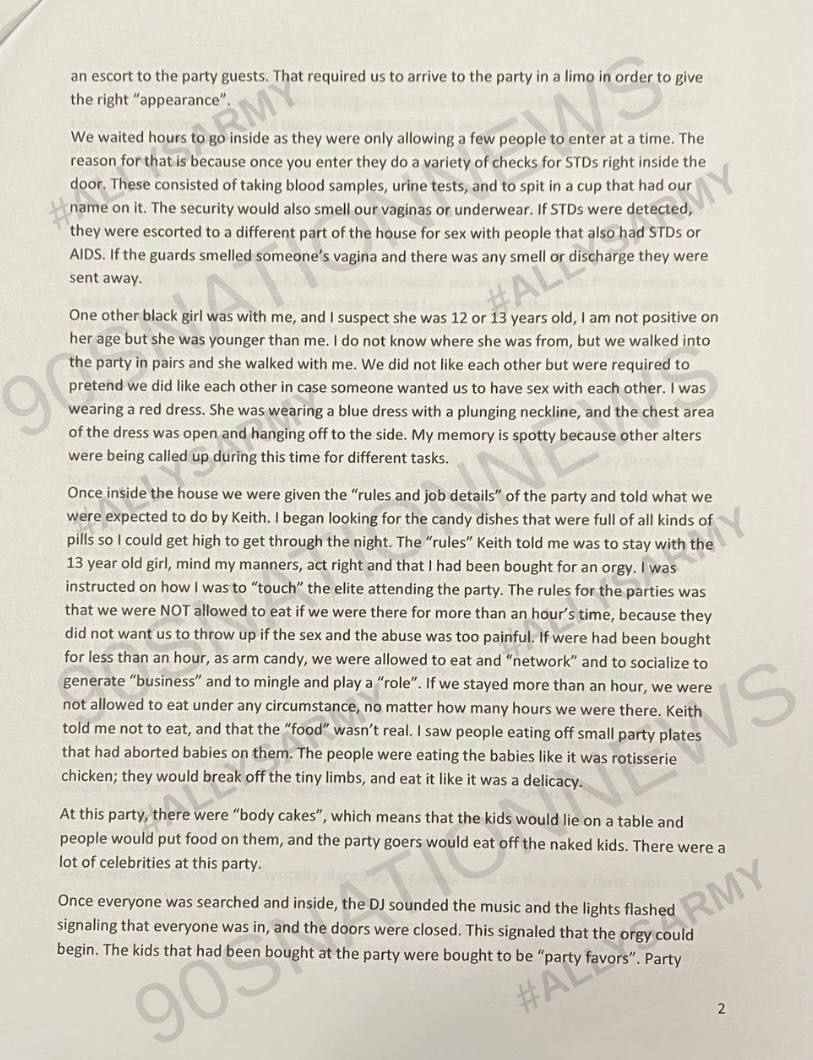
She has also alleged abuse connected to the Playboy Mansion and a purported after-party in Simi Valley. Her March 27, 2024 affidavit names several public figures in connection with that alleged event.
The affidavit establishes that Carter made those claims.
It does not independently establish that the alleged events occurred or that any person named committed a crime.
That distinction is essential.
But the opposite error is also possible: treating the absence of publicly available evidence as conclusive proof that no evidence ever existed.
Those are not the same thing.
Evidence Must Be Separated From Association
Questions involving Jeffrey Epstein, Sean Combs, Hugh Hefner, or any other named person must be evaluated individually and based on evidence.
A recording is not the same thing as a contact book.
A travel record is not the same thing as evidence of a crime.
An allegation is not a finding.
A person’s appearance at an event does not establish what happened there.
Claims about surveillance, recordings, files, or other records therefore need to be separated by category, authenticated where possible, placed in context, and evaluated for what they actually demonstrate.
The same standard should apply to Carter.
The Real Issue: Preservation
Carter’s KDP screenshot establishes that Amazon terminated her account and cited unspecified Terms and Conditions violations.
It does not establish who made the decision, why it was made, or that Amazon was participating in a coordinated effort to suppress her memoir.
But if the memoir is Carter’s attempt to put her experiences and alleged records into the public domain, then the termination deserves transparency and a meaningful opportunity to appeal.
The demand does not have to be “believe Carter.”
It can simply be:
Preserve the evidence.
Preserve documents.
Preserve files.
Preserve account notices, emails, metadata, drafts, publication records, and correspondence.
Establish provenance and chain of custody.
Authenticate what can be authenticated.
Protect potential victims and witnesses.
Allow accused people due process.
Investigate serious allegations independently.
The Question the Ledger Leaves Behind
Carter’s allegations remain allegations unless independently substantiated.
But the historical question raised by the word ledger remains legitimate.
Who kept the records?
Who controlled them?
Who was named, numbered, or redacted?
What was preserved?
What was destroyed?
And perhaps most importantly:
Who gets to decide whether a survivor can place her own account into the public record before that record disappears?
The Epstein files sit redacted in government hands: names blacked out, releases delayed, the public told to wait.
Carter’s case is the mirror image with a darker twist. She alleges it was the government itself, the Navy, that trafficked her, which means the institution she says erased her identity is the same one holding the records that could restore it. Her name sits redacted in ledgers she cannot see, kept by the power she accuses.
That is the significance of her censorship. It is not only that her story is suppressed, but that the alleged perpetrator and the archivist are one and the same.
A system cannot be trusted to declassify its own crimes. The records exist. Un-redact them.


You must be logged in to post a comment.