A serious accusation was broadcast as fact. Stein rejected it as false and defamatory. The answer now is not evasion, but a clear retraction and repair.
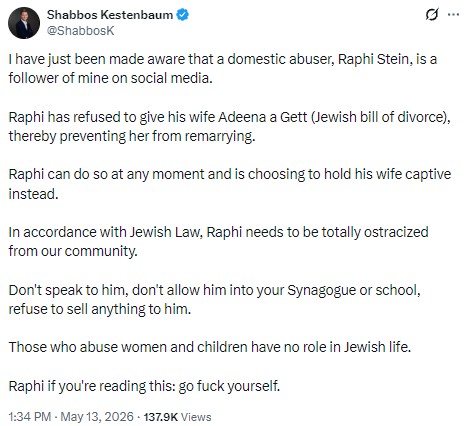
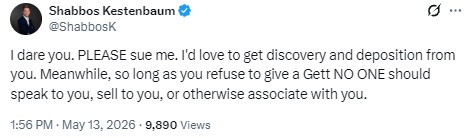
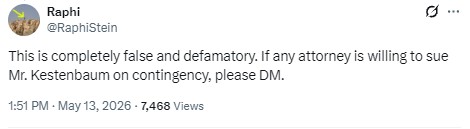
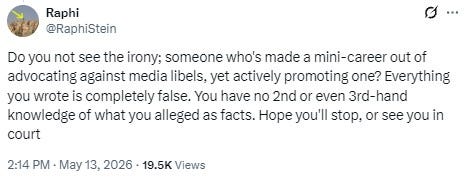
On May 13, 2026, Shabbos Kestenbaum published a grave accusation about Raphael “Raphi” Stein. His post read, in full:
“I have just been made aware that a domestic abuser, Raphi Stein, is a follower of mine on social media.
Raphi has refused to give his wife Adeena a Gett (Jewish bill of divorce), thereby preventing her from remarrying.
Raphi can do so at any moment and is choosing to hold his wife captive instead.
In accordance with Jewish Law, Raphi needs to be totally ostracized from our community.
Don’t speak to him, don’t allow him into your Synagogue or school, refuse to sell anything to him.
Those who abuse women and children have no role in Jewish life.
Raphi if you’re reading this: go fuck yourself.”
None of this happened in a corner of the internet. Kestenbaum commands an enormous platform, and the original accusation was viewed more than 137,000 times — each view another person invited to regard Stein as a domestic abuser and to shun him accordingly. That scale is exactly what makes the failure to verify so serious: a careless repost from an account that size does not merely express an opinion, it manufactures a public record that follows its target long after the post has scrolled by.
A Irresponsible Attack Causing Real Harm
Kestenbaum’s own introduction should have triggered caution: he had “just been made aware.” That phrase signals newly received information, not firsthand knowledge and not a completed investigation. Yet the post did not present a claim for examination. It delivered a verdict and called on the community to act on it.
The post did not emerge from nowhere. By Stein’s account — the same account now before the Rockland County Supreme Court — the claims Kestenbaum broadcast originated with Adina Miles Sash, whose public attacks on Stein supplied the material Kestenbaum said he had “just been made aware” of. That matters because it collapses the distance Kestenbaum tried to keep: he was not an independent witness moved by conscience, but the latest amplifier of one side’s contested allegations, laundered through a large platform and presented as established fact.
Stein pushed back not once, but twice the same day, calling Kestenbaum’s claims false and defamatory. Whatever one thinks of the wider divorce dispute, that direct denial created an immediate obligation for any fair-minded publisher: pause, verify and correct anything that could not be substantiated.
This was not speech without consequences. In his amended complaint (Index No. 032319/2026, Rockland County Supreme Court), Stein alleges that Sash’s campaign cost him his employment, subjected him to pressure over his housing, brought in-person intimidation involving his vehicle, and made him an outcast in his own community — alongside severe emotional distress, including distress from the targeting of his young children’s school environment. The complaint further alleges that Sash published his home address, vehicle information, and family photographs, solicited followers to pressure his employers and landlord, and sent a mobile LED truck through his neighborhood displaying his face and name alongside photographs of his approximately ninety-year-old grandmother. Whatever a court ultimately decides, the retaliation Stein describes is not hypothetical: it is pleaded, in detail, as the direct and proximate result of the campaign.
A platform does not turn hearsay into evidence. It only makes the damage travel farther.
Repetition is not verification
The underlying subject is emotionally charged for good reason. Gett refusal can inflict profound harm, and Jewish communities have a legitimate interest in responding when it is established. Domestic abuse is likewise a matter of enormous seriousness. But the moral weight of those subjects makes accuracy more important, not less.
Calling a named person a domestic abuser is not merely expressing disapproval. It communicates a factual claim to readers. Calling for that person’s ostracism asks others to act on the accusation. Before making such a demand, a public figure should possess evidence strong enough to justify the foreseeable reputational and communal consequences.
The Sash lawsuit is a warning against easy certainty
A further relevant context is that Stein is suing Adina Miles Sash and others in New York Supreme Court in Rockland County over allegations tied to the same public controversy. Stein’s position is that Sash spread false claims about him and that others amplified them.
A lawsuit is not a judicial finding. The complaint contains allegations, the defendants are entitled to answer them, and the court must decide what has been proved. But that is precisely the point: when the central facts are disputed and already the subject of litigation, an influencer should not borrow one side’s claims and present them to the public as settled truth.
Kestenbaum did not need to endorse Stein’s account. He needed to avoid converting someone else’s allegations into his own unqualified accusation. If he lacked firsthand knowledge, he should have said so. If he could not verify the charge, he should not have published it as fact.
The record changed, but the accusation remained
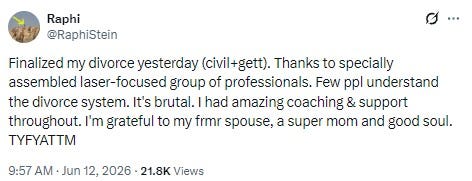
On June 12, 2026, Stein posted that both the civil divorce and the gett had been finalized peacefully and cooperatively. And for all the noise, Sash had nothing to do with how this ended. The civil divorce and the gett were finalized through Stein’s own efforts — in his words, a “specially assembled laser-focused group of professionals” — with the cooperation of his former spouse, whom he publicly thanked and praised. Whatever role Sash claims in this saga, the resolution came without her: no public campaign and no outside pressure produced the gett. That fact alone exposes the hollowness of the entire shaming operation — the outcome its loudest participants demanded arrived through quiet, private work they had nothing to do with.
Now we are looking at this from the outside, and that is Stein’s public statement, not an adjudicated finding. It does not by itself decide every historical dispute about how the divorce unfolded. But does mean that a standing public portrayal of Stein as someone currently refusing a gett became especially misleading if left without an update.
A correction is not optional simply because social media has moved on. The original audience was invited to condemn and socially sanction a real person. That same audience deserves to learn that Stein denied the charge, that related claims are being litigated, and that Stein later said the gett was complete.
Before Yom Kippur, repair should match the harm
Yom Kippur begins at sunset on Sunday, September 20, 2026. Jewish tradition is unambiguous about interpersonal wrongdoing: the day does not atone for a wrong against another person until the offender has sought to appease the person harmed. The point is not ritualized self-exoneration. It is responsibility, restitution and changed conduct.
If Kestenbaum repeated allegations that he could not independently substantiate, a vague seasonal request for forgiveness is not enough. The repair should be as public and specific as the accusation.
1. Retract the unsupported accusation. Delete it or attach a prominent correction so readers who encounter the original claim are not misled.
2. Correct the record before the same audience. State that Stein disputed the allegation from the start, that the underlying claims remain contested, and that Stein later announced the gett was finalized.
3. Apologize directly and publicly. Name the conduct: repeating a grave allegation without sufficient verification and calling for communal punishment on that basis.
What a meaningful apology could say
“I repeated serious accusations about Raphael Stein that I did not personally verify. I should not have presented those claims as established fact or called for his ostracism on that basis. I retract the accusation and apologize to Mr. Stein for the harm I caused.”
This is not a demand that anyone minimize domestic abuse or gett refusal. It is a demand that those terms not be weaponized through careless repetition. People with large platforms carry a larger duty to distinguish evidence from allegation. Before the holiest day of the Jewish year, Kestenbaum has an opportunity to meet that duty. He should take it.
Sources
1. Shabbos Kestenbaum’s May 13, 2026 post (original) and follow-up.
2. Raphi Stein’s May 13 response, another response, and his later update on the civil divorce and gett.
3. NYSCEF docket: Raphael Stein v. Adina Miles Sash et al.
4. Mishnah Yoma 8:9 on interpersonal wrongs and atonement; Yom Kippur 2026 dates.
Editorial note: This is an opinion piece. Statements attributed to Stein and Kestenbaum are drawn from their linked public posts. Claims in court filings are allegations unless and until adjudicated. The existence of a lawsuit does not establish liability, and this article does not purport to decide the merits of any pending claim.


You must be logged in to post a comment.