The Polarizing Consequences of a Communication Backchannel Which Appears to Have Operated, with Plausible Deniability, at the Behest of President Trump
QAnon did not spread only by making claims. It spread by teaching people a method for reading the world.
Its signature artifacts—usually called “QProofs”—were visual collages that joined anonymous Q posts to presidential tweets, news reports, photographs, television broadcasts, government documents, numbers, and timestamps. A phrase appeared in a Q post; a similar word later appeared in a Trump tweet. A number appeared on a jersey; Q was the seventeenth letter of the alphabet. A Q post preceded a public event by four or seven minutes. A coffee mug in a television program bore a letter Q.
For believers, these were not isolated coincidences. They were presented as a growing body of evidence that Q possessed inside knowledge and communicated, directly or indirectly, with the Trump presidency, the military, and other institutions.
The important point is not that every image was fabricated. Many were built from authentic components: real Q posts, real presidential tweets, real photographs, real government reports, real news headlines, and real outages. Their persuasive power came from a different move: they converted factual fragments into an unverified conclusion of hidden coordination.
This is what made QProofs so consequential. They did not merely distribute a conspiracy theory. They trained an audience to treat selected correspondences as a superior form of evidence—and, in the process, made that audience vulnerable to later manipulation by influencers, monetizers, propagandists, political entrepreneurs, and more extreme actors.
A note on method: This article distinguishes between (1) whether an underlying post, image, timestamp, or event is authentic; and (2) whether the proposed connection demonstrates advance knowledge, authorship, or coordination. The first question can often be checked. The second ordinarily cannot be resolved by a collage alone. At the same time, the cumulative pattern of overlaps, the rhetorical style of the posts, the political incentives of the period, and the official opacity surrounding the phenomenon make pure coincidence an incomplete explanation. Plausible deniability is itself part of the architecture.
The QProof formula
At their simplest, QProofs used a recurring formula:
A screenshot established that a phrase was used. A red box isolated the phrase. An arrow pointed to another screenshot. A timestamp created the appearance of precision. A headline supplied real-world consequence. Then a rhetorical question closed the argument: “How many coincidences until it becomes mathematically impossible?”
But no probability calculation was actually being performed. The collage did not define the universe of possible Q posts, Trump tweets, public events, numbers, phrases, time windows, symbols, or failed predictions. It did not show how often comparable matches did not occur. And it did not test alternative explanations.
Instead, it asked viewers to experience recognition: Do you see it?
That experience mattered. It allowed a participant to feel not that he or she had accepted a claim, but that he or she had independently discovered a hidden pattern.
The number 17: a real jersey, a disputed message
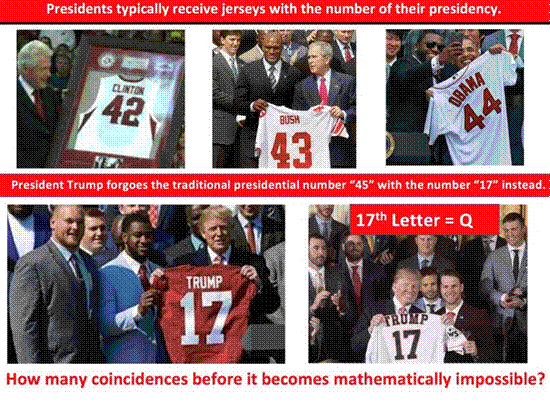
The jersey proof illustrates the method in compact form. The collage shows Bill Clinton with a “42” jersey, George W. Bush with “43,” Barack Obama with “44,” and Trump holding jerseys marked “17.” It then supplies the intended inference: Trump, the forty-fifth president, supposedly bypassed the traditional presidential number in order to signal Q—the seventeenth letter of the alphabet.
Several components are real. Q is the seventeenth letter. Trump did receive jerseys displaying 17. The images are not persuasive because they invent the number; they are persuasive because they make the number look anomalous.
The anomaly is less secure than the graphic suggests. Presidents do sometimes receive jerseys bearing their presidential number, but it is not a binding sports tradition. Teams routinely select numbers for reasons connected to championships, seasons, franchise history, player numbers, or the occasion being commemorated. In the Alabama example, the number 17 had an ordinary football meaning: the Crimson Tide had won the 2017 national championship, and the event celebrated that achievement.
The point is not that a viewer could not notice the number. The point is that the QProof removes the competing context before asking the viewer to infer secret intent. A real number becomes a coded message because the montage pre-selects its meaning.
Verdict: The jersey itself is authentic and the number 17 is real. Whether Trump (or someone in his orbit) chose or accepted the number with any awareness of the Q letter association cannot be proven from the photograph alone. What can be said is that the episode fits a broader pattern of public gestures that remained deniable while feeding a community already primed to read them as signals. The collage overclaims; the underlying event remains open to opportunistic or intentional ambiguity.
“Stay the course”: when timing becomes a code
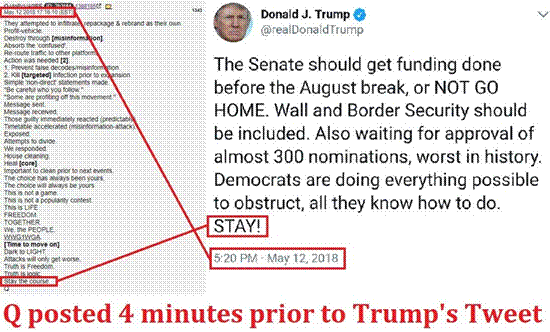
This proof pairs a Q post containing the phrase “Stay the course” with a Trump tweet posted four minutes later that ends with “STAY!” The relationship is visible and easy to understand: related language appears close together in time.
That is the verified core. If the archived timestamps are accurate, Q used “Stay the course,” and Trump subsequently used “STAY!” The four-minute interval is an objective temporal fact.
The inference is a separate matter. “Stay” is a common political imperative, and “stay the course” is a common political phrase. The QProof does not establish that Trump was responding to Q, that Q had advance knowledge of the tweet, or that four minutes carried an independently established meaning. The significance of the interval is assigned after both posts exist.
Yet the proof is rhetorically powerful because a clock looks like measurement. The timestamp supplies an aura of precision that transforms a loose semantic overlap into what appears to be a controlled exchange.
This is a recurring QProof technique: time ceases to be mere chronology and becomes a presumed communications channel.
Verdict: The temporal proximity and shared vocabulary are real. A four-minute gap is short enough to be striking and long enough to preserve deniability. One cannot prove from the collage that Trump was answering Q or that Q was tipped off in advance. One can reasonably note that the pattern is consistent with a public figure who understood the value of ambiguous, high-visibility language that could be read as affirmation by a particular audience while remaining dismissible as coincidence or common rhetoric. The architecture of plausible deniability is doing work here.
The 13-person claim: numerical overlap and expansion
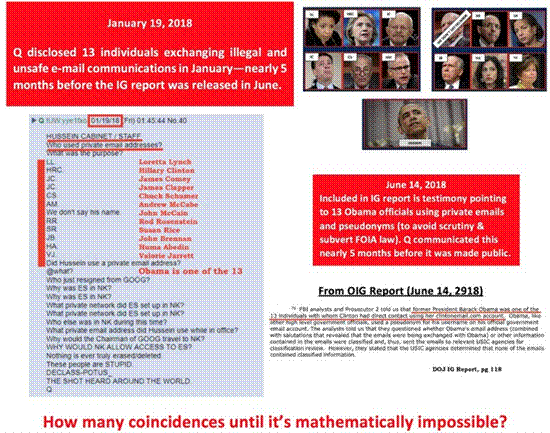
The “13 individuals” proof is particularly important because it contains a genuine numerical correspondence.
The January 2018 Q post shown in the image listed thirteen initials and names while asking about private email addresses and communications. A June 2018 Department of Justice Inspector General report later stated that FBI investigators had identified “only 13 individuals” with direct email contact with Hillary Clinton through her clintonemail.com account, including former President Barack Obama.
That is not nothing. The number 13 appears in both places, and the later report is a real government document.
But the QProof expands the meaning of that overlap. It asserts that Q had disclosed “13 individuals exchanging illegal and unsafe e-mail communications” almost five months before the IG report. The cited report does not establish that all thirteen people on Q’s list used aliases, operated unauthorized accounts, exchanged illegal communications, or were correctly identified by Q. The report’s reference to thirteen is narrower: it concerns people who had direct contact with Clinton through the account.
The distinction is central. The image turns a limited numerical match into a claim of comprehensive prior disclosure and culpability. It illustrates how QProofs could begin with a verifiable fragment and end with a conclusion that the fragment did not independently prove.
Verdict: A real numerical correspondence exists. The leap from “13 people had direct contact” to “Q named the exact network of illegal operators five months earlier” does not. Still, the fact that an anonymous poster focused on the private-email controversy and a later official document used the same count is the kind of overlap that invites speculation about sources or shared information environments. Whether that speculation points to genuine inside knowledge, skilled reading of publicly circulating rumors, or something in between remains unresolved by the collage itself.
“Just the tip”: metaphor as confirmation
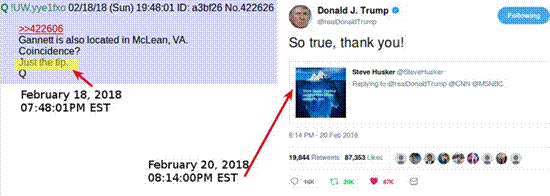
Here, a Q post says “Just the tip.” Two days later, Trump replies approvingly to a Twitter user whose post includes an iceberg graphic representing unseen Trump support beneath the surface.
The artifacts can be treated as authentic: Q used the phrase, and Trump’s reply attached to a tweet featuring an iceberg image. The connection is metaphorically intuitive. An iceberg’s visible peak is its “tip.”
But the graphic does not establish that Trump’s reply referred to Q’s phrase. “Just the tip” and an iceberg are ordinary elements of a familiar metaphor about hidden scale. The QProof gives the coincidence force by cropping the surrounding context and positioning the two items as a call-and-response.
This kind of pairing rewards associative reasoning. The question is not, “What evidence would show that one post caused or answered the other?” It is, “Can this image be made to resonate with that phrase?”
Verdict: The shared metaphor is real and the timing is close. Nothing in the public record forces the conclusion that Trump was responding to the Q post rather than to a common political image. Yet Trump’s habitual engagement with online imagery and his willingness to amplify messages that resonated with his base make pure accidental overlap less satisfying as a complete explanation. The interaction sits comfortably inside a zone of plausible deniability: noticeable to those looking for it, dismissible by those who are not.
The Father’s Day delta: Q teaches the rule after the event
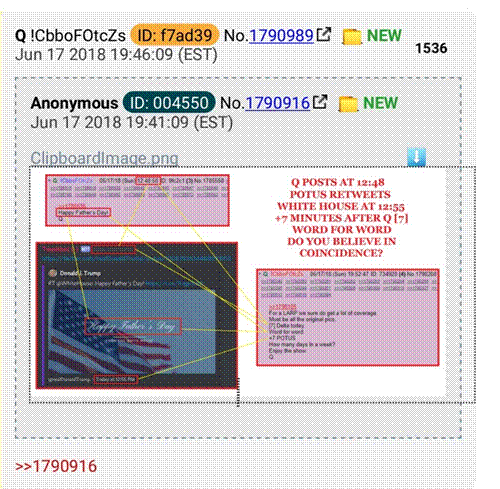
The Father’s Day proof reveals one of the movement’s most revealing techniques. The image shows Q posting “Happy Father’s Day!” at 12:48 p.m. and Trump retweeting a White House Father’s Day message at 12:55 p.m.—a seven-minute interval. It then shows Q calling attention to the number: “+7 POTUS. How many days in a week?”
Assuming the timestamps are correctly preserved, the underlying sequence is straightforward: the posts occurred seven minutes apart. The Q post that highlights the interval is also significant because it supplies the interpretive instruction.
The proof does not demonstrate that the interval was planned, however, and the number seven did not carry a fixed meaning that had been independently established before the event. Q supplied a symbolic association afterward: seven minutes, seven days in a week.
That is what makes the example analytically valuable. The movement did not simply identify patterns in the world; it could generate both the pattern and the rule by which the pattern was to be read. A timing gap became evidence because an authoritative decoder told followers which feature to notice and how to interpret it.
Verdict: The seven-minute gap is a documented fact. Q’s subsequent post that frames the gap as meaningful is also real—and revealing. This is less a pure prediction than a live demonstration of how the decoding system works: an event occurs, an authoritative voice nominates the feature that matters, and the audience learns the rule. Whether anyone on the Trump side intended the proximity is secondary to the fact that the movement itself taught followers how to manufacture significance from ordinary chronology. That pedagogical loop is the more durable finding.
“Rogue”: a dramatic event and a lexical echo
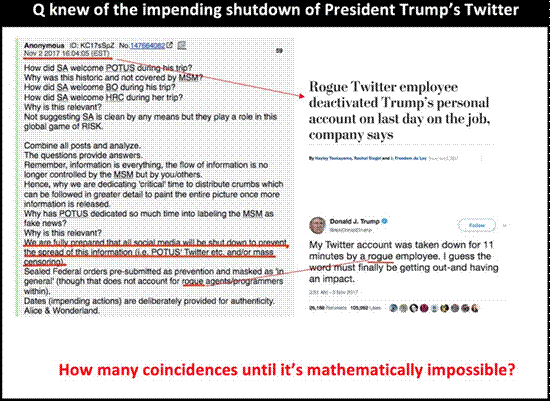
Trump’s Twitter account was unavailable for about eleven minutes on November 2, 2017. Twitter said a customer-support contractor had deactivated it on the employee’s last day. Trump later wrote that his account had been taken down by “a rogue employee.”
The Q post reproduced in the collage includes a warning about social-media shutdowns and refers to “rogue agents/programmers.” That wording overlap is real: Q used “rogue,” and Trump later used “rogue.”
The QProof’s conclusion—that Q knew of an impending shutdown or was being confirmed by Trump—does not follow from the overlap alone. “Rogue” was an ordinary and publicly available descriptor for an unauthorized employee action. The incident also had a widely reported explanation independent of Q.
Still, this was a potent early proof because it linked Q’s warning language to a dramatic disruption of Trump’s own communications channel. It offered followers an emotionally compelling event in which the president himself appeared, in their reading, to validate Q’s vocabulary.
Verdict: Q used “rogue”; Trump used “rogue.” The incident was real and publicly explained by Twitter as an employee action. The collage cannot prove foreknowledge. What it does illustrate is how a high-visibility disruption of the president’s primary platform, combined with matching language, supplied early emotional fuel. Trump’s choice of the word “rogue” after the fact kept the door open for those already watching for confirmation while remaining fully consistent with ordinary English. Deniability and resonance traveled together.
RT and the car door: retrospective precision
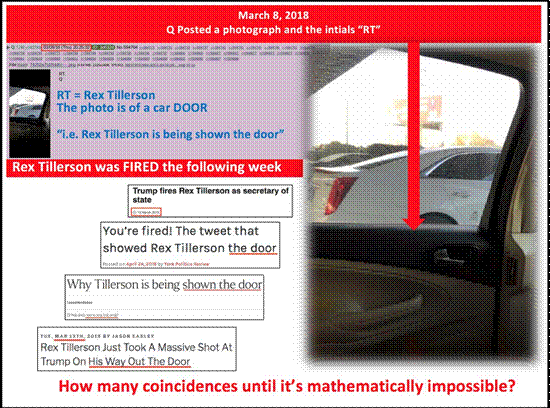
The RT proof combines an ambiguous image with a later high-profile event. Q posted the initials “RT” alongside a photograph of a car door on March 8, 2018. On March 13, Trump dismissed Secretary of State Rex Tillerson. Reporting described the dismissal as abrupt, publicly announced by Trump on Twitter; Tillerson was widely reported to have learned of the decision through the tweet.
After the firing, followers read “RT” as Rex Tillerson and the car door as a visual pun: Tillerson was being “shown the door.” The later event made the earlier image feel precise.
But that precision is retrospective. Before Tillerson’s firing, “RT” was not uniquely identifiable as his initials, and a car door could support many interpretations. The QProof works because the event narrows the range of possible meanings after the fact.
This is a central feature of the QProof system: ambiguity provides flexibility before an event; a subsequent event is then used to make the earlier artifact appear exact.
Verdict: Ambiguity first, specificity after the fact. That sequence is the operational heart of many QProofs. Nothing requires us to believe the car-door image was a coded announcement of Tillerson’s removal. The more interesting observation is structural: an open-ended post creates a ready-made slot that a later public event can fill. Whether the original post was lucky, informed, or simply flexible, the system rewarded the appearance of precision once the firing occurred. Retrospective fit is not the same as advance knowledge, but it is powerful all the same.
The “seventh floor”: an internal chronology problem
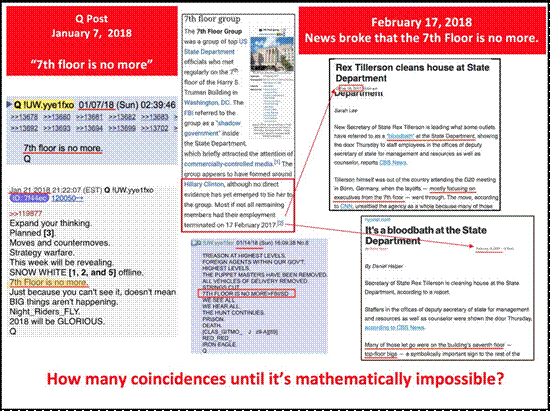
The “seventh floor” proof is useful not only because it invokes real State Department language, but because it demonstrates how chronology can disappear inside a persuasive graphic.
“The seventh floor” is a genuine Washington shorthand for senior State Department leadership and the Secretary’s office. The department experienced significant leadership turnover during the Trump administration, and Tillerson himself was removed in March 2018.
The image claims that Q wrote “7th floor is no more” on January 7, 2018 and that news later broke, on February 17, 2018, that the seventh floor had been cleared out.
But the source excerpts reproduced within the graphic date the relevant reports to February 17, 2017—not 2018. The image’s own evidence therefore raises a direct chronology problem: the purported confirmation may have preceded the Q post by nearly a year.
The issue is not whether “seventh floor” had a real institutional meaning. It did. The issue is whether the collage accurately represents the temporal sequence required for a prediction. In this case, the visual design supplies confidence while obscuring a date discrepancy that undermines the stated claim.
Verdict: This example is one of the clearest failures of the proof format. The institutional shorthand is real; the claimed predictive sequence is undermined by the dates visible inside the collage itself. When the graphic’s own sources do not support the timeline it asserts, the problem is not subtle inference but basic chronology. Even under a generous reading that allows for ongoing turnover at State, the specific claim of a 2018 confirmation of a January 2018 prediction does not hold. This is a case where the architecture of the proof actively misleads.
Xbox Live: turning an outage into an operation
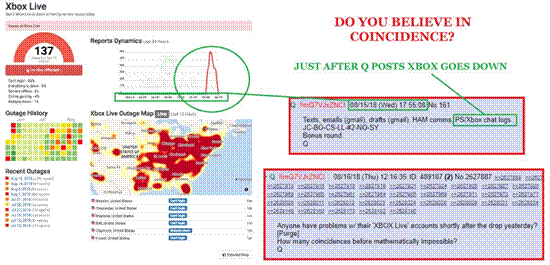
The Xbox proof follows another recurring pattern: an ordinary technological disruption is transformed into evidence of an unseen operation.
The image shows a Q post referencing “PS/Xbox chat logs,” followed by an outage-monitoring display showing reports of Xbox Live difficulties. It then presents the outage as an apparent “purge” connected to the Q post.
At the most limited level, the evidence may show temporal proximity: Q mentioned Xbox-related chat logs, and users reported an Xbox Live service disruption. That is a claim that can be tested against Q archives and contemporaneous outage records.
What the collage cannot establish is causation. Online-service outages occur for many reasons, including technical failures, maintenance, network congestion, software problems, and malicious attacks. The fact that an outage followed a Q post does not demonstrate a government intercept, a digital purge, or an operation directed by Q.
The social function of the proof was nevertheless clear. It taught followers to interpret infrastructure failures not as mundane technical events but as visible traces of a hidden struggle.
Verdict: Temporal proximity may exist; causation does not follow. Service outages are common. Treating an Xbox Live disruption as a “purge” is an interpretive decision, not a demonstrated operational fact. The more lasting effect of proofs like this was cultural: they trained participants to treat ordinary technical failures as potential evidence of a larger contest. That habit of mind is independent of whether any particular outage was related to anything.
“Chain of Command” and the Q mug
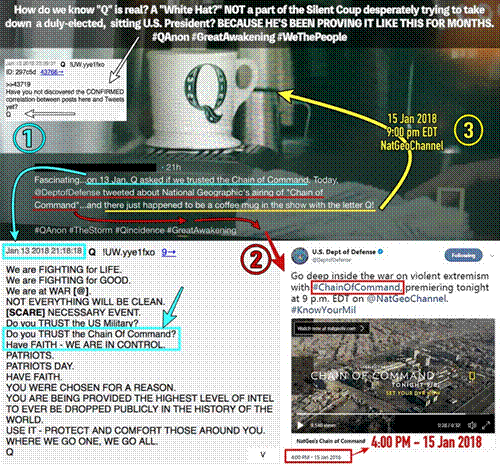
The Chain of Command proof is among the strongest examples of apparent institutional endorsement.
On January 13, 2018, Q asked followers whether they trusted the U.S. military and “the Chain Of Command.” Two days later, the Department of Defense promoted National Geographic’s documentary series Chain of Command, which premiered on January 15. The program examined military operations and the fight against violent extremism.
The collage then highlights a coffee mug carrying a large letter Q in a scene from the broadcast.
Every visual ingredient is powerful: Q’s military language; an official Pentagon account; a military-themed National Geographic series; the identical phrase “Chain of Command”; and the visible letter Q. Presented together, these elements can make institutional connection feel obvious.
But the inference remains unproven. “Chain of command” is a standard military expression and the title of the program. The Defense Department’s promotion of a documentary about military operations does not establish a QAnon message. A mug bearing Q does not demonstrate that military officials, the network, producers, or prop staff intended to signal the movement.
The example reveals how QProofs could collapse proximity into endorsement. A standard phrase, a public promotion, and an incidental object became, within the collage, apparent confirmation that Q had support from the military establishment.
Verdict: The phrase overlap and the mug are real. Institutional endorsement is not demonstrated. “Chain of command” is ordinary military language, and a coffee mug with a letter is ordinary set dressing. Still, the sequence—Q language, DoD promotion of a series with the same title, and a visible Q—created a potent visual package for those already inclined to see confirmation. The power of the proof lies in the density of the coincidences, not in any independent evidence that the Pentagon or the producers were participating. Plausible deniability remains intact; so does the emotional effect on the audience.
“Tip top”: the participatory feedback loop
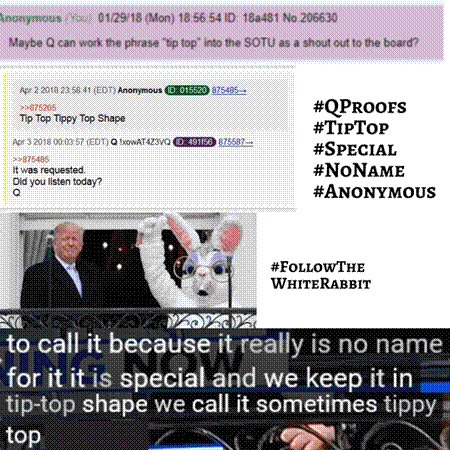
The “tip top” image may disclose more about the QProof process than any other artifact in the collection.
It begins not with Q or Trump, but with an anonymous board participant asking whether Q could work the phrase “tip top” into the State of the Union as a “shout out to the board.” The collage then places a later Q post—“Tip Top Tippy Top Shape”—beside a Trump clip in which he uses similar language.
Even without accepting the proof’s conclusion, the structure is revealing:
This is the participatory engine of the movement. Followers did not simply consume messages. They proposed tests, gathered screenshots, compared language, produced visual arguments, and circulated them as evidence. The movement’s authority came not only from an anonymous poster but from the shared labor of decoding.
That feature made the system scalable. Once participants learned the method, the original source did not need to explain every event. Other interpreters could identify clues, give them meaning, and construct the next proof.
Verdict: This example is less about whether Trump or Q “answered” a request and more about the feedback architecture of the movement itself. Anons proposed language; language later appeared; the appearance was treated as confirmation. Whether the loop was closed by deliberate signaling, statistical inevitability of common phrases, or selective attention, the social result is clear: the community learned that it could request, notice, and validate its own proofs. That participatory machinery is what allowed the phenomenon to grow far beyond any single author’s intentions.
Official silence and the architecture of deniability: the Black Vault FOIAs
If the Q phenomenon operated as a communication backchannel with plausible deniability, one would expect official records to be sparse, heavily redacted, or formally non-committal. Two Freedom of Information Act responses obtained by John Greenewald of The Black Vault illustrate precisely that pattern.
In February 2020 the Central Intelligence Agency issued a classic Glomar response to a request for records “that pertain or mention or contain cross reference to QAnon.” The Agency stated that it could “neither confirm nor deny the existence or nonexistence of records responsive to your request,” because “the fact of the existence or nonexistence of such records is itself currently and properly classified” and constitutes protected intelligence sources and methods information under the CIA Act of 1949 and the National Security Act of 1947. The request was denied under FOIA exemptions (b)(1) and (b)(3).
A Glomar response is not affirmative evidence that the CIA ran, monitored, or ignored Q. It is evidence of official refusal to discuss the subject in any way that would confirm or deny institutional knowledge. In the context of a claimed high-level communications channel, that refusal is consistent with—and necessary to—the preservation of plausible deniability.
The FBI’s May 2023 release is more revealing in what it does say. Of 43 pages reviewed, 19 were released, many heavily redacted under exemptions protecting privacy, law-enforcement techniques, and deliberative process. The released material shows that the Bureau opened investigative files treating the Q persona under the rubric of “False Personation of a Federal Official.” An August 2018 opening communication noted that Q purported to be “a highly placed federal official with a ‘Q Clearance’ and access to the President,” and that supporters had appeared at Trump rallies and, in at least two cases, been involved in armed standoffs.
Crucially, the same document records an explicit statement of uncertainty: “QANON has not publicly revealed their identity. It is unknown whether QANON is actually affiliated with the U.S. Government. It is also unknown whether QANON is profiting off of the assertion that they are a government employee.”
That sentence is the closest the released FBI material comes to addressing the central question. The Bureau investigated the possibility that someone was falsely claiming official status; it also left open the possibility of actual affiliation. The investigation generated intelligence products on radicalized followers and potential threats, not a public finding that the persona was either a pure hoax or an authorized channel. Subsequent pages document subpoenas, open-source collection, and concern about adherents who might act on the narrative.
Taken together, the CIA’s refusal to confirm or deny and the FBI’s documented uncertainty do not prove that President Trump directed or authorized the Q posts. They do, however, demonstrate that the U.S. government treated the phenomenon as sensitive enough for classification assertions and law-enforcement scrutiny while never publicly closing the question of institutional connection. That combination—investigative interest without public resolution, and formal refusal even to acknowledge the existence of records—is exactly the informational environment one would expect if a communications channel had been designed to remain deniable at every level.
The FOIAs therefore function less as smoking-gun evidence and more as structural corroboration. They show that the same opacity that protected the decoding community’s sense of secret knowledge also protected any official actor from having to own the channel. Plausible deniability was not only a feature of the public performance; it appears to have extended into the documentary record itself.
From proof-making to capture
The larger importance of QProofs lies in what they did to the audience.
They encouraged followers to privilege selected correspondences over ordinary standards of verification. They made ambiguity feel like encrypted intent. They made official denial feel like evidence of concealment. They made a timestamp, a shared word, an image, or a number feel more revealing than an institutional explanation.
Over time, this created a market for interpreters. The person who could find the next connection, explain the latest apparent failure, identify the newest enemy, or transform an ordinary news event into a high-stakes revelation could acquire influence. In a digital environment, influence could become engagement, attention, donations, subscriptions, merchandise sales, and political leverage.
This is where the movement became vulnerable to capture.
It is not necessary to prove that every later influencer was cynical, that every “paytriot” acted in bad faith, or that a single controlling actor engineered the whole process. The structural point is simpler: a community trained to see hidden code everywhere becomes dependent on people who claim to decode it. That dependence can be exploited by sincere believers, opportunists, propagandists, ideological entrepreneurs, hostile actors, and extremists alike.
The original Q posts therefore became only one part of a much larger system. The most consequential authority often belonged not to the anonymous poster but to the amplifiers who decided what counted as a proof.
Inoculation against correction
QAnon did more than tell adherents particular things to believe. It could train them in advance to resist correction.
When a prediction failed, the failure could be reinterpreted as deliberate misinformation, strategic deception, a necessary delay, or an operation still unfolding beyond public view. When journalism, courts, agencies, or other institutions contradicted a claim, that contradiction could itself be classified as proof that the institution was compromised.
This is what makes the system difficult to correct from outside. The question shifts from “What evidence supports this assertion?” to “Why would the system deny what the proof already shows?”
The result is a form of epistemic isolation. It does not require every follower to withdraw physically from society. It can separate people from shared informational standards, professional expertise, family relationships, journalism, public institutions, and ordinary democratic procedures. Those who reject the framework may come to appear not simply mistaken, but asleep, manipulated, corrupt, or morally compromised.
The destructive outcome
QAnon’s social consequences cannot be reduced to any single image or prediction. Not all participants became violent, and consuming or discussing QAnon material is not itself evidence of criminal intent. But a movement that frames political opponents and institutions as part of an existentially evil hidden system can create conditions in which a minority of adherents regard extraordinary action as defensive, patriotic, or morally necessary.
Federal assessments and research have warned that elements of the evolving QAnon belief system can contribute to radicalization and mobilization toward violence among a small subset of adherents. QAnon adherents were also among those charged in connection with the January 6 attack on the U.S. Capitol.
The movement’s danger was therefore not that every QProof successfully established a hidden communications channel. Its danger was that the proof-making system made such a channel feel real enough to guide trust, identity, loyalty, fear, and—in some cases—action.
Conclusion
QProofs were persuasive because they were built from reality. A Trump tweet was real. A jersey was real. A government report was real. A headline was real. A timestamp was real. A television frame was real. An outage was real.
But the reality of a component was not the reality of the conclusion.
The QProof format repeatedly converted authentic public fragments into claims of hidden coordination that could not be established by the fragments themselves. It transformed political news consumption into an interactive decoding exercise and gave adherents the experience of discovering evidence that others had missed.
Yet it is incomplete to treat the entire phenomenon as a spontaneous folklore that simply attached itself to Donald Trump. The density of linguistic and temporal overlaps, the rhetorical style of the early posts, the political incentives of the period, and the official opacity documented in the Black Vault FOIAs make it reasonable to claim that the movement did not come out of nowhere. At minimum, Q posts and Trump’s public communications operated in a zone of plausible deniability that allowed each side—or each participant—to benefit from the appearance of connection without ever having to own it. One can reasonably argue that the phenomenon originated in or around Trump’s orbit, or was at least tolerated and occasionally fed by it, as a communication backchannel designed to remain deniable.
What is equally clear is that Trump did not, and almost certainly could not, anticipate what would follow. Once the decoding method was taught, the system no longer required a single author, a single source of signals, or a single chain of command. Followers generated their own proofs, amplified their own interpreters, and constructed their own escalating narratives. The participatory engine, the market for influencers, and the inoculation against correction were structural features of the culture that developed around the posts, not features that any one person fully designed or controlled.
In that sense the Q phenomenon became something unintended. A set of techniques that may have begun as ambiguous signaling, media play, or opportunistic alignment hardened into a closed epistemic system capable of radicalization, monetization, and capture by actors far removed from any original intent. The boundary between verification and inference collapsed. When that boundary collapses, a movement can be redirected, monetized, radicalized, and used against the very people who believed they were learning to see the truth—including, eventually, against the political figure around whom the whole architecture had been built.


You must be logged in to post a comment.