The most revealing way to understand Matthew Ingalls’s conduct is not to begin with sex.
Begin with Chi Phi.
Ingalls himself said:
“I fucking love Chi Phi.”
That statement provides a possible key to the entire sequence—not as proof of motive by itself, but when considered alongside what he did before, during, and after the encounter.
The evidence presents a pattern that can be understood as trust, performance, recruitment, escalation, and then damage control.
Jane Doe trusted Ingalls. He brought her into the fraternity environment. He initiated the sexual encounter. He recruited another fraternity member. He communicated with the fraternity group and invited other men into the room. And afterward, when the consequences became apparent, he offered explanations that minimized or obscured his own role.
The sexual conduct may therefore have been the mechanism.
The status he gained within the fraternity may have been the objective.
“I fucking love Chi Phi.”
That statement matters because it identifies where Ingalls’s attention was directed.
He was not simply describing an encounter between two people.
He was deeply invested in the fraternity and in his standing within it. If the evidence establishes that he was using Doe’s presence and the sexual encounter to impress his fraternity brothers, then the conduct takes on a different meaning.
The question becomes:
What was Ingalls trying to accomplish with them?
His own conduct provides some of the answer.
First: he had her trust
Jane Doe went to the Chi Phi house to see Ingalls.
That trust gave him access to her and placed her in an environment where he had considerably more social power than she did.
The Cornell Title IX proceeding ultimately found Ingalls responsible for sexual assault and expelled him. The university’s findings concluded that he manipulated and exploited Doe for his own interests.
The relevant question is what those interests were.
One reasonable inference from the evidence is that Ingalls saw an opportunity to demonstrate something to the people whose approval mattered to him.
He had the girl. His fraternity brothers could see it.
Then Ingalls “popped the question”
Ingalls’s own recorded account places him at the center of the escalation.
He said:
“We start dancing for like maybe three to five minutes, and then I pop the question. You say yes.”
He then described approaching another fraternity member:
“So I go up to [him] who was on the dance floor too, and I pop the question, and he’s like ‘Yo,’ and then we go upstairs.”
He initiated the encounter.
He approached another man.
He brought him upstairs.
And then the encounter became something that could be shared with the fraternity.
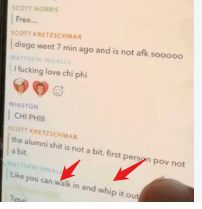
“Like you can walk in and whip it out.”
This is where the digital evidence becomes critical.
Messages attributed to Ingalls in the Chi Phi Snapchat group include:
“Like you can walk in and whip it out.”
And:
“Boys come whip it out.”
Those words are not merely evidence that other men eventually appeared.
They potentially show recruitment.
Ingalls was communicating with his fraternity brothers and inviting them into what was happening.
If authenticated, the screenshots provide contemporaneous evidence of his conduct at the moment the encounter was escalating.
And that is precisely why the messages matter more than a later argument about what someone remembers.
They show what Ingalls was communicating when it was happening.
The point was not simply sex
This is the distinction that should remain at the center of the narrative.
If Ingalls’s primary objective had simply been private sexual gratification, there would be no obvious reason to broadcast the encounter to a fraternity group or invite additional men into the room.
But if his objective included impressing his fraternity brothers, demonstrating his status, or gaining their approval, the conduct becomes more intelligible.
The evidence does not independently establish what Ingalls was thinking.
But his words and actions allow the plaintiff to argue the inference:
“I fucking love Chi Phi” was not incidental. It was the social environment in which the conduct occurred.
Doe’s trust provided access.
The sexual encounter provided the performance.
The Snapchat group provided the audience.
The invitations provided the recruitment mechanism.
And Chi Phi provided the social reward.
Then the story changes
Afterward, Ingalls’s account becomes markedly different.
When Doe questioned how other men ended up in the room, he said:
“The door was just unlocked… the party was sort of like crowded… there was nowhere else to go.”
That explanation presents the presence of other men as almost accidental.
But compare it with:
“Like you can walk in and whip it out.”
and:
“Boys come whip it out.”
The jury can decide what those statements mean.
But the contradiction is obvious enough to matter.
An unlocked door explains opportunity. It does not explain an invitation.
Then comes the sobriety argument
Ingalls also told Doe:
“You did tell me you were sober, by the way. You did, you said you hadn’t been anywhere.”
Again, the significance is not that the statement automatically proves what Doe’s condition was.
It is that Ingalls was constructing an explanation for why the encounter should be understood as consensual.
And then he went further.
“It’s possible that both of us…remember this, and it’s not true.”
When discussing his own memory of the event, Ingalls told Doe:
“I have racked my brain for this mystery. You know it’s possible that both of us, like, remember this, and it’s not true.”
That statement becomes particularly important when placed next to the contemporaneous digital record.
His memory could be uncertain.
The screenshots are not memories.
They are communications made at the time.
From fraternity status to damage control
The sequence therefore presents two very different versions of Ingalls.
Before the allegations:
“I fucking love Chi Phi.”
He initiates.
He recruits.
He invites.
He broadcasts.
He brings other men into the encounter.
Afterward:
The door was unlocked.
The party was crowded.
Doe had supposedly said she was sober.
Maybe neither of them remembered what really happened.
That is the transition from performance to preservation.
The same fraternity environment that appears to have provided the audience and social incentive at the beginning becomes the environment whose reputation and members now need protection.
The narrative the plaintiff can put before the jury
The plaintiff does not need to prove that Ingalls consciously planned every subsequent event from the beginning.
The stronger argument is that his actions form a recognizable progression.
He gained Doe’s trust.
He used that trust to bring her into the fraternity environment.
He initiated the sexual encounter.
He involved another fraternity member.
He communicated with the fraternity group.
He invited other men into the room.
And then, after the fact, he offered explanations that minimized his role in bringing them there.
Against that sequence sits his own declaration:
“I fucking love Chi Phi.”
That is potentially the missing piece in the narrative.
The issue may not have been simply what Ingalls wanted from Doe.
It may have been what Ingalls wanted to prove to the people whose approval mattered to him.
If the jury accepts that inference, the sexual conduct becomes the means rather than the ultimate motive.
Doe was not the audience. Chi Phi was.
And that is why the screenshots, Ingalls’s recorded statements, and his later explanations matter together: they potentially document the progression from trust, to performance, to recruitment, to escalation, and finally to cover-up.


You must be logged in to post a comment.