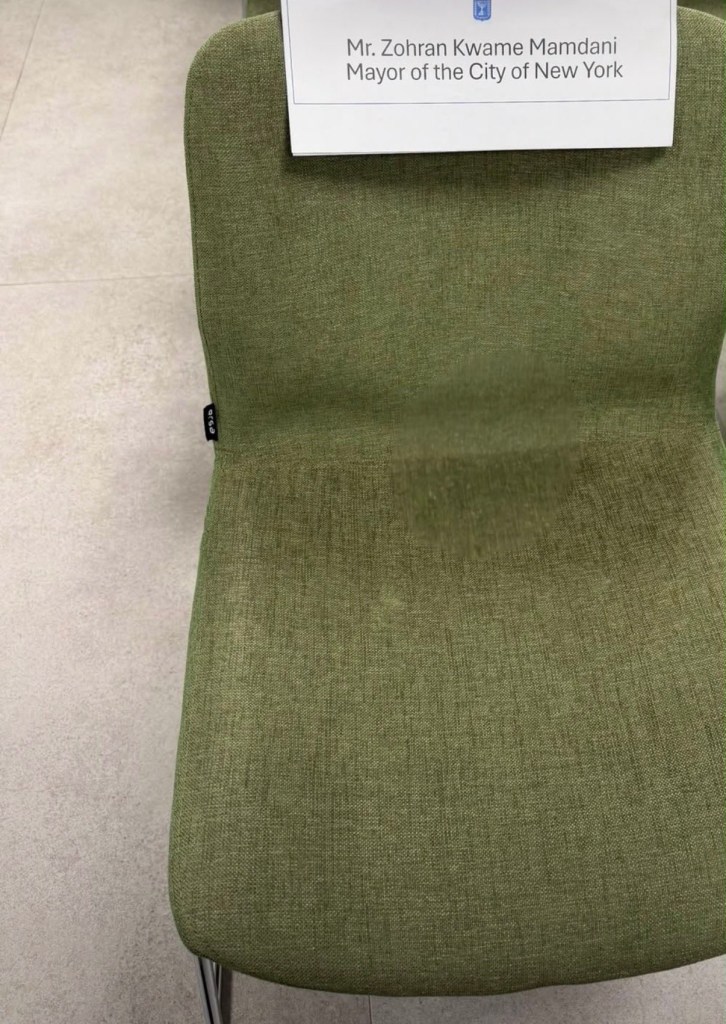
A green upholstered chair sits empty in a sterile institutional hallway. A crisp white placard rests on the backrest: “Mr. Zohran Kwame Mamdani, Mayor of the City of New York.” A dark, irregular wet stain spreads across the seat—like someone left in a hurry, or never arrived at all. The chair was reserved. The invitation was public. The screening of the IDF’s raw October 7 atrocity footage was happening in New York on the third anniversary of the massacre. The mayor did not sit down.
That empty chair is not an accident of scheduling. It is the purest expression of a political style: constant, high-visibility performance that never risks genuine confrontation with uncomfortable facts. Zohran Mamdani’s social media posts and public appearances follow the same script. They are carefully staged signals to a base, not expressions of personal curiosity, moral reckoning, or civic responsibility. The chair proves it.
On the anniversary itself, Mamdani issued a statement that performed the expected gestures—brief mention of the 1,100 Israelis killed and the hostages—then pivoted immediately to accusing Israel of “genocide” and “apartheid.” The consul general invited him, repeatedly and publicly, to watch the 47-minute film that includes footage filmed by the perpetrators themselves. Mamdani stayed away. The reserved seat remained vacant while the mayor’s online persona continued its well-rehearsed routine.
This is not unique. It is the operating system of a certain political class.
The Pattern of Manufactured Authority
The figures who dominate today’s institutional landscape rarely emerge from organic local accountability. Their rise follows a recognizable path of institutional grooming, strategic placement, and sustained performance that serves interests far removed from the concrete needs of the populations they claim to represent.
Volodymyr Zelensky’s trajectory remains the textbook case. A television comedian bankrolled by oligarch media power, he was packaged as the anti-corruption everyman in Servant of the People. Once in office, the role never ended. Nightly addresses, carefully lit wartime imagery, and endless international media appearances function as continuous fundraising theater for NATO-aligned priorities. The performance sustains the flow of resources; the underlying power arrangements remain intact.
Mahmood Mamdani, the academic father of New York’s current mayor, occupies the intellectual wing of the same apparatus. Educated and tenured inside elite Western universities—Pittsburgh, Fletcher, Harvard, Columbia—his career is inseparable from the prestige networks that reward particular critiques of power while shielding others from scrutiny. Work framed as anti-colonial analysis circulates within those networks as orthodoxy. Initiatives such as involvement with the Gaza Tribunal channel institutional energy toward approved geopolitical targets. The result is not neutral scholarship; it is narrative management that weakens the legitimacy of national histories while the managerial class consolidates elsewhere.
Barack Obama remains the archetype of the propositional leader. Rapid elevation from state legislature to Senate to presidency was engineered by donor networks and political machines. The brand projected “change” while the administrative state expanded, international institutions gained leverage, and traditional social bonds were systematically diluted. Post-presidency, the cultural capital continues to enforce the consensus. The performance was always the point.
What the Empty Chair Reveals
Zohran Mamdani sits at the intersection of these patterns. Son of the academic, product of elite New York pathways, elevated by progressive institutional machinery, he governs a city of eight million while his public persona remains tuned to activist aesthetics and social-media signaling. The October 7 invitation offered a simple test: sit in the chair, watch the primary evidence of the massacre carried out by the people whose cause he has long championed, and then speak. He declined. The statement went out on schedule. The chair stayed empty. The wet mark on the fabric is the only physical residue of a non-event.
Social media posts and staged appearances are frictionless. They cost nothing and confirm the audience’s priors. Facing unfiltered footage of what happened on October 7 requires something the performance economy cannot supply: the willingness to let reality revise the script. The empty chair is therefore not a footnote. It is the clearest available data point.
The modern managerial class, the globalist institutions that credential it, and the media apparatuses that amplify it do not primarily produce leaders who answer to heritage populations. They produce reliable performers. The reserved seat, the unanswered invitation, and the carefully worded post are all part of the same production. The stain on the green fabric is what remains when the performance refuses to meet the evidence.


You must be logged in to post a comment.