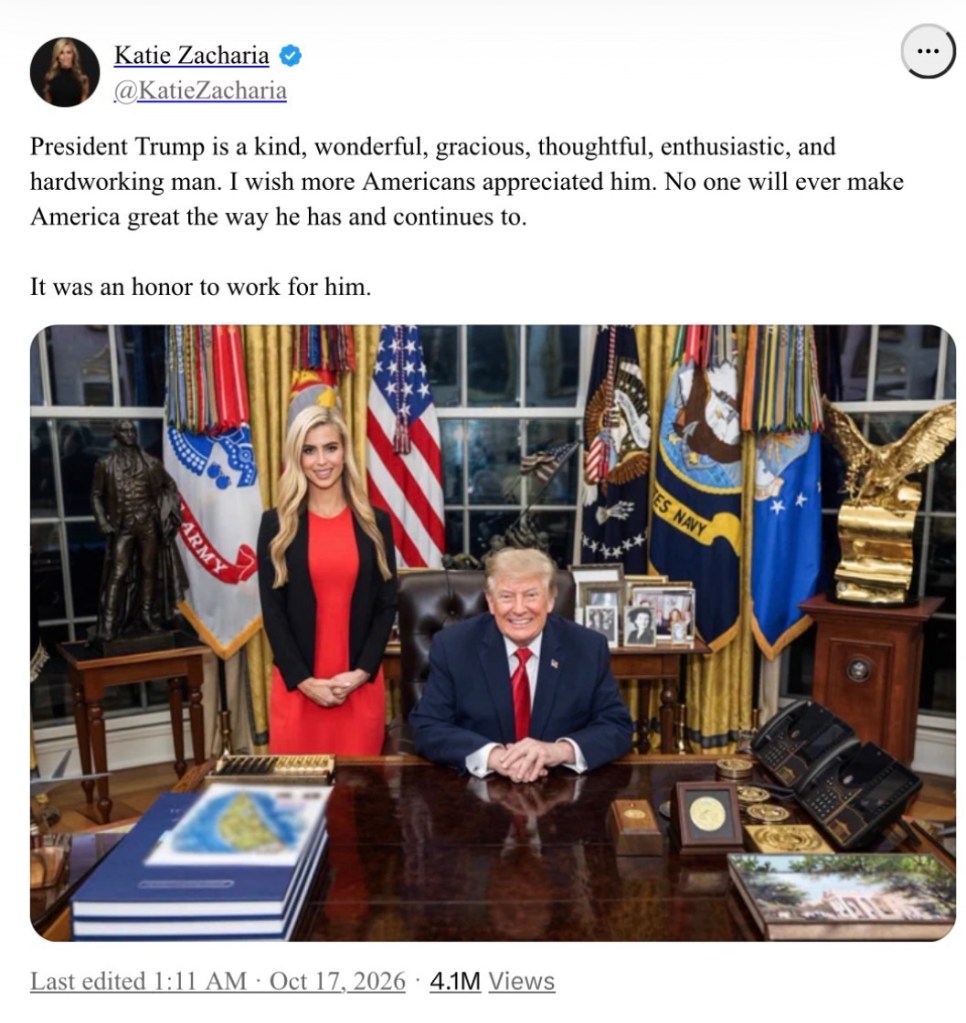
On October 16, 2026, Katie Zacharia was fired as White House press secretary after five days — the shortest tenure in the office’s history. That evening she posted a farewell on X: a photograph of herself standing behind President Trump at the Resolute Desk, and a few sentences of praise. “It was an honor to work for him.”
On the desk, directly in front of the president, sat a blurred map.
She was in the job five days, briefed with less than a day’s notice, handed her briefing book the morning of her only press conference. The photograph is a standard farewell pose. The map on the Resolute Desk was not hers to place — and she was gone before the week ended.
None of that matters to the proof.
What a QProof Is
In the Q system there are two kinds of proof. The first is the timestamp: a Q drop and a Trump post landing in the same minute, presented as evidence of coordination. The second is correspondence: a later event matching a drop’s language or imagery — “future proves past.” The farewell tweet can only ever be the second kind.
Keep in mind: A QProof is not a property of the event. It is a verdict rendered by the reading community, using rules the drops supplied. The system certifies its own proofs.
The Map Is Not a Map
Start here, because everything else depends on it. The map is not a literal map. It is the interlinked totality of the drops: one post mentions a theme, which links to another post on the same theme, which links to another — until the connections form a total picture. The purpose of the picture is orientation: to position yourself toward the truth instead of toward what you were brainwashed to believe. Drop 2971 names the mechanism outright — “Define ‘brainwashing’” — and then points: “The TRUTH is RIGHT IN FRONT OF YOU.”
This is why the map can never be falsified the way a document can. A document makes claims; the map is a way of standing. “Learn to read the map” doesn’t mean decode a cipher. It means re-orient: take the same visible world everyone else sees and stand where the truth becomes visible. The map is a stance, not a sheet of paper.
Which is what makes the photograph almost too perfect. A literal map — blurred, unreadable, sitting in front of the president in a news photograph — is the orientation device rendered as an object. You are looking at the truth. You cannot read it yet. That is the entire system in one frame.
The First Leg: The Map in Front of You
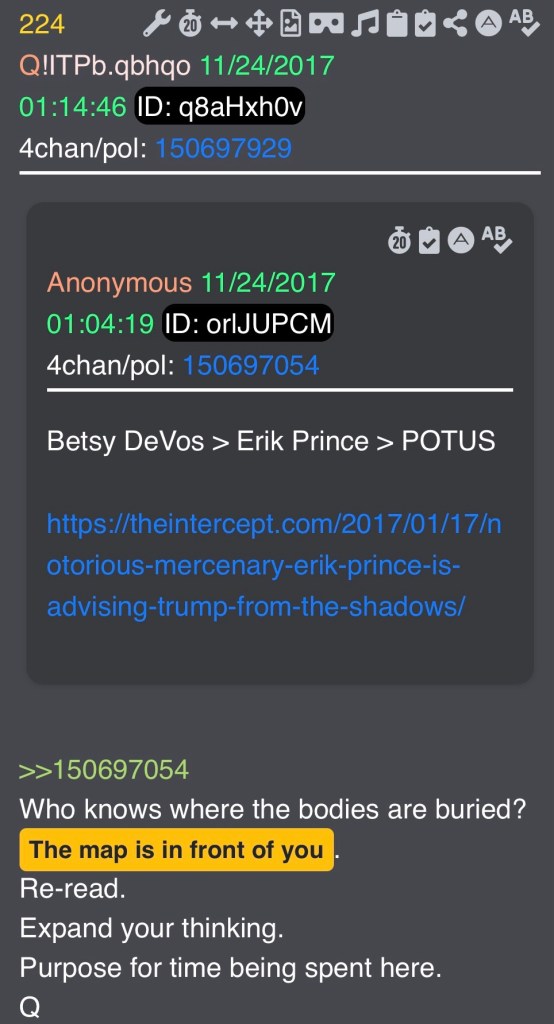
Q drop 224 (Nov 2017): “The map is in front of you.”
Across 2018 to 2020, ten more drops repeat the formula with one substitution: “The TRUTH is right in front of you.” “It’s right in front of you. It always has been.” Same syntax, same location — map becomes truth. The corpus makes the equation itself: the map is the truth, and the truth was never hidden, only unseen.
Nine years later, a news photograph shows a map sitting on the Resolute Desk, in front of the president. The drops also supply the mechanism:
Q drop 306: “News unlocks map. Future proves past.”
Q drop 852: “News / Tweets unlock the MAP.”
The map appears inside the news. The farewell post — 4.1 million views — is the news.
Then there is the blur. A blurred map is the system’s central aesthetic made literal: hidden in plain sight, visible but unreadable. The blur doesn’t obstruct the proof. The blur performs it — the truth in front of you, not yet legible, the failure located in the reading and never in the image.
And she didn’t place it. This is what makes the proof clean: it doesn’t depend on her intent. There is no claim to debunk about what she meant, because she meant nothing by it. She was posing for a goodbye photo.
The Second Leg: The Temp Hire
See this interchange:
Anon: “temporary role. cause destruction then move on. hard to hit a moving target, anon”
Q drop 2957 (Mar 2019): “’Scaramucci model’. ‘TEMP’ hire by design. Shadow to Sessions by design. Public will become aware > doc dump.”
Read Q’s payoff line carefully: “Public will become aware > doc dump.” The destruction is exposure. The temporary role exists to cause destruction, and the destruction is a document dump — the public becoming aware. Elsewhere the drops call this DECLAS, for declassification. . The pattern is: temporary placement, exposure, move on.
Q drop 3532 (Jul 2019): “The SWAMP runs deep. DNC server(s) hold many answers. SCARAMUCCI MODEL.”
Anthony Scaramucci lasted eleven days as communications director in 2017 — a tenure so brief it became a unit of measurement. Zacharia lasted five. On the day of the firing, “Scaramucci” trended on X alongside her name, and Q-following accounts posted the connection directly: “‘TEMP’ hire by design.”
During his brief tenure, Scaramucci ignited major controversy with a profanity-laced, on-the-record phone rant to The New Yorker in which he savaged senior colleagues like Reince Priebus and Steve Bannon while threatening to fire the entire White House communications team over leaks.
Zacharia’s five days were also a broadcast event. Her appointment surfaced her 2022 social media history — including a Truth Social exchange in which she engaged with Q drops by number (“It reminds me of Q posts 765, 767, and 847… I was wondering the same thing…”). For a week, QAnon was in mainstream news because the press secretary used to read the drops. The exposure happened. Then the firing. Then the farewell — the “move on.”
Plausible Deniability
Notice what Q never does in 2957: assert. Q quotes. The explosive frame — temporary hires as instruments of destruction — belongs to the anon; Q merely affirms it, in quotation marks, and adds the payoff.
This is the deniability architecture of the entire operation, and the drops run on it everywhere: questions instead of claims (“Who knows where the bodies are buried?”), imperatives instead of arguments (“Learn to read the map”), anons instead of authors. Nothing is ever quite stated by anyone who can be held to it. The system speaks entirely in ratified echoes — which is why it can never be caught misspeaking, only its readers can, and the readers are told “we may have overestimated your ability.”
Apply this to the farewell tweet. Nobody instructed the courier. Nobody asserted anything. A photo was posted; readers did the rest. Every step of the proof’s assembly is deniable, because every step was performed by someone who was “just” doing something else — posing, posting, decoding. Deniability isn’t a cover story here. It’s the medium.
Game Theory: The Move Nobody Ordered
They knew she would post a farewell tweet. Nobody told her to.
This is the mechanism of the entire setup, and it is game-theoretic, not conspiratorial. A fired press secretary posts a gracious farewell with a photograph — that is the predictable move, the dominant strategy. It requires no instruction, no coordination, no briefing. Anyone who understands the game can predict it with near certainty.
If you can predict the move, you don’t need to order it. You only need the board arranged before she moves: the desk as it always is, the map where maps sit, the camera where cameras are. Or less than that — you need only the audience, already trained, waiting for the post. The courier’s predictable graciousness does the delivery. Her ignorance isn’t an obstacle to the plan; her ignorance is what makes the plan deniable.
Note the elegance: the same property that makes her the perfect courier — she was a trained reader herself, citing drops by number in 2022 — also makes her the perfect cutout. She belongs to the audience and to the institution at once, and neither membership required her to know what the photograph would become.
What Her Tweet Conveys
On its face: gratitude, loyalty, honor — the standard language of a gracious exit. “It was an honor to work for him.”
Read as a QProof, it conveys three things. First, the map: displayed, blurred, in front of him — the truth visible and unreadable at once, the orientation device as an object. Second, the completed pattern: the temp hire came, the exposure happened (a week of QAnon in the headlines — the doc dump as news cycle), and now the “move on.” Her farewell is the move-on, executed in her own words. Third, the signature of the system that assembled it: every element deniable, every actor “just” doing their job, the proof certifying itself in the replies.
The tweet doesn’t announce any of this. It doesn’t have to. The courier’s job was only to carry the photograph out of the building.
What This Shows
The standard question is who planned it. The reporting offers candidates — whispers that she was set up to fail, claims of a “trap” laid through the Fox appearances. That question may never be answered, and this essay doesn’t need it answered, because the game-theoretic reading dissolves it: predictable moves don’t need orders, and deniable architectures don’t need designers on the scene.
The real finding is structural. The Q system is a proof-generating machine that runs on ordinary news and predictable people. It doesn’t require a hidden hand; it requires only the trained readers, and they are already in place — one of them briefly held the podium. “Future proves past” on autopilot — with the courier waving goodbye in the frame.
Where This Ends
The Q campaign is enduring because it gives the President cover. But it is effective due to its participatory, validating approach. Even now, years after disappearing, links citizens together as a freely thinking, rhetorically sophisticated, oppositional digital army set against the best efforts of the mainstream media to propagandize and brainwash.
So when the document dump comes, the Trump haters will of course dismiss it as nothing. But the reality is otherwise, and Q followers will grasp it as the truth they were oriented toward all along.
They in turn will influence the masses, who will receive Trump’s truths the way they always have — filtered down, meme by meme, from the readers who never stopped reading the map.


You must be logged in to post a comment.