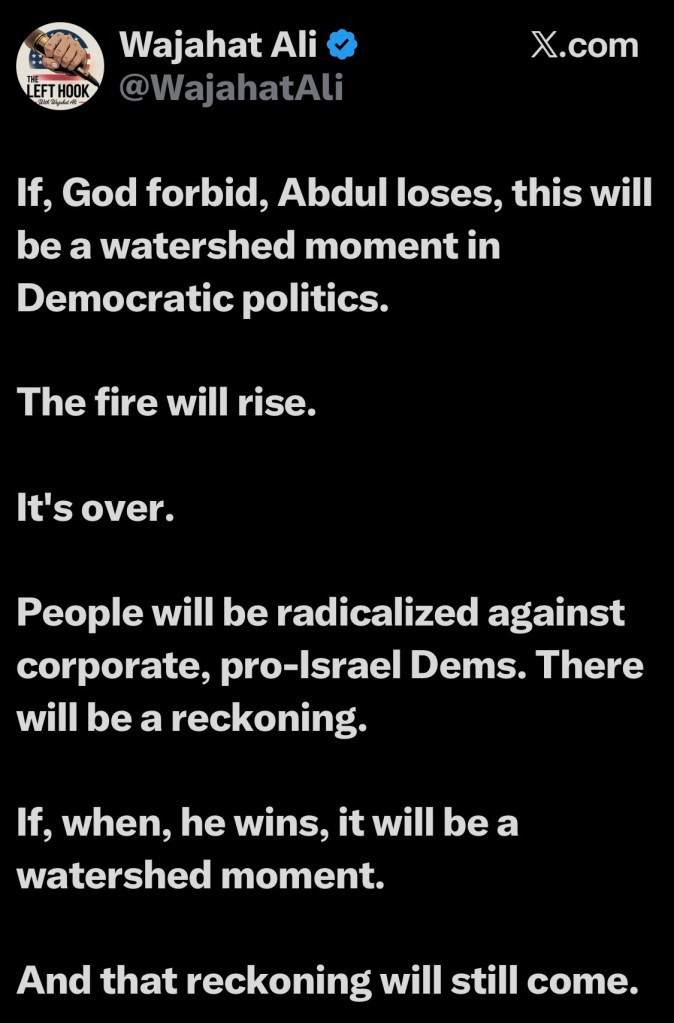
Wajahat Ali wants it both ways. After posting that a loss by Michigan Senate candidate Abdul El-Sayed would make “the fire will rise,” that people would be “radicalized against corporate, pro-Israel Dems,” and that “there will be a reckoning”—win or lose—he later insisted the whole thing was merely “political and cultural.” Violence, he added with a wink, is “your thing.”
This is not clarification. It is damage control. The original language was not the measured language of coalition politics or even sharp dissent. It was the language of inevitability and purification. “The fire will rise.” “It’s over.” “There will be a reckoning.” These are not synonyms for “we will primary some moderates” or “voters will punish the establishment.” They are the vocabulary of rupture. When a prominent progressive commentator frames one candidate’s electoral fate as the trigger for mass radicalization against an entire category of Democrats defined by their support for Israel, the claim that this is ordinary “political and cultural” speech collapses under the weight of its own words.
The Original Post and the Walk-Back
On November 1, 2026, Ali wrote:
If, God forbid, Abdul loses, this will be a watershed moment in Democratic politics.
The fire will rise.
It’s over.
People will be radicalized against corporate, pro-Israel Dems. There will be a reckoning.
If, when, he wins, it will be a watershed moment.
And that reckoning will still come.
The structure is deliberate. Defeat produces radicalization and fire. Victory produces the same reckoning. The outcome of the election is almost beside the point; the target—“corporate, pro-Israel Dems”—is fixed. The language does not describe a policy disagreement. It describes an enemy class inside the party whose defeat or containment is presented as historically necessary.
When criticism mounted, Ali pivoted: the reckoning would be “political and cultural.” Violence belongs to the other side. This is a classic move. First deploy the maximalist rhetoric that signals purity and urgency to the base. Then, when the temperature rises, insist the words never meant what they plainly suggested. The problem is that the original phrasing already did the work. “Fire” and “reckoning” in political contexts have long histories of implying more than procedural change. They imply that the existing order has become illegitimate and that something more intense is both coming and deserved. Pretending otherwise is not sophistication. It is evasion.
Context: Candidate, Campaign, and the Grocery Ad
Abdul El-Sayed is not a random progressive. He is the Democratic nominee in a high-profile Michigan Senate race, a physician and former public-health official who defeated a more conventional, pro-Israel Democrat in the primary. His positions on Israel have been consistently hard-line: opposition to continued military aid, including defensive systems; characterization of Israeli policy in extreme terms; and a conditional, hedged answer when asked whether Israel has a right to exist as a Jewish state. On national television he has affirmed a Palestinian right to exist without parallel caveats while attaching conditions to Israel’s. That is a legitimate political position. It is also one that places him far outside the historic mainstream of the Democratic Party on the issue.
The environment around his campaign has included more than policy disagreement. In late October 2026, an independent PAC running ads in support of El-Sayed produced a commercial that explicitly tied American grocery prices to U.S. aid to Israel. A couple in a supermarket is shown putting eggs and bananas back on the shelf. The woman explains they must “set that $7 aside for killing Palestinians.” The ad links household inflation and food costs to spending on Israel, including a reference to Israeli healthcare being subsidized by American taxpayers. The unmistakable implication is that ordinary Americans are sacrificing basic necessities so that Israel can conduct military operations.
This is not a novel critique of foreign aid. It is a classic antisemitic economic scapegoating trope updated for the grocery aisle. The idea that Jews or the Jewish state secretly or disproportionately control the levers of economic pain—raising prices, diverting resources, making life harder for ordinary people—has a long and bloody history. It appears in medieval blood libels, in 19th- and 20th-century conspiracy literature, and in modern variants that replace “Jewish bankers” with “the Israel lobby” or “Zionist influence.” The ad’s creators and defenders insist it is simply about budget priorities. That defense ignores both the specific language (“killing Palestinians”) and the choice of target. U.S. military aid to Israel is a small fraction of the federal budget—on the order of a few billion dollars annually against a multi-trillion-dollar budget and over a trillion dollars in annual grocery spending. It does not drive egg or banana prices. Inflation has complex causes: supply chains, energy, labor, monetary policy, weather, and more. Singling out Israel as the reason families cannot afford food is not analysis. It is redirection of economic frustration onto the Jewish state.
When a campaign ecosystem produces both this kind of ad and commentary promising a “reckoning” against “pro-Israel Dems,” the two reinforce each other. The ad supplies the grievance narrative: your suffering has a foreign, Jewish-linked cause. The rhetoric supplies the political conclusion: those who defend the relationship with Israel are the enemy within, and their defeat will produce a necessary purification.
Why “Political and Cultural” Is Not a Free Pass
Political speech is robust for good reason. Primary challenges, donor fights, and ideological battles are how parties evolve. Cultural critique of institutions is often necessary. None of that requires the language of rising fire and inevitable reckoning directed at co-partisans defined by their stance on Israel.
There is a difference between saying “support for unconditional aid to Israel is politically costly and morally wrong” and saying that people will be radicalized against an entire category of Democrats and that a reckoning is coming regardless of the election result. The first is argument. The second is prophecy with a threat edge. It treats democratic outcomes as provisional and the target group as permanently illegitimate. Once that frame is accepted, ordinary persuasion becomes secondary to pressure, purity tests, and the expectation that the fire will do the rest of the work.
This is especially corrosive inside a coalition party. Democrats include significant numbers of Jewish voters, pro-Israel liberals, and moderates who support a strong U.S.-Israel relationship even while criticizing specific Israeli governments. Declaring those voters and their elected representatives the object of radicalization and reckoning does not expand the coalition. It signals that their presence is contingent and their preferences suspect. The practical effect is to make Jewish Democrats choose between their party identity and the knowledge that prominent voices on their side view “pro-Israel” as a mark of corporate corruption rather than a legitimate foreign-policy position.
Ali’s walk-back does not solve the problem. By insisting the language was always only political and cultural, he implies that critics are either too stupid to understand metaphor or acting in bad faith. That is a closed loop. Any objection can be dismissed as overreaction or as the projection of the objector’s own violent tendencies. The original words remain on the record, doing the work of escalation while the speaker claims clean hands.
The Antisemitism Question
Not every criticism of Israel is antisemitic. That point is true and important. It is also not the full story. When criticism of Israel is paired with economic scapegoating that blames the Jewish state for domestic inflation, when it treats “pro-Israel” as a near-synonym for corporate capture, and when it is accompanied by rhetoric of fire and reckoning against those who hold the contrary view, the cumulative effect tracks classic patterns of antisemitic politics. The target is not merely a government or a set of policies. It is a people and a relationship portrayed as the hidden source of ordinary Americans’ hardship and the obstacle to progressive purification.
The grocery ad is the clearest example. It does not argue that military aid should be reduced on strategic or humanitarian grounds and then leave the economic claim alone. It invents a direct causal link between aid to Israel and the price of eggs. That link is false. Its emotional power comes from the older idea that Jewish interests somehow extract wealth or impose costs on the majority population. Defenders of the ad treat the charge of antisemitism as a silencing tactic. In reality, the charge is a description of the mechanism: take a real problem (inflation), invent a false cause (Israel), and direct popular anger accordingly.
Ali’s post operates in the same atmosphere. By naming “corporate, pro-Israel Dems” as the group against whom radicalization and reckoning are expected, he collapses a range of positions—support for Israel’s security, skepticism of certain progressive foreign-policy demands, mainstream Democratic orthodoxy—into a single toxic category. The corporate label does additional work, suggesting that the pro-Israel stance is not a matter of conviction or alliance but of money and capture. This is another long-standing antisemitic motif: Jewish or Zionist influence as the hidden hand behind establishment politics.
Broader Consequences
Language like this does not stay confined to Substack essays and X posts. It shapes the expectations of activists, the boundaries of acceptable speech inside the party, and the willingness of Jewish Democrats and their allies to remain invested. It also hands ammunition to those on the right who claim that progressive politics has become structurally hostile to Jews. When the response to criticism is to double down on the claim that the original rhetoric was merely political, the cycle continues: maximalist language, backlash, insistence that the backlash is the real problem.
There is a healthier alternative. Argue the policy. Challenge the donors. Run primaries. Organize. Do all of it without declaring that the fire must rise and that a reckoning against an identity-and-policy category is inevitable. That alternative requires accepting that democratic politics includes durable disagreement, including on Israel, and that radicalization is not a strategy but a failure mode.
Ali’s post and its subsequent defense fail that test. The original language was not careful political analysis. It was a performance of inevitability and threat directed at a specific faction defined by its support for Israel. Calling it “political and cultural” after the fact does not change what was written. It only confirms that the speaker understands the power of the words he chose and would prefer not to own their implications.
The fire does not have to rise. The reckoning does not have to come. Those outcomes are not forces of nature. They are choices made by people who decide that ordinary politics is insufficient and that something more purifying is required. Rhetoric that treats that choice as destiny is not neutral commentary. It is part of the problem it claims to describe.
Sources:
https://x.com/wajahatali/status/2116948616283578433 (the “fire will rise / reckoning” post)
https://x.com/WajahatAli/status/2116987112813703601 (his follow-up claiming the reckoning is only “political and cultural”)
The grocery-price ad and reactions
https://www.theatlantic.com/ideas/2026/10/groceries-israel-funding-budget/689151/ (David Frum, The Atlantic)
https://www.wsj.com/opinion/michigan-ad-israel-gaza-cenk-uygur-abdul-el-sayed-4d1794c3 (Wall Street Journal editorial)
https://www.jns.org/news/u-s-news/ad-for-el-sayed-blaming-rising-grocery-costs-on-israel-a-case-study-in-jew-hatred (Jewish News Syndicate)
https://newscord.org/article/rabble-back-committee-ad-links-israel-aid-to-grocery-prices-says-7-to-kill-pales–Story_20261027_7698679c3 (coverage summary of the ad)
https://x.com/JGreenblattADL (ADL comments on the ad, referenced in multiple reports)
Abdul El-Sayed background and positions
https://www.jpost.com/american-politics/article-913530
https://drshushan.substack.com/p/michigans-political-earthquake-abdul
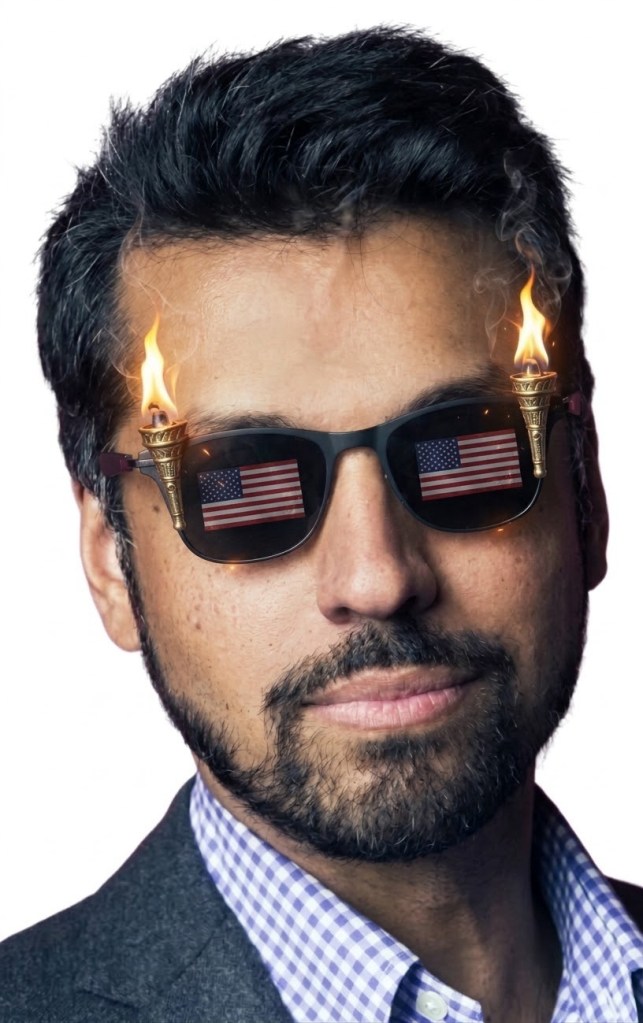
AI modified photo.


You must be logged in to post a comment.