Free to reuse with attribution.
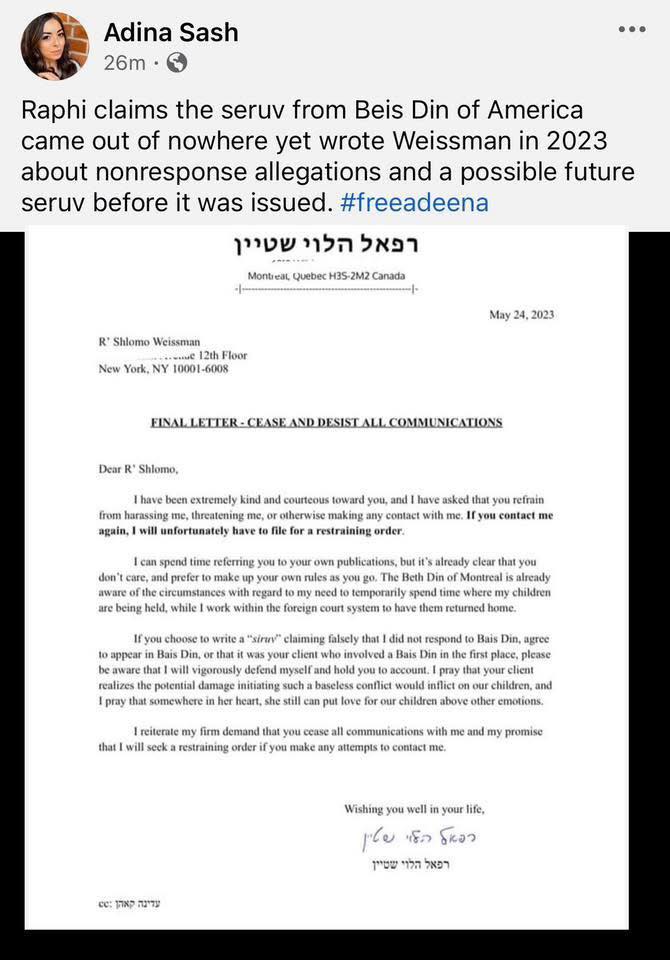
Today, May 25, 2026, social media influencer Adina Sash, known as FlatbushGirl, published a private 2023 cease-and-desist letter sent by Raphi Stein to Rabbi Shlomo Weissman, director of the Beis Din of America (BDA).
It read, in part:
“I have asked that you refrain from harassing me, threatening me, or otherwise making any contact with me. If you contact me again, I will unfortunately have to file for a restraining order….If you choose to write a ‘siruv’ claiming falsely that I did not respond to Bais Din, agree to appear in Bais Din, or that it was your client who involved a Bais Din in the first place, please be aware that I will vigorously defend myself and hold you to account.”
The letter raises a basic but important question: how did a private document from an ongoing divorce dispute end up in the hands of Adina Sash, aka “FlatbushGirl,” an Instagram influencer?
The Overlap of Civil and Religious Litigation
The answer matters because the Rockland County file in Kohn v. Stein shows that social media conduct has already become part of the litigation. The docket includes an exhibit on “social media disparagement of defendant” and, later, a filing addressing “harmful social media activity by/for plaintiff,” indicating that online pressure is not separate from the case but part of it.
The overlap between the plaintiff’s civil lawyer, David Abramson, and the religious representative identified as Yael Abramson Braun is notable because Braun is, according to Eli Evans, Abramson’s daughter and the plaintiff’s to’enet (rabbinical court advocate) before the BDA.
(Public court records identify David S. Abramson as one of the attorneys of record; an article in Kveller verifies the relationship; I cannot independently verify that Braun is the to’enet. https://www.kveller.com/this-trailblazing-orthodox-mom-helps-women-get-a-jewish-divorce/)
If this incestuous arrangement is actually happening, it isn’t illegal, but it does erode the illusion of a wall between the civil and religious sides of the dispute.
Allegations of a Defamation Campaign
On his (now-defunct) freeraphi.org website, which was stood up on June 10, 2022, nearly a year before Stein sent the cease and desist letter to Weissman, Stein directly accused both him and Braun of threatening him with a “public defamation campaign”, meaning social media harassment. He wrote:
“Now, Raphi is being threatened with a public defamation campaign spearheaded by Instagram personality Yael Abramson Braun (billing at $400/hour) and Shlomo Weissmann, claiming, falsely, that Raphi is violating halacha and should be excommunicated.”
The question comes up, who would be paying Braun $400 an hour? The Beis Din of America? Or would she be billing that to the plaintiff, who would plausibly then pass the fees on to the defendant FOR HIS OWN HARASSMENT?
In any case, this 2022 claim is important for several reasons.
First, it clearly establishes potential collusion between the BDA—which is supposed to be neutral—and the social media influencer ecosystem. Consequently, the accusation that a private legal document was handed from the BDA to the to’enet, and subsequently to Sash, becomes much more plausible.
Second, because the BDA case directly affects the outcome of the civil case (as a get is required for it to be closed), Stein’s argument that the BDA was harassing him shows they were potentially interfering in the custody and financial arrangements of the divorce—matters in which they had no formal interest or jurisdiction.
If this happened to Stein, who else has it happened to? For how many others has Sash acted as judge, jury, and executioner?
Milking the Pain of Divorcees
Sash’s high-reach Instagram account translates a complex legal battle into a simplified morality play for a large audience, and that amplification can quickly convert inside information into public pressure. Her formula is simple: take a private document, package it for outrage, and mobilize followers to intensify pressure online.
Undoubtedly, many women have suffered from the very real pain of being denied a divorce by their cynical spouses. One litigator described dealing with this kind of horror for decades. But Sash also makes a living off of this victimization, and that’s an incentive for her to pump up the volume as high as she can.
Her appearance on the May 24, 2026 episode of the Zev Brenner show was a pretty good example.
“I will make sure Gittin (the part of the Talmud dealing with divorce) is illegal,” wailed Sash theatrically. “I will sound every alarm.”
Sash whips up her Internet mob. She doesn’t represent Kohn, but she is trying to force a legal resolution using extra legal means, a dangerous precedent for all parties involved.
The Legal Silence of New York Domestic Relations
Sash’s personal interest in defaming Stein means she takes every opportunity to protest at the way he appears to be dragging the case out. And she repeats the timeline like a mantra. “Five years! Five years!”
But contrary to what Sash would have her viewers believe, the arguments are active and ongoing, to this very day. Any viewer can look up the Rockland County file, which is full of filings about custody, finances, discovery, and trial memoranda. This is not a case that Stein is holding in abeyance. It is a complicated matter in which the real, underlying disputes have not been resolved.
Some have asked why Stein doesn’t defend himself. The answer is that domestic relations proceedings in New York are governed by privacy rules and court procedures that can sharply limit what a party can disclose publicly, especially when the case involves children, finances, and sealed filings.
If Stein cannot post transcripts, discovery materials, or the details of his defense online without risking legal consequences, then his inability to answer publicly is itself part of the imbalance.
From Social Media to Courtroom Evidence
Sash’s online rants and impassioned pleas to her many thousands of viewers are becoming a part of the Kohn vs. Stein divorce case itself.
The record also includes a February 2023 exhibit concerning social media disparagement, followed by a March 2026 application packed with internet printouts detailing “harassment conduct and post-hearing evidence.”
What happens on social media can become evidentiary material in court, which gives public harassment a direct role in the litigation environment.
Consider what could happen if that tactic were turned against a hapless wife and mother by a well-connected and ill-intentioned ex.
Trial by Spectacle
The fact that the target of her campaign must be silent makes it easy for Sash, the self-appointed enforcer of the BDA’s rulings, to make him look guilty.
Plus, algorithms reward outrage, audiences reward certainty, and the public often mistakes one-sided narration for proof.
In that environment, silence becomes a liability: it is read as guilt, then used to justify even more pressure, and then fed back into the litigation record.
The Erosion of Due Process
All of this is why the “just give her the gett” slogan is too simplistic. It collapses a multi-year legal battle into a single moral command and assumes the underlying process is clean.
When “one hand is washing the other” between the civil and religious court systems, and public pressure becomes a primary engine of legal outcome, the case ceases to be only about a religious divorce. It becomes a question of basic fairness.
So what about the letter?
The larget concern is not simply that a communication was leaked, or even what its contents were. It is that the leak sits inside a broader system in which civil litigation, religious authority, and social-media mobilization reinforce one another TO INTERFERE WITH THE OUTCOME OF A DIVORCE CASE, before the underlying issues are put forth in court and resolved.
From a Jewish perspective, if procedural work from the Beis Din is being echoed by a plaintiff’s representative and then delivered to a public influencer for amplification, it starts to look a lot like the weaponization of the halachic process by “militant feminists,” who are very happy to see the line between religious arbitration and civil coercion erode.
Next Steps
The public should demand to know from Sash how she got that letter in the first place.
We should insist that the boundary between the Beis Din and the civil court system is observed and respected.
And we should never delegate our judgment to the cynical machinations of grifting social media influencers like Sash.
If we fail to change the mob mentality that falls in line whenever the word “Agunah” enters the conversation, weaponized public shaming campaigns and back-door disclosures will continue to hijack disputes that should be decided through law and common sense, not spectacle.
 Writing by Dr. Dannielle Blumenthal
You must be logged in to post a comment.