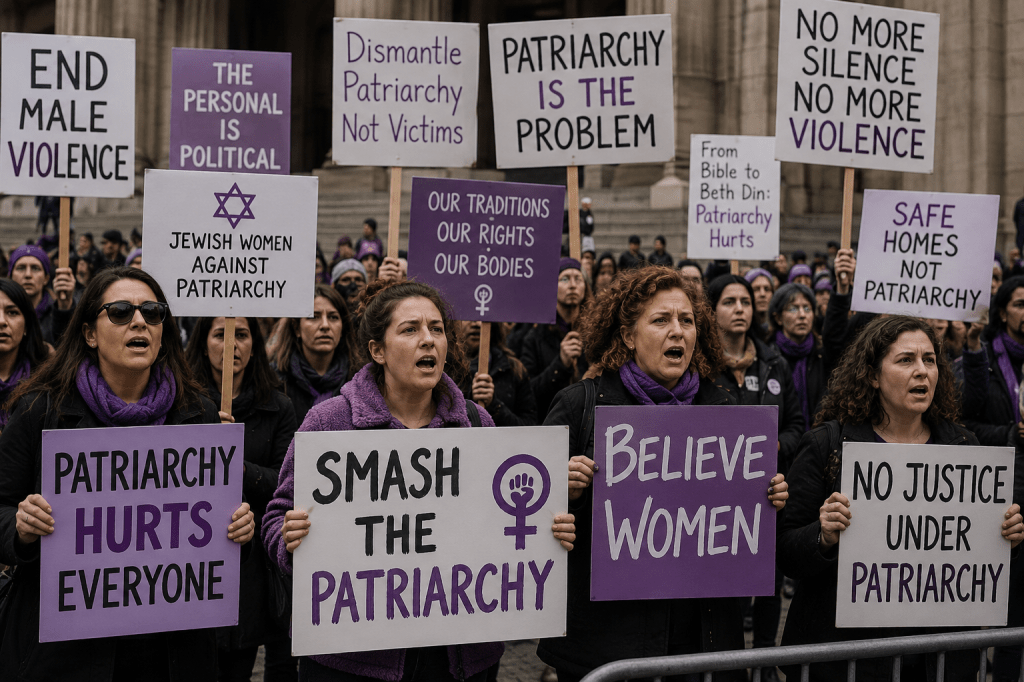
For generations, a powerful cultural myth circulated quietly within many Jewish communities: “Jews don’t beat their spouses.” Wrapped in the religious ideal of Shalom Bayit (peace in the home), domestic abuse was often imagined as something that happened elsewhere, in other cultures or dysfunctional secular environments.
But survivors, advocates, clinicians, and community organizations have spent decades dismantling that illusion.
Intimate partner violence (IPV) exists across every sector of Jewish life, including Reform, Conservative, Orthodox, Reconstructionist, secular, and unaffiliated circles. Abuse crosses lines of class, education, religiosity, and social status. Research suggests that Jewish communities experience domestic abuse at rates broadly comparable to the wider population, though stigma and underreporting make precise measurement difficult.
At the same time, discussions about abuse in Jewish communities are often distorted by two competing myths. One myth insists that religious communities are morally insulated from domestic violence. The other reduces nearly every family pathology to a simplistic framework of patriarchy, male oppression, and female victimhood.
Both narratives obscure reality.
Beyond Simplistic Ideological Frameworks
Some contemporary feminist frameworks approach family dysfunction almost entirely through the lens of systemic male power. In this model, abuse is interpreted primarily as an expression of patriarchy: men as controllers, women as victims, and religious tradition as a mechanism of female subjugation.
There are important truths embedded within this framework. Historically, women have often been economically dependent, socially constrained, and vulnerable to coercion within both secular and religious societies. Serious intimate partner violence disproportionately affects women, and many abused Jewish women have faced profound institutional failures, including Get (religious divorce) coercion, communal silencing, and pressure to preserve appearances at the expense of safety.
But problems emerge when ideology replaces observation.
Not every abusive Jewish marriage fits neatly into a patriarchal model. Some abusive relationships involve mutual coercion, female-perpetrated abuse, psychological domination rather than physical violence, parental alienation, financial manipulation by either spouse, or extended family systems that amplify conflict independent of gender. In some cases, communal or activist narratives can become so rigidly gendered that male victims are treated as impossible by definition, while female aggression is minimized, rationalized, or reframed as reactive behavior.
This can produce serious blind spots. Male victims in religious communities may fear that they will not be believed, that allegations against them will be presumed credible without scrutiny, that access to their children could be jeopardized, or that communal institutions will reflexively interpret them as perpetrators regardless of the underlying facts.
Likewise, when one spouse becomes less religious—or more religious—family conflicts may become entangled with ideological battles over identity, education, and communal belonging rather than simply male domination. In high-conflict divorces, parental alienation can emerge from either parent, sometimes reinforced by grandparents, in-laws, activist networks, or communal factions that frame the conflict in moral absolutes. Reducing these dynamics solely to “the patriarchy” can obscure the actual mechanisms of coercion operating inside particular families.
The Weaponization of Moral Language
One of the most difficult realities in communal abuse cases is that moral language itself can become weaponized. An abusive husband may invoke Shalom Bayit, religious duty, modesty, or communal reputation to pressure a wife into silence.
But ideological language can also be weaponized in the opposite direction. Terms such as “misogyny,” “patriarchy,” “abuser,” or “unsafe” can sometimes be deployed irresponsibly in ways that shut down investigation, bypass due process, or socially destroy individuals before facts are carefully established.
This does not mean abuse allegations should be dismissed. Historically, genuine victims were ignored far too often. But neither should ideological assumptions replace careful evaluation of evidence, context, and behavior. Healthy communal responses require enough moral seriousness to hold two truths simultaneously: abuse is real and often hidden, and ideological narratives can sometimes distort how abuse is interpreted, investigated, or publicly understood.
The Need for a More Honest Communal Framework
A healthier approach to domestic violence within Jewish communities requires moving beyond both denial and reductionism. That means recognizing abuse against women, abuse against men, coercive control, psychological abuse, religious manipulation, false allegations, parental alienation, economic sabotage, and institutional failures across multiple directions.
It also means acknowledging that strong families are not preserved by suppressing truth for the sake of communal image management. Authentic Shalom Bayit cannot exist where fear, coercion, intimidation, humiliation, or manipulation dominate the home. Protecting victims requires moral clarity, professional standards, due process, and the willingness to confront uncomfortable realities even when they challenge communal or ideological assumptions.
 Writing by Dr. Dannielle Blumenthal
You must be logged in to post a comment.