The Illusory Independent Leader
History is routinely taught through individual biography: a charismatic leader emerges, an organic resistance movement forms, an exile community organizes, or a dissident acquires international prominence. Western audiences are trained to evaluate these events strictly at face value—focusing entirely on the heroic individual or the spontaneous movement while ignoring the external institutions quietly steering the outcome. Standard historiography reinforces this blind spot by isolating episodes into discrete national dramas, whether in Eastern Europe, East Asia, or Latin America. The personalities, cultures, and explicit ideologies differ radically, spanning anti-communism, anti-colonialism, religious nationalism, and democratic liberation. Yet when examined across a broader timeline, this framing collapses. A historical view reveals that these episodes are rarely independent; they follow a consistent institutional design.
The Mechanics of Intelligence Warfare
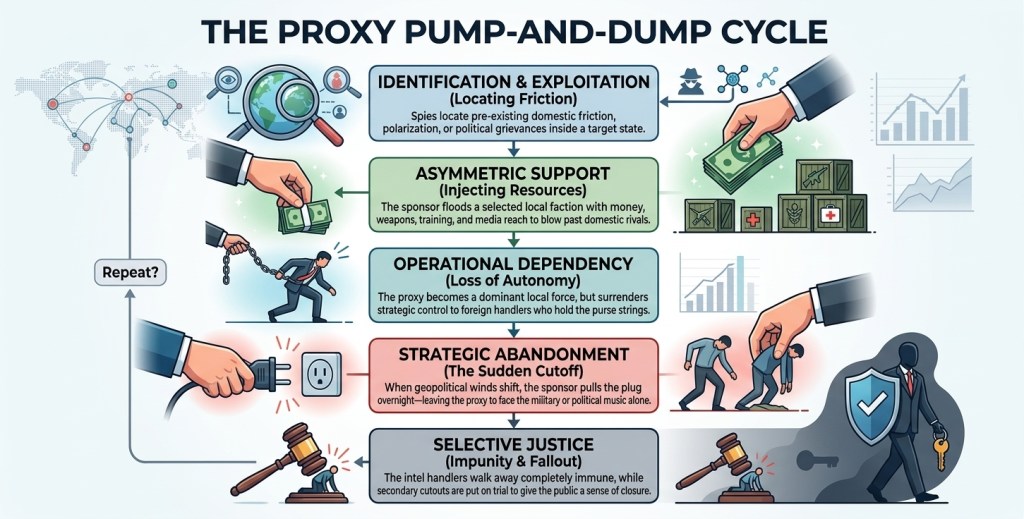
Major Western intelligence agencies—primarily the United States’ Central Intelligence Agency (CIA), Britain’s Secret Intelligence Service (MI6), and Israel’s Institute for Intelligence and Special Operations (Mossad)—do not operate in a vacuum. Their primary methodology relies on identifying, exploiting, or actively manufacturing internal domestic polarization to gain geopolitical leverage. Where genuine grievances exist, intelligence services insert money, weapons, training, communications, and diplomatic backing to inflate specific proxy factions over their rivals. This massive asymmetric support grants the chosen local faction domestic dominance, but at a severe cost: total operational dependency on foreign handlers. The intelligence apparatus gains decisive control over the movement’s trajectory. Then, once strategic priorities shift or regional destabilization reaches a breaking point, the foreign sponsor abruptly cuts funding, dismantles support pipelines, and abandons the proxy to absorb the catastrophic fallout alone.
Case Studies in Leverage and Abandonment
Examining these operations in chronological order reveals how Western intelligence services consistently build up, control, and ultimately discard their local partners:
- 1949 – Eastern European Émigré Networks (CIA & MI6): In the immediate aftermath of World War II, the CIA and MI6 established institutional umbrellas like the National Committee for a Free Europe and Radio Free Europe. They recruited anti-Soviet émigrés to conduct political and psychological warfare against Eastern Bloc governments. Ukrainian émigré groups, such as the ZP/UHVR under Project AERODYNAMIC, were leveraged for intelligence collection and clandestine infiltration. Once Soviet consolidation rendered these operations impractical and geopolitical containment strategies shifted, active operational support was curtailed, leaving internal underground networks exposed to systematic Soviet liquidation.
- 1949 – Post-War Albania (MI6 & CIA): Under Operation Valuable, British and American intelligence recruited anti-communist Albanian exiles to infiltrate and overthrow Enver Hoxha’s regime. MI6 and the CIA trained these fighters and dropped them into Albania, seeking to destabilize a Soviet-aligned state. Owing to operational insecurity and penetration by Soviet intelligence (via double agents like Kim Philby), the missions failed completely. The Western agencies abandoned the program, leaving the remaining local fighters and their domestic contacts to be captured, tried, or executed by Hoxha’s security apparatus.
- 1959 – Tibet and the Khamba Resistance (CIA): Following the Chinese annexation of Tibet, the CIA began funding, arming, and training Tibetan Khamba guerrillas at sites like Camp Hale in Colorado. U.S. intelligence weaponized Tibetan religious and national identity to tie down People’s Liberation Army resources and contain Chinese expansion. However, when the Nixon administration normalized diplomatic relations with the People’s Republic of China in 1972, the CIA cut all funding and logistics to the Tibetan resistance overnight, leaving the fighters isolated against the Chinese military.
- 1961 – Cuba and Brigade 2506 (CIA): Following the Cuban Revolution, the CIA recruited, funded, and organized Cuban exiles into Brigade 2506 to execute the Bay of Pigs invasion. The fighters possessed authentic anti-Castro convictions, but the operational planning, supply lines, and air support architecture were entirely managed by U.S. intelligence. When the landed forces met intense resistance, President Kennedy cancelled planned air strikes to maintain plausible deniability. The CIA cut its tactical support on the beachhead, resulting in the immediate defeat, death, or capture of over 1,000 brigade members.
- 1961 – Laos and the Hmong Secret Army (CIA): In Southeast Asia, the CIA’s Special Activities Center recruited General Vang Pao and built a 30,000-strong covert army of Hmong hill tribesmen to fight the Pathet Lao and North Vietnamese forces. Supported logistically by the CIA’s proprietary airline, Air America, the Hmong suffered staggering casualties guarding U.S. strategic interests for over a decade. Following the 1973 Paris Peace Accords and the subsequent U.S. military withdrawal, the CIA abruptly abandoned the territory. The Hmong were left without military support to face brutal reprisals, imprisonment, and displacement by the victorious Pathet Lao regime.
- 1967 – Infiltration of the U.S. Anti-War Movement (CIA & FBI): Under Operation CHAOS (CIA) and COINTELPRO (FBI), domestic intelligence services turned their tradecraft inward against the American anti-Vietnam War movement. Agencies covertly inserted agent provocateurs, manufactured internal ideological rifts, and funded radical sub-factions to discredit the broader peace movement. Once the war concluded, these intelligence networks did not disappear; their institutional methods and personnel shifted into legitimate political infrastructure, laying early groundwork for intelligence-aligned influence within the modern Democratic Party and national security establishment.
- 1972 – Iraqi Kurdistan and the Barzani Revolt (CIA, Mossad, & SAVAK): To tie down the Soviet-aligned Iraqi Ba’athist regime, the CIA and Mossad collaborated with Iran’s SAVAK to supply money and arms to Mulla Mustafa Barzani’s Kurdish movement. Henry Kissinger explicitly viewed the Kurds as an expendable proxy to keep Iraq off-balance. In 1975, when Iraq and Iran signed the Algiers Agreement settling their border dispute, the U.S. immediately cut off all military and humanitarian aid to the Kurds. Denied logistics, the Kurdish front collapsed instantly, and Iraqi forces launched massive military retributions. When Barzani pleaded for intervention, U.S. leadership famously refused to assist, noting that covert action is not to be confused with missionary work.
- 1979 – Afghanistan and the Mujahideen Pipeline (CIA & ISI): Under Operation Cyclone, the CIA, alongside Pakistani ISI and Saudi intelligence, funneled billions of dollars to Islamist resistance factions fighting the Soviet occupation. By controlling the distribution pipeline, Western and allied intelligence disproportionately empowered radical fundamentalist commanders like Gulbuddin Hekmatyar over moderate domestic leaders. Following the 1989 Soviet withdrawal, the CIA immediately disengaged from the region, leaving a heavily militarized, hyper-polarized society to collapse into a brutal civil war that ultimately birthed the Taliban.
- 1981 – The Nicaraguan Contras (CIA): The CIA created, funded, and directed the Contras—a coalition of anti-Sandinista fighters—to destabilize the revolutionary government in Managua. While indigenous opposition to the Sandinistas existed, the CIA weaponized these factions into an organized paramilitary force operating out of bases in Honduras. When U.S. Congressional opposition led to the Boland Amendments prohibiting direct aid, funding was diverted through illicit arms transfers (the Iran-Contra affair). Once geopolitical pressure forced a political settlement in 1990, foreign support evaporated, leaving the combatants and local communities to absorb the economic and social ruin of the decade-long civil conflict.
- 2014 – Ukraine and the Modern Proxy System (CIA & MI6): Following the 2014 Maidan uprising, Western intelligence agencies built extensive operational partnerships inside Ukraine, transforming the country into a fortified frontline state against Russia. By funding military infrastructure, training nationalist volunteer battalions, and establishing intelligence outposts along the border, agencies like the CIA and MI6 turned genuine Ukrainian statehood aspirations into the operational tip of a Western containment strategy. The trajectory of Volodymyr Zelensky reflects this structural trap: elected in 2019 on a peace platform to negotiate an end to internal conflict, he was rapidly subsumed by Western geopolitical requirements. As the war of attrition drags on, Ukraine faces total demographic and economic exhaustion, operating under constant exposure to the structural threat that Western patrons will eventually alter their strategic calculus and cut support when domestic political priorities shift.
- 2016–Present – The United States and Domestic Counter-Intelligence Escalation (CIA, FBI, & The “Deep State”): In a departure from traditional foreign operations, the internal mechanisms of intelligence-managed proxy warfare were directed inward against an incoming American administration. Beginning with the 2016 Crossfire Hurricane investigation and subsequent FISA warrant applications, elements within the FBI and intelligence establishment attempted to neutralize a non-aligned political insurgent—Donald Trump—by framing his national-populist movement as a compromised foreign proxy. When standard media and legal narratives failed to secure a political conviction, the intelligence apparatus escalated its countermeasures, leveraging internal leaks, whistleblower protocols, and coordinated public intelligence letters (such as the 2020 Hunter Biden laptop statement) to shape election outcomes and constrain presidential policy. Unlike traditional foreign cutouts who lacked domestic leverage, Trump recognized the institutional design of his opponents and mounted a direct counter-offensive. Rather than submitting to foreign-policy oversight or internal containment, his administration bypassed standard intelligence pipelines, declassified key operational documents, challenged the statutory authority of FISA courts, and systematically targeted career intelligence leadership. By identifying how intelligence networks turn domestic figures into disposable political assets, Trump disrupted the agency playbook—forcing an unprecedented public collision between an elected president and the permanent national security state.
Whether in foreign theaters or domestic politics, once these operational tools are exposed, the system relies on selective legal mechanisms to resolve the fallout.
Selective Justice and Strategic Impunity
The final phase of this intelligence pattern emerges long after the proxy conflict has ended and the initial sponsors have pulled back. As the fallout settles and public demands for legal accountability arise, international justice is deployed selectively. The broader intelligence apparatuses and their primary political assets often secure complete impunity, while secondary, highly visible figures are paraded through courtrooms to serve as public symbols of closure.
The Post-War Fascist Networks & Ratlines
Following World War II, Western intelligence services—including the U.S. Army Counter Intelligence Corps (CIC) and British intelligence—actively facilitated the escape of high-ranking fascist leaders through clandestine network pathways known as “ratlines” to Latin America and the Middle East. Sponsoring agencies deliberately shielded these top figures to utilize their networks as anti-communist intelligence assets during the cold war. Ante Pavelić, the supreme leader (Poglavnik) of the Axis-puppet Independent State of Croatia (NDH)—a regime responsible for the mass murder of hundreds of thousands of Serbs, Jews, and Roma—was allowed to escape Europe entirely via Vatican and Western ratlines. Pavelić lived out his life in Argentina and Spain, dying in 1959 without ever facing a court of law.
The Case of Andrija Artuković
Decades later, when public pressure demanded accountability for the crimes of the NDH, Western legal systems did not target the architects who had been shielded by post-war intelligence arrangements. Instead, they targeted Andrija Artuković, the former NDH Interior Minister who had lived openly in California for decades after being brought to the U.S. By the time of his extradition to Yugoslavia in 1986, Artuković was 85 years old, legally blind, and suffering from advanced dementia.
While the historic criminality of the NDH regime was indisputable, Artuković’s highly publicized trial in Zagreb demonstrated how post-war legal frameworks operate. The actual core leadership had been allowed to escape through covert protection networks; the available, frail subordinate was brought forward to stand as a public substitute for the entire regime.
Conclusion
Whether in the initial deployment of a proxy movement or the ultimate management of its post-war fallout, the underlying dynamic remains identical. Western intelligence services identify domestic tension, cultivate dependent assets, exploit the conflict for immediate geopolitical utility, cut and run when all hell breaks loose, and finally manage the legal accounting by punishing accessible proxies while the primary architects move on unscathed.
Key Concepts
- Asymmetric Inflation: Artificially elevating radical or minor domestic factions over moderate rivals to maximize tactical friction.
- Crossfire Hurricane & FISA Oversight: The 2016 FBI counterintelligence investigation into potential coordination between foreign entities and an American presidential campaign, highlighting the domestic use of Foreign Intelligence Surveillance Act (FISA) warrants against domestic political targets.
- Operation CHAOS & COINTELPRO: Covert domestic intelligence programs conducted by the CIA and FBI designed to infiltrate, manipulate, disrupt, and neutralize domestic anti-war, political, and civil rights movements inside the United States.
- Plausible Deniability: The deliberate creation of operational structures and intermediary networks that allow senior political leaders or intelligence agencies to deny responsibility for covert actions if the operation is exposed or fails.
- Proxy Warfare: A conflict in which a major power uses third parties—such as non-state armed groups, exile networks, or partner nations—as direct combatants to achieve strategic goals without officially engaging in open, direct war.
- Ratlines: Post-conflict escape networks used to protect valuable operatives from international prosecution in exchange for intelligence utility.
- Selective Prosecution: Deploying international justice frameworks against available subordinate figures while preserving complete immunity for senior intelligence handlers.
- Strategic Abandonment: The systemic institutional practice of terminating financial, military, and logistical support to a proxy force overnight once geopolitical priorities shift, leaving the proxy group to absorb the consequences alone.


You must be logged in to post a comment.