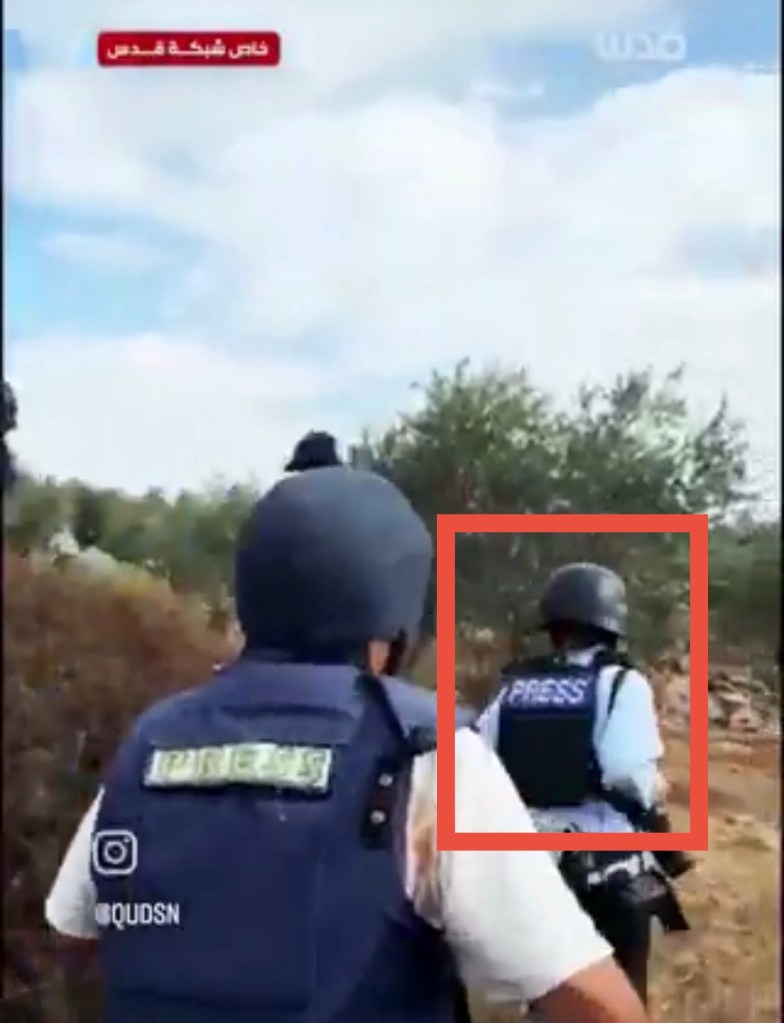

Look directly at the October 16 incident in Abu Falah involving Washington Post freelance photojournalist Heidi Levine. Levine wore a distinct press jacket and blue shirt—attire clearly documented at the scene.
Video circulated multiple times by Quds News Network (QudsN) on Instagram and other platforms shows this exact press-jacketed figure embedded directly alongside groups advancing toward settlement areas.
The same man who was photographed assisting her, the one she called her “Palestinian colleague,” also may appear in this footage.
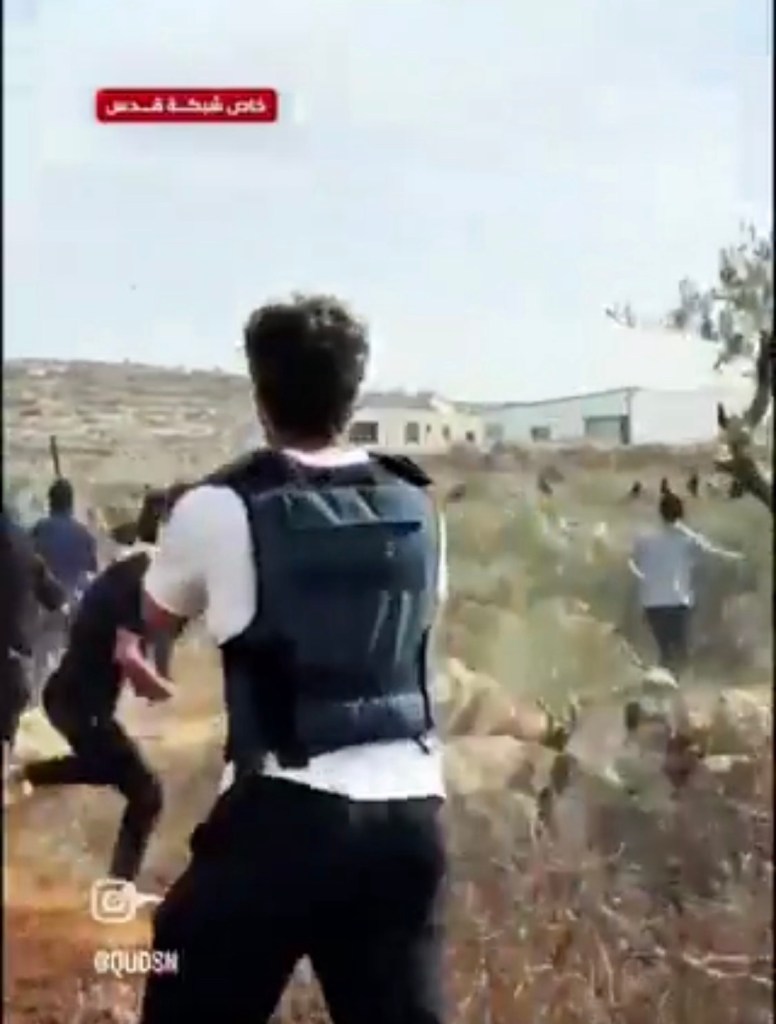
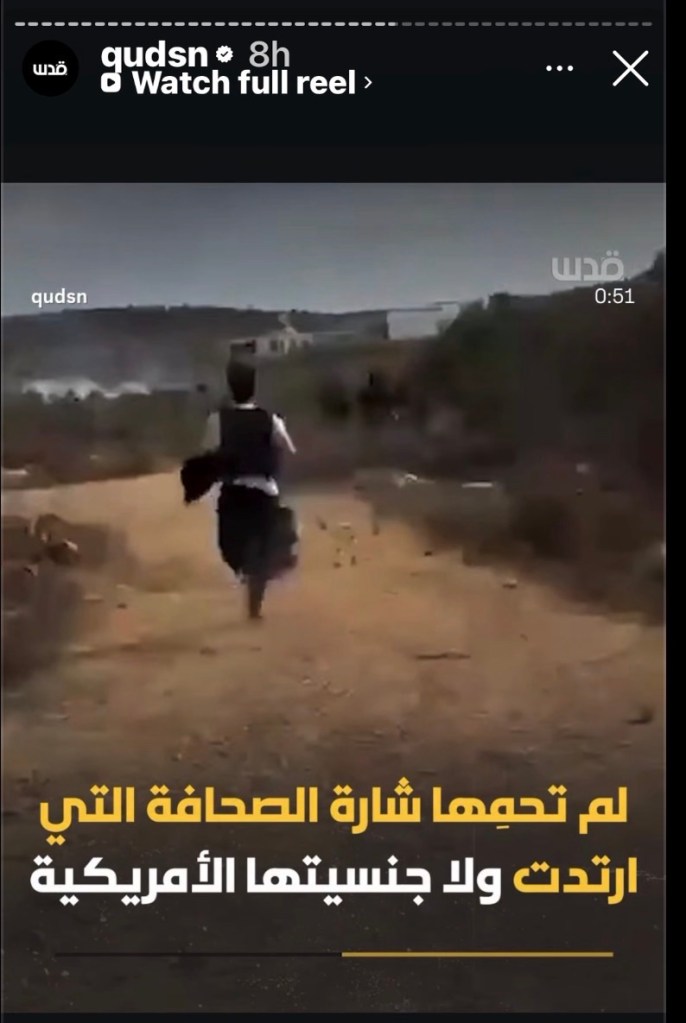
Crucially, the QudsN footage does not depict passive observers or agricultural work. It shows young men armed with slingshots actively hurling stones.
The press-jacketed journalist was embedded alongside individuals engaged in physical attack.
This sequence exposes why equipment and cameras were seized during the chaotic clash that followed.
From the perspective of residents facing stone-throwers, destroying or taking equipment that records an organized approach and active engagement is a predictable reaction to active hostility.
The press was not observing a sudden assault from a distance; they were inside the advancing line.
The incident in Taybeh the following day with European diplomats followed the same mechanics. Ongoing livestock disputes—including sheep thefts by local Palestinians—routinely draw responses from residents protecting their property.
Inserting an uncoordinated diplomatic convoy—with a participant who had raised the Palestinian flag—into a known friction point during a volatile harvest predictably leads to confrontation.
In the media, the pre-existing thefts and the deliberate insertion of foreign officials are discarded as background, while the resulting damaged vehicles become global proof of “settler terror”.
When these engineered incidents broke, coordinated talking points went out immediately to condemn Jewish residents rather than address the orchestrated provocation.
Even U.S. Ambassador Mike Huckabee adopted the international narrative, issuing sweeping condemnations that echoed standard press lines.
Prime Minister Benjamin Netanyahu stood essentially alone in pointing out the broader context.
While rejecting lawlessness by any party, Netanyahu refused to endorse the lopsided narrative, emphasizing that outside agitators and staged provocations unfairly tarnish a law-abiding, moral population in Judea and Samaria.
Lawlessness by any individual should be dealt with. But serious analysis requires examining the entire picture: the uncoordinated entries into sensitive areas, the embedding of press with stone-throwers using slingshots, the circulation of violent footage on hostile state channels, and the instant conversion of partial videos into a collective indictment.
Until the media acknowledges the deliberate tactics used to generate these clips, the annual harvest will continue to deliver the same manufactured story: one side’s actions are structural terror; the other side’s provocations do not exist.


You must be logged in to post a comment.